
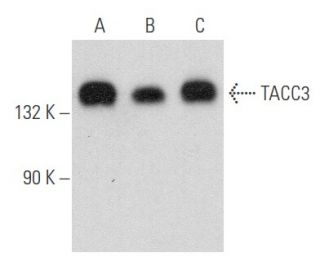
TACC3 Antibody (D-2): sc-48368
- TACC3 Antibody (D-2) is a mouse monoclonal IgG1 κ, cited in 5 publications, provided at 200 µg/ml
- raised against amino acids 1-300 of TACC3 of human origin
- recommended for detection of TACC3 of mouse, rat and human origin by WB, IP, IF, IHC(P) and ELISA
- m-IgG Fc BP-HRP, m-IgG1 BP-HRP and m-IgGκ BP-HRP are the preferred secondary detection reagents for TACC3 Antibody (D-2) for WB and IHC(P) applications. These reagents are now offered in bundles with TACC3 Antibody (D-2) (see ordering information below).

QUICK LINKS
TACC3 Antibody (D-2) is a mouse monoclonal IgG1 antibody that detects TACC3 in mouse, rat, and human samples through various applications including western blotting (WB), immunoprecipitation (IP), immunofluorescence (IF), immunohistochemistry, and enzyme-linked immunosorbent assay (ELISA). TACC3, a member of the transforming acidic coiled-coil (TACC) protein family, plays a crucial role in cell cycle regulation and mitotic spindle assembly, which are essential processes for proper cell division and maintaining genomic stability. TACC3 is primarily localized to the centrosomes and microtubules, where TACC3 is involved in organizing the microtubule network during mitosis. This localization is vital as TACC3 ensures accurate chromosome segregation, preventing aneuploidy, which is often associated with cancer development. TACC3′s interaction with microtubules and centrosomes highlights TACC3′s importance in cellular architecture and function, making TACC3 a significant target for research in cancer biology and therapeutic interventions. Anti-TACC3 antibody (D-2) is an invaluable tool for researchers aiming to explore the intricate mechanisms of cell division and the implications of TACC3 in tumorigenesis.
Alexa Fluor® is a trademark of Molecular Probes Inc., OR., USA
LI-COR® and Odyssey® are registered trademarks of LI-COR Biosciences
TACC3 Antibody (D-2) References:
- TACC3 is essential for EGF-mediated EMT in cervical cancer. | Ha, GH., et al. 2013. PLoS One. 8: e70353. PMID: 23936413
- Association between the TACC3 rs798766 Polymorphism and Risk of Urinary Bladder Cancer: A Synthesis Based on Current Evidence. | Meng, XY., et al. 2017. Dis Markers. 2017: 7850708. PMID: 28655970
- The role of TACC3 in mitotic spindle organization. | Ding, ZM., et al. 2017. Cytoskeleton (Hoboken). 74: 369-378. PMID: 28745816
- TACC3 promotes prostate cancer cell proliferation and restrains primary cilium formation. | Qie, Y., et al. 2020. Exp Cell Res. 390: 111952. PMID: 32156598
- Inhibiting of TACC3 Promotes Cell Proliferation, Cell Invasion and the EMT Pathway in Breast Cancer. | Huo, Q., et al. 2021. Front Genet. 12: 640078. PMID: 34149795
- Reviving immunogenic cell death upon targeting TACC3 enhances T-DM1 response in HER2-positive breast cancer. | Gedik, ME., et al. 2023. bioRxiv.. PMID: 37745348
- Knockdown of TACC3 inhibits tumor cell proliferation and increases chemosensitivity in pancreatic cancer. | Shi, S., et al. 2023. Cell Death Dis. 14: 778. PMID: 38012214
- TACC3: a multi-functional protein promoting cancer cell survival and aggressiveness. | Saatci, O. and Sahin, O. 2023. Cell Cycle. 22: 2637-2655. PMID: 38197196
- Targeting TACC3 Induces Immunogenic Cell Death and Enhances T-DM1 Response in HER2-Positive Breast Cancer. | Gedik, ME., et al. 2024. Cancer Res. 84: 1475-1490. PMID: 38319231
- Cellular senescence gene TACC3 associated with colorectal cancer risk via genetic and DNA methylated alteration. | Shen, H., et al. 2024. Arch Toxicol. 98: 1499-1513. PMID: 38480537
Ordering Information
| Product Name | Catalog # | UNIT | Price | Qty | FAVORITES | |
TACC3 Antibody (D-2) | sc-48368 | 200 µg/ml | $322.00 | |||
TACC3 Antibody (D-2): m-IgG Fc BP-HRP Bundle | sc-536816 | 200 µg Ab; 10 µg BP | $361.00 | |||
TACC3 Antibody (D-2): m-IgGκ BP-HRP Bundle | sc-533982 | 200 µg Ab; 40 µg BP | $361.00 | |||
TACC3 Antibody (D-2): m-IgG1 BP-HRP Bundle | sc-544837 | 200 µg Ab; 20 µg BP | $361.00 |