
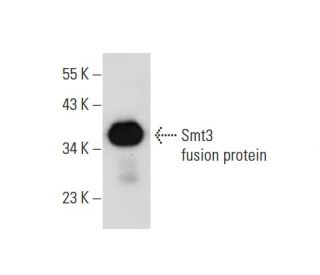

Smt3 Antibody (E-6): sc-137206
- Smt3 Antibody (E-6) is a mouse monoclonal IgG1 κ provided at 200 µg/ml
- raised against amino acids 15-98 of Smt3 of Saccharomyces cerevisiae origin
- recommended for detection of Smt3 of y origin by WB, IP, IF and ELISA
- m-IgG Fc BP-HRP and m-IgGκ BP-HRP are the preferred secondary detection reagents for Smt3 Antibody (E-6) for WB applications. These reagents are now offered in bundles with Smt3 Antibody (E-6) (see ordering information below).

QUICK LINKS
SEE ALSO...
Smt3 Antibody (E-6) is a mouse monoclonal IgG1 antibody that detects Smt3 in Saccharomyces cerevisiae by applications such as western blotting (WB), immunoprecipitation (IP), immunofluorescence (IF), and enzyme-linked immunosorbent assay (ELISA). Smt3, a ubiquitin-like protein, plays a crucial role in cellular processes by regulating protein stability and function through post-translational modifications. Specifically, Smt3 is involved in the SUMOylation pathway, which modifies target proteins to influence their activity, localization, and interactions. This modification is essential for various cellular functions, including DNA repair, cell cycle regulation, and stress responses, highlighting the importance of Smt3 in maintaining cellular homeostasis. Anti-Smt3 antibody (E-6) provides reliable detection of Smt3, enabling researchers to explore its role in these critical biological processes and interactions with other proteins, such as Ubc9, which is necessary for the conjugation of Smt3 to target proteins. Through Smt3 (E-6) antibody applications, scientists can gain insights into the dynamics of protein regulation and the implications of SUMOylation in cellular health and disease.
Alexa Fluor® is a trademark of Molecular Probes Inc., OR., USA
LI-COR® and Odyssey® are registered trademarks of LI-COR Biosciences
Smt3 Antibody (E-6) References:
- Covalent modification of the Werner's syndrome gene product with the ubiquitin-related protein, SUMO-1. | Kawabe, Y., et al. 2000. J Biol Chem. 275: 20963-6. PMID: 10806190
- The SUMO ubiquitin-protein isopeptide ligase family member Miz1/PIASxbeta /Siz2 is a transcriptional cofactor for TFII-I. | Tussie-Luna, MI., et al. 2002. J Biol Chem. 277: 43185-93. PMID: 12193603
- SUMO-1 modification of the C-terminal KVEKVD of Axin is required for JNK activation but has no effect on Wnt signaling. | Rui, HL., et al. 2002. J Biol Chem. 277: 42981-6. PMID: 12223491
- Activation of transforming growth factor-beta signaling by SUMO-1 modification of tumor suppressor Smad4/DPC4. | Lin, X., et al. 2003. J Biol Chem. 278: 18714-9. PMID: 12621041
- Repression of Smad4 transcriptional activity by SUMO modification. | Long, J., et al. 2004. Biochem J. 379: 23-9. PMID: 14750902
- The role of SUMO in chromosome segregation. | Watts, FZ. 2007. Chromosoma. 116: 15-20. PMID: 17031663
- Structural and functional studies of SIZ1, a PIAS-type SUMO E3 ligase from Arabidopsis. | Cheong, MS., et al. 2010. Plant Signal Behav. 5: 567-9. PMID: 20404572
- Function and regulation of SUMO proteases. | Hickey, CM., et al. 2012. Nat Rev Mol Cell Biol. 13: 755-66. PMID: 23175280
- SUMO-targeted ubiquitin ligases. | Sriramachandran, AM. and Dohmen, RJ. 2014. Biochim Biophys Acta. 1843: 75-85. PMID: 24018209
- SUMO and cellular adaptive mechanisms. | Ryu, HY., et al. 2020. Exp Mol Med. 52: 931-939. PMID: 32591648
Ordering Information
| Product Name | Catalog # | UNIT | Price | Qty | FAVORITES | |
Smt3 Antibody (E-6) | sc-137206 | 200 µg/ml | $322.00 | |||
Smt3 Antibody (E-6): m-IgG Fc BP-HRP Bundle | sc-537420 | 200 µg Ab; 10 µg BP | $361.00 | |||
Smt3 Antibody (E-6): m-IgGκ BP-HRP Bundle | sc-534678 | 200 µg Ab; 40 µg BP | $361.00 |