
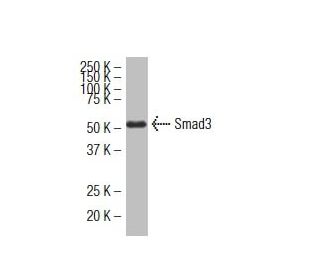


Smad3 Antibody (38-Q): sc-101154
- Smad3 Antibody (38-Q) is a mouse monoclonal IgG2a κ, cited in 129 publications, provided at 50 µg/0.5 ml
- raised against recombinant Smad3 of human origin
- recommended for detection of Smad3 of mouse, rat and human origin by WB, IP, IF, IHC(P) and ELISA
- See Smad2/3 (C-8): sc-133098 for Smad3 antibody conjugates, including AC, HRP, FITC, PE, Alexa Fluor® 488, 594, 647, 680 and 790.
- m-IgG2a BP-HRP and m-IgGκ BP-HRP are the preferred secondary detection reagents for Smad3 Antibody (38-Q) for WB and IHC(P) applications. These reagents are now offered in bundles with Smad3 Antibody (38-Q) (see ordering information below).

Smad3 Antibody (38-Q) is a mouse monoclonal IgG2a kappa light chain antibody, specifically designed to detect Smad3 proteins from mouse, rat, and human origins across a variety of applications including western blotting (WB), immunoprecipitation (IP), immunofluorescence (IF), immunohistochemistry with paraffin-embedded sections (IHCP), and enzyme-linked immunosorbent assay (ELISA). Anti-Smad3 antibody (38-Q) is raised against recombinant human Smad3. Smad3, also referred to as LDS3 and MADH3, is a critical intracellular mediator in the Transforming Growth Factor-beta (TGF-β) signaling pathway, playing a pivotal role in regulating gene expression related to cell proliferation, differentiation, apoptosis, and extracellular matrix production. By transducing signals from the cell membrane to the nucleus, Smad3 facilitates the transcription of target genes that are essential for maintaining cellular homeostasis and tissue development. Dysregulation of Smad3 activity is implicated in various pathological conditions, including fibrosis, cancer progression, and immune response modulation, making Smad3 a significant target for research and therapeutic intervention. Smad3 monoclonal antibody (38-Q) accurately detects and quantifies Smad3 protein levels, enabling researchers to explore the intricate mechanisms of TGF-β signaling and its impact on disease processes, thereby contributing to advancements in biomedical research and the development of novel treatments.
Alexa Fluor® is a trademark of Molecular Probes Inc., OR., USA
LI-COR® and Odyssey® are registered trademarks of LI-COR Biosciences
Smad3 Antibody (38-Q) References:
- The complexity of the Rab and Rho GTP-binding protein subfamilies revealed by a PCR cloning approach. | Chavrier, P., et al. 1992. Gene. 112: 261-4. PMID: 1555775
- Global analysis of Smad2/3-dependent TGF-beta signaling in living mice reveals prominent tissue-specific responses to injury. | Lin, AH., et al. 2005. J Immunol. 175: 547-54. PMID: 15972691
- Smads and chromatin modulation. | van Grunsven, LA., et al. 2005. Cytokine Growth Factor Rev. 16: 495-512. PMID: 15979924
- TGF-beta signalling through the Smad pathway. | Massaous, J. and Hata, A. 1997. Trends Cell Biol. 7: 187-92. PMID: 17708943
- Smad3 plays an inhibitory role in phosphate-induced vascular smooth muscle cell calcification. | Shimokado, A., et al. 2014. Exp Mol Pathol. 97: 458-64. PMID: 25303897
- Smad3 promotes adverse cardiovascular remodeling and dysfunction in doxorubicin-treated hearts. | Cobb, MS., et al. 2022. Am J Physiol Heart Circ Physiol. 323: H1091-H1107. PMID: 36269647
- MADR2 maps to 18q21 and encodes a TGFbeta-regulated MAD-related protein that is functionally mutated in colorectal carcinoma. | Eppert, K., et al. 1996. Cell. 86: 543-52. PMID: 8752209
- Receptor-associated Mad homologues synergize as effectors of the TGF-beta response. | Zhang, Y., et al. 1996. Nature. 383: 168-72. PMID: 8774881
- Partnership between DPC4 and SMAD proteins in TGF-beta signalling pathways. | Lagna, G., et al. 1996. Nature. 383: 832-6. PMID: 8893010
- Smad6 inhibits signalling by the TGF-beta superfamily. | Imamura, T., et al. 1997. Nature. 389: 622-6. PMID: 9335505
- Smad8 mediates the signaling of the ALK-2 [corrected] receptor serine kinase. | Chen, Y., et al. 1997. Proc Natl Acad Sci U S A. 94: 12938-43. PMID: 9371779
- TGF-beta signalling from cell membrane to nucleus through SMAD proteins. | Heldin, CH., et al. 1997. Nature. 390: 465-71. PMID: 9393997
Ordering Information
| Product Name | Catalog # | UNIT | Price | Qty | FAVORITES | |
Smad3 Antibody (38-Q) | sc-101154 | 50 µg/0.5 ml | $339.00 | |||
Smad3 Antibody (38-Q): m-IgGκ BP-HRP Bundle | sc-534535 | 50 µg Ab; 40 µg BP | $361.00 | |||
Smad3 Antibody (38-Q): m-IgG2a BP-HRP Bundle | sc-546192 | 50 µg Ab; 10 µg BP | $361.00 |