
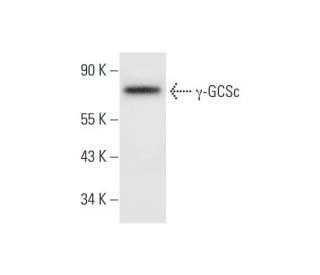
γ-GCSc Antibody (F-9): sc-166356
- γ-GCSc Antibody (F-9) is a mouse monoclonal IgG2a κ, cited in 5 publications, provided at 200 µg/ml
- raised against amino acids 338-637 mapping at the C-terminus of γ-GCSc of human origin
- Anti-gamma-GCSc Antibody (F-9) is recommended for detection of γ-GCSc of mouse, rat and human origin by WB, IP, IF, IHC(P) and ELISA
- Anti-gamma-GCSc Antibody (F-9) is available conjugated to agarose for IP; HRP for WB, IHC(P) and ELISA; and to either phycoerythrin or FITC for IF, IHC(P) and FCM
- also available conjugated to Alexa Fluor® 488, Alexa Fluor® 546, Alexa Fluor® 594 or Alexa Fluor® 647 for WB (RGB), IF, IHC(P) and FCM, and for use with RGB fluorescent imaging systems, such as iBright™ FL1000, FluorChem™, Typhoon, Azure and other comparable systems
- also available conjugated to Alexa Fluor® 680 or Alexa Fluor® 790 for WB (NIR), IF and FCM; for use with Near-Infrared (NIR) detection systems, such as LI-COR®Odyssey®, iBright™ FL1000, FluorChem™, Typhoon, Azure and other comparable systems
- m-IgG Fc BP-HRP, m-IgG2a BP-HRP and m-IgGκ BP-HRP are the preferred secondary detection reagents for γ-GCSc Antibody (F-9) for WB and IHC(P) applications. These reagents are now offered in bundles with γ-GCSc Antibody (F-9) (see ordering information below).

QUICK LINKS
γ-GCSc Antibody (F-9) is a mouse monoclonal IgG2a kappa light chain antibody that detects γ-GCSc in mouse, rat, and human samples through applications such as western blotting (WB), immunoprecipitation (IP), immunofluorescence (IF), immunohistochemistry, and enzyme-linked immunosorbent assay (ELISA). γ-GCSc (F-9) antibody is available in both non-conjugated and various conjugated forms, including agarose, horseradish peroxidase (HRP), phycoerythrin (PE), fluorescein isothiocyanate (FITC), and multiple Alexa Fluor® conjugates. The GCLC gene, which encodes the 636 amino acid protein γ-GCSc (also known as the γ-glutamylcysteine synthetase heavy subunit), consists of 16 exons and plays a crucial role in the synthesis of glutathione, a vital antioxidant that protects cells from oxidative stress. γ-GCSc is predominantly expressed in hemocytes, brain, liver, and kidney, where γ-GCSc forms a heterodimer with the regulatory subunit γ-GCSm (γ-glutamylcysteine synthetase light subunit) to create the γ-GCS enzyme complex. This complex is the first enzyme in the glutathione biosynthesis pathway and is responsible for the rate-limiting step in the production of this essential tripeptide. The regulation of γ-GCSc is influenced by various factors, including oxidants and heavy metals, which can enhance transcription, thereby increasing glutathione levels and potentially providing protective effects against chemically induced carcinogenesis. Notably, a His370Leu amino acid substitution in γ-GCSc has been linked to reduced enzymatic activity, resulting in hemolytic anemia and diminished glutathione levels in red blood cells, highlighting the importance of this protein in maintaining cellular health and function.
Alexa Fluor® is a trademark of Molecular Probes Inc., OR., USA
LI-COR® and Odyssey® are registered trademarks of LI-COR Biosciences
γ-GCSc Antibody (F-9) References:
- Nrf2 and c-Jun regulation of antioxidant response element (ARE)-mediated expression and induction of gamma-glutamylcysteine synthetase heavy subunit gene. | Jeyapaul, J. and Jaiswal, AK. 2000. Biochem Pharmacol. 59: 1433-9. PMID: 10751553
- Activation of the Nrf2 pathway, but decreased gamma-glutamylcysteine synthetase heavy subunit chain levels and caspase-3-dependent apoptosis during exposure of primary mouse hepatocytes to diphenylarsinic acid. | Sumi, D., et al. 2007. Toxicol Appl Pharmacol. 223: 218-24. PMID: 17628625
- Glucagon-like peptide-1 (GLP-1) protects against methylglyoxal-induced PC12 cell apoptosis through the PI3K/Akt/mTOR/GCLc/redox signaling pathway. | Kimura, R., et al. 2009. Neuroscience. 162: 1212-9. PMID: 19463904
- Down-regulation of GCLC is involved in microcystin-LR-induced malignant transformation of human liver cells. | Jia, X., et al. 2019. Toxicology. 421: 49-58. PMID: 30940545
- Downregulation of LncRNA GCLC-1 Promotes Microcystin-LR-Induced Malignant Transformation of Human Liver Cells by Regulating GCLC Expression. | Huang, X., et al. 2023. Toxics. 11: PMID: 36851037
- Endocrine pancreas-specific Gclc gene deletion causes a severe diabetes phenotype. | Davidson, EA., et al. 2023. bioRxiv.. PMID: 37398356
- Identification of a putative antioxidant response element in the 5'-flanking region of the human gamma-glutamylcysteine synthetase heavy subunit gene. | Mulcahy, RT. and Gipp, JJ. 1995. Biochem Biophys Res Commun. 209: 227-33. PMID: 7726839
- Transcriptional regulation of gamma-glutamylcysteine synthetase-heavy subunit by oxidants in human alveolar epithelial cells. | Rahman, I., et al. 1996. Biochem Biophys Res Commun. 229: 832-7. PMID: 8954980
- Constitutive and beta-naphthoflavone-induced expression of the human gamma-glutamylcysteine synthetase heavy subunit gene is regulated by a distal antioxidant response element/TRE sequence. | Mulcahy, RT., et al. 1997. J Biol Chem. 272: 7445-54. PMID: 9054446
- Identification of cis-acting DNA elements of the human gamma-glutamylcysteine synthetase heavy subunit gene. | Tomonari, A., et al. 1997. Biochem Biophys Res Commun. 232: 522-7. PMID: 9125214
Ordering Information
| Product Name | Catalog # | UNIT | Price | Qty | FAVORITES | |
γ-GCSc Antibody (F-9) | sc-166356 | 200 µg/ml | $322.00 | |||
γ-GCSc Antibody (F-9): m-IgG Fc BP-HRP Bundle | sc-528946 | 200 µg Ab; 10 µg BP | $361.00 | |||
γ-GCSc Antibody (F-9): m-IgGκ BP-HRP Bundle | sc-521573 | 200 µg Ab, 40 µg BP | $361.00 | |||
γ-GCSc Antibody (F-9): m-IgG2a BP-HRP Bundle | sc-547214 | 200 µg Ab; 10 µg BP | $361.00 | |||
γ-GCSc Antibody (F-9) AC | sc-166356 AC | 500 µg/ml, 25% agarose | $424.00 | |||
γ-GCSc Antibody (F-9) HRP | sc-166356 HRP | 200 µg/ml | $322.00 | |||
γ-GCSc Antibody (F-9) FITC | sc-166356 FITC | 200 µg/ml | $336.00 | |||
γ-GCSc Antibody (F-9) PE | sc-166356 PE | 200 µg/ml | $349.00 | |||
γ-GCSc Antibody (F-9) Alexa Fluor® 488 | sc-166356 AF488 | 200 µg/ml | $364.00 | |||
γ-GCSc Antibody (F-9) Alexa Fluor® 546 | sc-166356 AF546 | 200 µg/ml | $364.00 | |||
γ-GCSc Antibody (F-9) Alexa Fluor® 594 | sc-166356 AF594 | 200 µg/ml | $364.00 | |||
γ-GCSc Antibody (F-9) Alexa Fluor® 647 | sc-166356 AF647 | 200 µg/ml | $364.00 | |||
γ-GCSc Antibody (F-9) Alexa Fluor® 680 | sc-166356 AF680 | 200 µg/ml | $364.00 | |||
γ-GCSc Antibody (F-9) Alexa Fluor® 790 | sc-166356 AF790 | 200 µg/ml | $364.00 |