
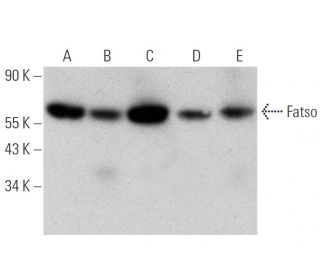
Fatso Antibody (G-1): sc-515410
- Fatso Antibody (G-1) is a mouse monoclonal IgG2a κ provided at 200 µg/ml
- specific for an epitope mapping between amino acids 479-495 at the C-terminus of Fatso of human origin
- recommended for detection of Fatso of mouse, rat and human origin by WB, IP, IF and ELISA
- m-IgG Fc BP-HRP, m-IgG2a BP-HRP and m-IgGκ BP-HRP are the preferred secondary detection reagents for Fatso Antibody (G-1) for WB applications. These reagents are now offered in bundles with Fatso Antibody (G-1) (see ordering information below).

QUICK LINKS
SEE ALSO...
Fatso Antibody (G-1) is a mouse monoclonal IgG2a antibody that detects Fatso in mouse, rat, and human samples through applications such as western blotting (WB), immunoprecipitation (IP), immunofluorescence (IF), and enzyme-linked immunosorbent assay (ELISA). Fatso, also known as FTO or KIAA1752, is a 505 amino acid protein characterized by an N-terminal nuclear localization signal, which directs Fatso to the nucleus where Fatso plays a significant role in regulating energy homeostasis and metabolism. Anti-Fatso antibody (G-1) has been crucial in studying FTO′s involvement in obesity development, as FTO has been linked to increased body mass index and type 2 diabetes pathogenesis, making FTO a critical target for metabolic disorder research. Fatso is expressed in various tissues, with highest levels found in brain and pancreatic tissue, and exists in four alternatively spliced isoforms, one associated with obesity predisposition. FTO is located on human chromosome 16, a region harboring over 900 genes implicated in several genetic disorders, including giant axonal neuropathy and Crohn′s disease. Fatso monoclonal antibody (G-1) enables researchers to gain valuable insights into molecular mechanisms underlying obesity and related metabolic conditions, enhancing understanding of these complex diseases.
Alexa Fluor® is a trademark of Molecular Probes Inc., OR., USA
LI-COR® and Odyssey® are registered trademarks of LI-COR Biosciences
Fatso Antibody (G-1) References:
- Fat mass and obesity-associated protein promotes the tumorigenesis and development of liver cancer. | Ye, Z., et al. 2020. Oncol Lett. 20: 1409-1417. PMID: 32724383
- Fat mass and obesity-associated protein regulates lipogenesis via m6 A modification in fatty acid synthase mRNA. | Sun, D., et al. 2021. Cell Biol Int. 45: 334-344. PMID: 33079435
- Fat mass and obesity-associated protein regulates tumorigenesis of arecoline-promoted human oral carcinoma. | Li, X., et al. 2021. Cancer Med. 10: 6402-6415. PMID: 34378866
- Downregulated fat mass and obesity-associated protein inhibits bone resorption and osteoclastogenesis by nuclear factor-kappa B inactivation. | Zhuang, J., et al. 2021. Cell Signal. 87: 110137. PMID: 34469786
- Cerebroprotective Role of N6-Methyladenosine Demethylase FTO (Fat Mass and Obesity-Associated Protein) After Experimental Stroke. | Chokkalla, AK., et al. 2023. Stroke. 54: 245-254. PMID: 36321453
- Fat mass and obesity-associated protein alleviates Aβ1-40 induced retinal pigment epithelial cells degeneration via PKA/CREB signaling pathway. | Hu, Y., et al. 2023. Cell Biol Int. 47: 584-597. PMID: 36378581
- MicroRNA-192-5p downregulates Fat Mass and Obesity-associated Protein to aggravate renal ischemia/reperfusion injury. | Zhang, C., et al. 2023. Ren Fail. 45: 2285869. PMID: 38044851
- Fat mass and obesity-associated protein (FTO) affects midpalatal suture bone remodeling during rapid maxillary expansion. | Zhao, T., et al. 2024. Eur J Orthod. 46: PMID: 38376496
- Fat mass and obesity associated protein inhibits neuronal ferroptosis via the FYN/Drp1 axis and alleviate cerebral ischemia/reperfusion injury. | Zhang, Y. and Gong, X. 2024. CNS Neurosci Ther. 30: e14636. PMID: 38430221
- Fat mass and obesity-associated protein (FTO) mediated m6A modification of circFAM192A promoted gastric cancer proliferation by suppressing SLC7A5 decay. | Wu, X., et al. 2024. Mol Biomed. 5: 11. PMID: 38556586
Ordering Information
| Product Name | Catalog # | UNIT | Price | Qty | FAVORITES | |
Fatso Antibody (G-1) | sc-515410 | 200 µg/ml | $322.00 | |||
Fatso Antibody (G-1): m-IgG Fc BP-HRP Bundle | sc-538784 | 200 µg Ab; 10 µg BP | $361.00 | |||
Fatso Antibody (G-1): m-IgGκ BP-HRP Bundle | sc-536454 | 200 µg Ab; 40 µg BP | $361.00 | |||
Fatso Antibody (G-1): m-IgG2a BP-HRP Bundle | sc-548408 | 200 µg Ab; 10 µg BP | $361.00 | |||
Fatso (G-1) Neutralizing Peptide | sc-515410 P | 100 µg/0.5 ml | $69.00 |