
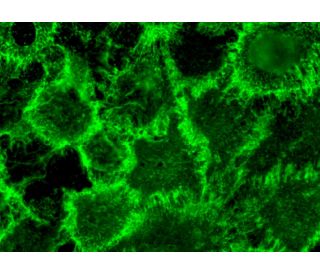

EGFR Antibody (EGFR.1): sc-80543
- EGFR Antibody (EGFR.1) is a mouse monoclonal IgG2b κ, cited in 6 publications, provided at 200 µg/ml
- recommended for detection of EGFR of mouse, rat and human origin by IP, IF and FCM
- See EGFR (A-10): sc-373746 for EGFR antibody conjugates, including AC, HRP, FITC, PE, Alexa Fluor® 488, 594, 647, 680 and 790.
- m-IgG2b BP-HRP and m-IgGκ BP-HRP are the preferred secondary detection reagents for EGFR Antibody (EGFR.1). These reagents are now offered in bundles with EGFR Antibody (EGFR.1) (see ordering information below).

QUICK LINKS
SEE ALSO...
EGFR Antibody (EGFR.1) is a mouse monoclonal IgG2b antibody that detects a cell surface domain of the EGF receptor of human origin in mouse, rat, and human samples through applications such as immunoprecipitation (IP), immunofluorescence (IF), and flow cytometry (FCM). EGFR is a critical receptor tyrosine kinase that plays a pivotal role in cell signaling pathways regulating cell proliferation, survival, and differentiation. EGFR′s location on the cell membrane is crucial, as binding of various ligands, including epidermal growth factor (EGF) and transforming growth factor α (TGFα), triggers receptor dimerization and subsequent activation of intrinsic tyrosine kinase activity. This activation leads to a cascade of downstream signaling events essential for normal cellular functions, such as organ morphogenesis, where EGFR signaling directs epithelial cell proliferation, migration, and differentiation during development, shaping tissues and organs. In tissue repair, EGFR activation promotes keratinocyte migration and proliferation at wound sites, accelerating re-epithelialization and restoration of damaged structures. However, aberrant expression or mutations in EGFR are frequently associated with various carcinomas, contributing to tumor progression and metastasis. EGFR internalization and degradation after ligand binding helps regulate receptor levels on the cell surface and maintain cellular homeostasis. Given EGFR′s central role in oncogenesis, anti-EGFR antibody (EGFR.1) serves as a valuable tool for researchers investigating EGFR function and implications in cancer biology.
Ordering Information
| Product Name | Catalog # | UNIT | Price | Qty | FAVORITES | |
EGFR Antibody (EGFR.1) | sc-80543 | 200 µg/ml | $322.00 | |||
EGFR Antibody (EGFR.1): m-IgGκ BP-HRP Bundle | sc-534452 | 200 µg Ab; 40 µg BP | $361.00 | |||
EGFR Antibody (EGFR.1): m-IgG2b BP-HRP Bundle | sc-549258 | 200 µg Ab; 10 µg BP | $361.00 |