
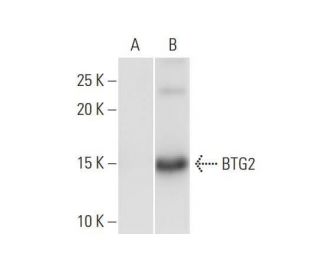


BTG2 Antibody (1A5): sc-517187
- BTG2 Antibody (1A5) is a mouse monoclonal IgG1 κ BTG2 antibody, cited in 5 publications, provided at 100 µg/ml
- raised against amino acids 59-158 representing partial recombinant BTG2 protein of human origin
- recommended for detection of BTG2 of human origin by WB, IP and ELISA
- m-IgG Fc BP-HRP, m-IgG1 BP-HRP and m-IgGκ BP-HRP are the preferred secondary detection reagents for BTG2 Antibody (1A5) for WB applications. These reagents are now offered in bundles with BTG2 Antibody (1A5) (see ordering information below).

QUICK LINKS
BTG2 Antibody (1A5) is a mouse monoclonal IgG1 kappa light chain antibody that detects BTG2 protein of human origin by western blotting (WB), immunoprecipitation (IP), and enzyme-linked immunosorbent assay (ELISA). Anti-BTG2 antibody (1A5) is available as the non-conjugated monoclonal isotype antibody. BTG2 is a crucial member of the B cell translocation gene family, which plays a significant role in regulating cell proliferation and transcription. BTG2 functions as a p53-inducible protein that acts as an anti-proliferative factor, particularly influencing the G1/S transition of the cell cycle. BTG2 expression increases in response to various cellular stressors, including DNA damage and growth stimulation, highlighting BTG2′s importance in maintaining cellular integrity and regulating the cell cycle. High levels of BTG2 are found in key tissues such as kidney proximal tubules, lung alveolar bronchial epithelium, and the basal cell layer of prostate acini, indicating BTG2′s vital role in these organs. BTG2 contains LXXLL motifs, which are essential for interaction with nuclear receptors, further underscoring BTG2′s involvement in transcriptional regulation. BTG2′s ability to modulate cell cycle progression and respond to cellular signals makes BTG2 a significant protein in cancer research and therapeutic development.
Alexa Fluor® is a trademark of Molecular Probes Inc., OR., USA
LI-COR® and Odyssey® are registered trademarks of LI-COR Biosciences
BTG2 Antibody (1A5) References:
- Relationships of the antiproliferative proteins BTG1 and BTG2 with CAF1, the human homolog of a component of the yeast CCR4 transcriptional complex: involvement in estrogen receptor alpha signaling pathway. | Prévôt, D., et al. 2001. J Biol Chem. 276: 9640-8. PMID: 11136725
- The gene PC3(TIS21/BTG2), prototype member of the PC3/BTG/TOB family: regulator in control of cell growth, differentiation, and DNA repair? | Tirone, F. 2001. J Cell Physiol. 187: 155-65. PMID: 11267995
- The human BTG2/TIS21/PC3 gene: genomic structure, transcriptional regulation and evaluation as a candidate tumor suppressor gene. | Duriez, C., et al. 2002. Gene. 282: 207-14. PMID: 11814693
- Expression of B-cell translocation gene 2 protein in normal human tissues. | Melamed, J., et al. 2002. Tissue Cell. 34: 28-32. PMID: 11989967
- BTG2 antiproliferative protein interacts with the human CCR4 complex existing in vivo in three cell-cycle-regulated forms. | Morel, AP., et al. 2003. J Cell Sci. 116: 2929-36. PMID: 12771185
- BTG1, a member of a new family of antiproliferative genes. | Rouault, JP., et al. 1992. EMBO J. 11: 1663-70. PMID: 1373383
- Impaired expression of the cell cycle regulator BTG2 is common in clear cell renal cell carcinoma. | Struckmann, K., et al. 2004. Cancer Res. 64: 1632-8. PMID: 14996721
- TIS21/BTG2/PC3 is expressed through PKC-delta pathway and inhibits binding of cyclin B1-Cdc2 and its activity, independent of p53 expression. | Ryu, MS., et al. 2004. Exp Cell Res. 299: 159-70. PMID: 15302583
- Expression of the NF-kappaB-responsive gene BTG2 is aberrantly regulated in breast cancer. | Kawakubo, H., et al. 2004. Oncogene. 23: 8310-9. PMID: 15378000
- Identification of BTG2, an antiproliferative p53-dependent component of the DNA damage cellular response pathway. | Rouault, JP., et al. 1996. Nat Genet. 14: 482-6. PMID: 8944033
Ordering Information
| Product Name | Catalog # | UNIT | Price | Qty | FAVORITES | |
BTG2 Antibody (1A5) | sc-517187 | 100 µg/ml | $322.00 | |||
BTG2 Antibody (1A5): m-IgG Fc BP-HRP Bundle | sc-538839 | 100 µg Ab; 10 µg BP | $361.00 | |||
BTG2 Antibody (1A5): m-IgGκ BP-HRP Bundle | sc-536518 | 100 µg Ab; 40 µg BP | $361.00 | |||
BTG2 Antibody (1A5): m-IgG1 BP-HRP Bundle | sc-545902 | 100 µg Ab; 20 µg BP | $361.00 |