
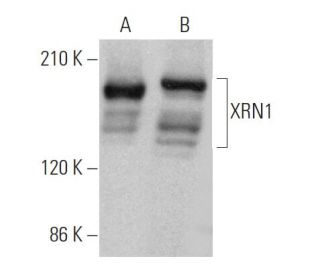
XRN1 Antibody (C-1): sc-165985
- XRN1 Antibody (C-1) is a mouse monoclonal IgG1 κ XRN1 antibody, cited in 11 publications, provided at 200 µg/ml
- raised against amino acids 301-450 mapping within an internal region of XRN1 of human origin
- XRN1 Antibody (C-1) is recommended for detection of XRN1 of mouse, rat and human origin by WB, IP, IF and ELISA
- Anti-XRN1 Antibody (C-1) is available conjugated to agarose for IP; HRP for WB, IHC(P) and ELISA; and to either phycoerythrin or FITC for IF, IHC(P) and FCM
- also available conjugated to Alexa Fluor® 488, Alexa Fluor® 546, Alexa Fluor® 594 or Alexa Fluor® 647 for WB (RGB), IF, IHC(P) and FCM, and for use with RGB fluorescent imaging systems, such as iBright™ FL1000, FluorChem™, Typhoon, Azure and other comparable systems
- also available conjugated to Alexa Fluor® 680 or Alexa Fluor® 790 for WB (NIR), IF and FCM; for use with Near-Infrared (NIR) detection systems, such as LI-COR®Odyssey®, iBright™ FL1000, FluorChem™, Typhoon, Azure and other comparable systems
- m-IgG Fc BP-HRP, m-IgG1 BP-HRP and m-IgGκ BP-HRP are the preferred secondary detection reagents for XRN1 Antibody (C-1) for WB applications. These reagents are now offered in bundles with XRN1 Antibody (C-1) (see ordering information below).
QUICK LINKS
XRN1 Antibody (C-1) is a mouse monoclonal IgG1 kappa light chain antibody that detects XRN1 protein of mouse, rat, and human origin by western blotting (WB), immunoprecipitation (IP), immunofluorescence (IF), and enzyme-linked immunosorbent assay (ELISA). XRN1 Antibody (C-1) is available in both non-conjugated and various conjugated forms, including agarose, horseradish peroxidase (HRP), phycoerythrin (PE), fluorescein isothiocyanate (FITC), and multiple Alexa Fluor® conjugates. XRN1, also known as Exoribonuclease I, Sep1, or Rar5, is a crucial 1,694-amino acid enzyme that primarily functions as the major cytoplasmic 5′ to 3′ exoribonuclease, playing a vital role in mRNA turnover and degradation, which is essential for regulating gene expression. XRN1 not only facilitates the decay of mRNA but also contributes to the formation of stress granules and processing bodies, which are critical for cellular responses to stress and mRNA regulation. XRN1 is involved in the microtubular cytoskeleton and has implications in DNA recombination and replication processes. Loss of XRN1 can lead to detrimental effects on cell growth rates, underscoring XRN1′s importance in maintaining cellular homeostasis and function.
Alexa Fluor® is a trademark of Molecular Probes Inc., OR., USA
LI-COR® and Odyssey® are registered trademarks of LI-COR Biosciences
XRN1 Antibody (C-1) References:
- Inhibition of mRNA turnover in yeast by an xrn1 mutation enhances the requirement for eIF4E binding to eIF4G and for proper capping of transcripts by Ceg1p. | Brown, JT., et al. 2000. Genetics. 155: 31-42. PMID: 10790382
- 5'-exoribonuclease 1: Xrn1. | Stevens, A. 2001. Methods Enzymol. 342: 251-9. PMID: 11586897
- mRNA decay: x (XRN1) marks the spot. | Long, RM. and McNally, MT. 2003. Mol Cell. 11: 1126-8. PMID: 12769838
- Decay of mRNAs targeted by RISC requires XRN1, the Ski complex, and the exosome. | Orban, TI. and Izaurralde, E. 2005. RNA. 11: 459-69. PMID: 15703439
- Stress granules and processing bodies are dynamically linked sites of mRNP remodeling. | Kedersha, N., et al. 2005. J Cell Biol. 169: 871-84. PMID: 15967811
- Regulation and intracellular localization of Saccharomyces cerevisiae strand exchange protein 1 (Sep1/Xrn1/Kem1), a multifunctional exonuclease. | Heyer, WD., et al. 1995. Mol Cell Biol. 15: 2728-36. PMID: 7739553
- Identification of functional domains in the Sep1 protein (= Kem1, Xrn1), which is required for transition through meiotic prophase in Saccharomyces cerevisiae. | Bashkirov, VI., et al. 1995. Chromosoma. 104: 215-22. PMID: 8529461
- Structural modifications of RNA influence the 5' exoribonucleolytic hydrolysis by XRN1 and HKE1 of Saccharomyces cerevisiae. | Poole, TL. and Stevens, A. 1997. Biochem Biophys Res Commun. 235: 799-805. PMID: 9207242
Ordering Information
| Product Name | Catalog # | UNIT | Price | Qty | FAVORITES | |
XRN1 Antibody (C-1) | sc-165985 | 200 µg/ml | $316.00 | |||
XRN1 Antibody (C-1): m-IgG Fc BP-HRP Bundle | sc-528888 | 200 µg Ab; 10 µg BP | $354.00 | |||
XRN1 Antibody (C-1): m-IgGκ BP-HRP Bundle | sc-521476 | 200 µg Ab, 40 µg BP | $354.00 | |||
XRN1 Antibody (C-1): m-IgG1 BP-HRP Bundle | sc-543194 | 200 µg Ab; 20 µg BP | $354.00 | |||
XRN1 Antibody (C-1) AC | sc-165985 AC | 500 µg/ml, 25% agarose | $416.00 | |||
XRN1 Antibody (C-1) HRP | sc-165985 HRP | 200 µg/ml | $316.00 | |||
XRN1 Antibody (C-1) FITC | sc-165985 FITC | 200 µg/ml | $330.00 | |||
XRN1 Antibody (C-1) PE | sc-165985 PE | 200 µg/ml | $343.00 | |||
XRN1 Antibody (C-1) Alexa Fluor® 488 | sc-165985 AF488 | 200 µg/ml | $357.00 | |||
XRN1 Antibody (C-1) Alexa Fluor® 546 | sc-165985 AF546 | 200 µg/ml | $357.00 | |||
XRN1 Antibody (C-1) Alexa Fluor® 594 | sc-165985 AF594 | 200 µg/ml | $357.00 | |||
XRN1 Antibody (C-1) Alexa Fluor® 647 | sc-165985 AF647 | 200 µg/ml | $357.00 | |||
XRN1 Antibody (C-1) Alexa Fluor® 680 | sc-165985 AF680 | 200 µg/ml | $357.00 | |||
XRN1 Antibody (C-1) Alexa Fluor® 790 | sc-165985 AF790 | 200 µg/ml | $357.00 |