
Date published: 2026-5-1

1-800-457-3801

SCBT Portrait Logo
Seach Input

Smt3 Antibody (D-8): sc-137177

5.0(1)
Write a reviewAsk a question

Datasheets
  • Smt3 Antibody (D-8) is a mouse monoclonal IgG2b κ provided at 200 µg/ml
  • raised against amino acids 15-98 of Smt3 of Saccharomyces cerevisiae origin
  • recommended for detection of Smt3 of y origin by WB, IP, IF and ELISA
  • m-IgG2b BP-HRP is the preferred secondary detection reagent for Smt3 Antibody (D-8) for WB applications. This reagent is now offered in a bundle with Smt3 Antibody (D-8) (see ordering information below).
    Gene Editing Promo Banner

    QUICK LINKS

    SEE ALSO...

    Smt3 Antibody (D-8) is a mouse monoclonal IgG2b antibody that detects Smt3 in Saccharomyces cerevisiae by applications such as western blotting (WB), immunoprecipitation (IP), immunofluorescence (IF), and enzyme-linked immunosorbent assay (ELISA). Smt3, a ubiquitin-like protein, plays a crucial role in cellular processes by modifying target proteins through a process known as SUMOylation, which is essential for regulating various cellular functions, including transcription, DNA repair, and cell cycle progression. The ability of Smt3 to conjugate to other proteins is vital for maintaining cellular homeostasis and responding to stress, as Smt3 helps modulate protein interactions and stability. Smt3 requires the E2 conjugating enzyme Ubc9 for attachment to substrates, and this modification can influence the localization and activity of target proteins, thereby impacting critical signaling pathways. Anti-Smt3 antibody (D-8) serves as an invaluable tool for researchers studying the dynamics of protein modification and the intricate networks of protein interactions in yeast, providing insights into the fundamental mechanisms of cellular regulation.

    For Research Use Only. Not Intended for Diagnostic or Therapeutic Use.

    Alexa Fluor® is a trademark of Molecular Probes Inc., OR., USA

    LI-COR® and Odyssey® are registered trademarks of LI-COR Biosciences

    Smt3 Antibody (D-8) References:

    1. SUMO conjugation and deconjugation.  |  Schwienhorst, I., et al. 2000. Mol Gen Genet. 263: 771-86. PMID: 10905345
    2. Posttranslational modification of TEL and TEL/AML1 by SUMO-1 and cell-cycle-dependent assembly into nuclear bodies.  |  Chakrabarti, SR., et al. 2000. Proc Natl Acad Sci U S A. 97: 13281-5. PMID: 11078523
    3. SUMO keeps a check on recombination during DNA replication.  |  Ulrich, HD., et al. 2005. Cell Cycle. 4: 1699-702. PMID: 16294012
    4. Noncovalent binding of small ubiquitin-related modifier (SUMO) protease to SUMO is necessary for enzymatic activities and cell growth.  |  Ihara, M., et al. 2007. J Biol Chem. 282: 16465-75. PMID: 17428805
    5. Role of Cdc48/p97 as a SUMO-targeted segregase curbing Rad51-Rad52 interaction.  |  Bergink, S., et al. 2013. Nat Cell Biol. 15: 526-32. PMID: 23624404
    6. NSMCE2 suppresses cancer and aging in mice independently of its SUMO ligase activity.  |  Jacome, A., et al. 2015. EMBO J. 34: 2604-19. PMID: 26443207
    7. The Regulation of Chromatin by Dynamic SUMO Modifications.  |  Wilson, NR. and Hochstrasser, M. 2016. Methods Mol Biol. 1475: 23-38. PMID: 27631795
    8. Engineered SUMO/protease system identifies Pdr6 as a bidirectional nuclear transport receptor.  |  Vera Rodriguez, A., et al. 2019. J Cell Biol. 218: 2006-2020. PMID: 31023724
    9. SUMO and cellular adaptive mechanisms.  |  Ryu, HY., et al. 2020. Exp Mol Med. 52: 931-939. PMID: 32591648
    10. Stability of Rad51 recombinase and persistence of Rad51 DNA repair foci depends on post-translational modifiers, ubiquitin and SUMO.  |  Antoniuk-Majchrzak, J., et al. 2023. Biochim Biophys Acta Mol Cell Res. 1870: 119526. PMID: 37364618

    Ordering Information

    Product NameCatalog #UNITPriceQtyFAVORITES

    Smt3 Antibody (D-8)

    sc-137177
    200 µg/ml
    $322.00

    Smt3 Antibody (D-8): m-IgG2b BP-HRP Bundle

    sc-548506
    200 µg Ab; 10 µg BP
    $361.00

    What is the recommended secondary reagent to be used with sc-137177: Smt3 (D-8) mouse monoclonal primary?

    Asked by: jenniferc
    We recommend using one our exclusive Mouse IgG Binding Proteins as a secondary detection reagent. A complete list of available binding proteins is available on our website here: https://www.scbt.com/scbt/browse/support-products-mouse-igg-binding-proteins/_/N-ecrety
    Answered by: Technical Support
    Date published: 2017-04-12
    • y_2026, m_4, d_29, h_11CST
    • bvseo_bulk, prod_bvqa, vn_bulk_3.0.43
    • cp_1, bvpage1
    • co_hasquestionsanswers, tq_1
    • loc_en_US, sid_137177, prod, sort_[SortEntry(order=LAST_APPROVED_ANSWER_SUBMISSION_TIME, direction=DESCENDING)]
    • clientName_scbt
    • bvseo_sdk, java_sdk, bvseo-4.0.0
    • CLOUD, getContent, 110ms
    • QUESTIONS, PRODUCT
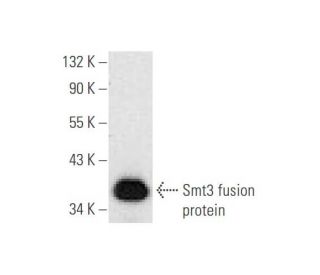
    Rated 5 out of 5 by from Satisfactory Western blot data of yeast recombinantSatisfactory Western blot data of yeast recombinant Smt3 fusion protein. -SCBT QC
    Date published: 2014-05-30
    • y_2026, m_4, d_29, h_11
    • bvseo_bulk, prod_bvrr, vn_bulk_3.0.43
    • cp_1, bvpage1
    • co_hasreviews, tv_0, tr_1
    • loc_en_US, sid_137177, prod, sort_[SortEntry(order=SUBMISSION_TIME, direction=DESCENDING)]
    • clientName_scbt
    • bvseo_sdk, java_sdk, bvseo-4.0.0
    • CLOUD, getReviews, 20ms
    • REVIEWS, PRODUCT
    Smt3 Antibody (D-8) is rated 5.0 out of 5 by 1.
    • y_2026, m_4, d_29, h_11
    • bvseo_bulk, prod_bvrr, vn_bulk_3.0.43
    • cp_1, bvpage1
    • co_hasreviews, tv_0, tr_1
    • loc_en_US, sid_137177, prod, sort_[SortEntry(order=SUBMISSION_TIME, direction=DESCENDING)]
    • clientName_scbt
    • bvseo_sdk, java_sdk, bvseo-4.0.0
    • CLOUD, getAggregateRating, 104ms
    • REVIEWS, PRODUCT
