
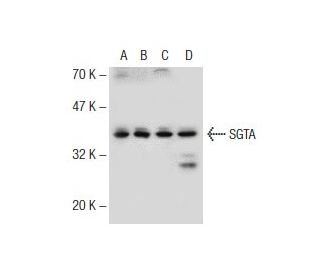


SGTA Antibody (6A4): sc-130557
- SGTA Antibody (6A4) is a mouse monoclonal IgG1 κ SGTA antibody, cited in 4 publications, provided at 200 µg/ml
- raised against recombinant SGTA of human origin
- SGTA Antibody (6A4) is recommended for detection of SGTA of mouse, rat and human origin by WB, IP, IF and ELISA
- Anti-SGTA Antibody (6A4) is available conjugated to agarose for IP; HRP for WB, IHC(P) and ELISA; and to either phycoerythrin or FITC for IF, IHC(P) and FCM
- also available conjugated to Alexa Fluor® 488, Alexa Fluor® 546, Alexa Fluor® 594 or Alexa Fluor® 647 for WB (RGB), IF, IHC(P) and FCM, and for use with RGB fluorescent imaging systems, such as iBright™ FL1000, FluorChem™, Typhoon, Azure and other comparable systems
- also available conjugated to Alexa Fluor® 680 or Alexa Fluor® 790 for WB (NIR), IF and FCM; for use with Near-Infrared (NIR) detection systems, such as LI-COR®Odyssey®, iBright™ FL1000, FluorChem™, Typhoon, Azure and other comparable systems
- m-IgG Fc BP-HRP, m-IgG1 BP-HRP and m-IgGκ BP-HRP are the preferred secondary detection reagents for SGTA Antibody (6A4) for WB applications. These reagents are now offered in bundles with SGTA Antibody (6A4) (see ordering information below).

QUICK LINKS
SGTA Antibody (6A4) is a mouse monoclonal IgG1 kappa light chain antibody that detects SGTA protein of mouse, rat, and human origin by western blotting (WB), immunoprecipitation (IP), immunofluorescence (IF), and enzyme-linked immunosorbent assay (ELISA). Anti-SGTA antibody (6A4) is available in both non-conjugated and various conjugated forms, including agarose, horseradish peroxidase (HRP), phycoerythrin (PE), fluorescein isothiocyanate (FITC), and multiple Alexa Fluor® conjugates. SGTA, or small glutamine-rich tetratricopeptide repeat (TPR)-containing protein A, is a crucial protein that plays a significant role in cellular processes, particularly in androgen signaling. SGTA is characterized by three TPR motifs that facilitate protein-protein interactions, allowing SGTA to function as a co-chaperone within the androgen receptor (AR) chaperone complex. By binding to the hinge region of AR, SGTA retains the receptor in the cytoplasm, effectively inhibiting androgen signaling, which is vital for regulating various physiological processes. SGTA′s involvement in apoptosis through interactions with heat shock proteins HSP 90 and HSP 70 highlights SGTA′s importance in cellular stress responses. Given SGTA′s multifaceted role in both androgen signaling and apoptosis, SGTA is considered a potential target for therapeutic interventions in conditions such as polycystic ovary syndrome (PCOS), which is associated with androgen excess and metabolic disturbances. SGTA has been shown to interact with viral proteins, including the nonstructural Parvovirus protein NS1 and HIV-1 proteins Vpu and Gag, underscoring SGTA′s relevance in virology and potential implications in viral pathogenesis.
Alexa Fluor® is a trademark of Molecular Probes Inc., OR., USA
LI-COR® and Odyssey® are registered trademarks of LI-COR Biosciences
SGTA Antibody (6A4) References:
- A trimeric protein complex functions as a synaptic chaperone machine. | Tobaben, S., et al. 2001. Neuron. 31: 987-99. PMID: 11580898
- Small glutamine-rich protein/viral protein U-binding protein is a novel cochaperone that affects heat shock protein 70 activity. | Angeletti, PC., et al. 2002. Cell Stress Chaperones. 7: 258-68. PMID: 12482202
- A brain-specific isoform of small glutamine-rich tetratricopeptide repeat-containing protein binds to Hsc70 and the cysteine string protein. | Tobaben, S., et al. 2003. J Biol Chem. 278: 38376-83. PMID: 12878599
- Small glutamine-rich tetratricopeptide repeat-containing protein is composed of three structural units with distinct functions. | Liou, ST. and Wang, C. 2005. Arch Biochem Biophys. 435: 253-63. PMID: 15708368
- SGT, a Hsp90beta binding partner, is accumulated in the nucleus during cell apoptosis. | Yin, H., et al. 2006. Biochem Biophys Res Commun. 343: 1153-8. PMID: 16580629
- Control of androgen receptor signaling in prostate cancer by the cochaperone small glutamine rich tetratricopeptide repeat containing protein alpha. | Buchanan, G., et al. 2007. Cancer Res. 67: 10087-96. PMID: 17942943
- Small glutamine-rich tetratricopeptide repeat-containing protein alpha (SGTA), a candidate gene for polycystic ovary syndrome. | Goodarzi, MO., et al. 2008. Hum Reprod. 23: 1214-9. PMID: 18332089
- Isolation and characterization of human SGT and identification of homologues in Saccharomyces cerevisiae and Caenorhabditis elegans. | Kordes, E., et al. 1998. Genomics. 52: 90-4. PMID: 9740675
Ordering Information
| Product Name | Catalog # | UNIT | Price | Qty | FAVORITES | |
SGTA Antibody (6A4) | sc-130557 | 200 µg/ml | $322.00 | |||
SGTA Antibody (6A4): m-IgG Fc BP-HRP Bundle | sc-528736 | 200 µg Ab; 10 µg BP | $361.00 | |||
SGTA Antibody (6A4): m-IgGκ BP-HRP Bundle | sc-521217 | 200 µg Ab, 40 µg BP | $361.00 | |||
SGTA Antibody (6A4): m-IgG1 BP-HRP Bundle | sc-543104 | 200 µg Ab; 20 µg BP | $361.00 | |||
SGTA Antibody (6A4) AC | sc-130557 AC | 500 µg/ml, 25% agarose | $424.00 | |||
SGTA Antibody (6A4) HRP | sc-130557 HRP | 200 µg/ml | $322.00 | |||
SGTA Antibody (6A4) FITC | sc-130557 FITC | 200 µg/ml | $336.00 | |||
SGTA Antibody (6A4) PE | sc-130557 PE | 200 µg/ml | $349.00 | |||
SGTA Antibody (6A4) Alexa Fluor® 488 | sc-130557 AF488 | 200 µg/ml | $364.00 | |||
SGTA Antibody (6A4) Alexa Fluor® 546 | sc-130557 AF546 | 200 µg/ml | $364.00 | |||
SGTA Antibody (6A4) Alexa Fluor® 594 | sc-130557 AF594 | 200 µg/ml | $364.00 | |||
SGTA Antibody (6A4) Alexa Fluor® 647 | sc-130557 AF647 | 200 µg/ml | $364.00 | |||
SGTA Antibody (6A4) Alexa Fluor® 680 | sc-130557 AF680 | 200 µg/ml | $364.00 | |||
SGTA Antibody (6A4) Alexa Fluor® 790 | sc-130557 AF790 | 200 µg/ml | $364.00 |