
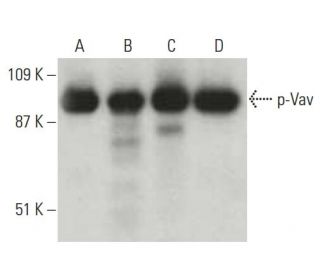
p-Vav Antibody (9.Tyr 174): sc-135788
- p-Vav Antibody (9.Tyr 174) is a mouse monoclonal IgG2b κ, cited in 3 publications, provided at 200 µg/ml
- raised against a short amino acid sequence containing phosphorylated Tyr 174 Vav of human origin
- recommended for detection of Tyr 174 phosphorylated Vav of mouse, rat and human origin by WB, IP and ELISA
- available conjugated to agarose for IP; and to HRP for WB, IHC(P) and ELISA
- m-IgG2b BP-HRP and m-IgGκ BP-HRP are the preferred secondary detection reagents for p-Vav Antibody (9.Tyr 174) for WB applications. These reagents are now offered in bundles with p-Vav Antibody (9.Tyr 174) (see ordering information below).

QUICK LINKS
p-Vav Antibody (9.Tyr 174) is a mouse monoclonal IgG2b kappa light chain antibody that detects the Tyr 174 phosphorylated Vav protein of mouse, rat, and human origin by western blotting (WB), immunoprecipitation (IP), and enzyme-linked immunosorbent assay (ELISA). anti-p-Vav antibody (9.Tyr 174) is available in both conjugated and non-conjugated forms, providing flexibility for various experimental needs. Vav proteins serve as guanine nucleotide exchange factors for Rho family GTPases, playing a crucial role in activating signaling pathways that lead to actin cytoskeletal rearrangements and transcriptional changes, which are essential for processes such as cell migration and proliferation. Vav protein′s structure includes several protein-binding domains that facilitate the connection between cell surface receptors and downstream signaling proteins, thereby influencing cellular responses to external stimuli. Notably, Vav3, a member of the Vav family, interacts with receptor protein tyrosine kinases and exhibits a unique expression profile across different tissues, distinguishing Vav3 from Vav and Vav2. This interaction mediates receptor tyrosine kinase signaling and regulates GTPase activity, with both native and mutant forms of Vav3 capable of altering cell morphology and potentially inducing cell transformation. Phosphorylation of Tyrosine 174 is a key regulatory event that occurs upon stimulation of mitogenic and antigenic receptors, a modification that is conserved among Vav family members and underscores Vav proteins′ importance in cellular signaling pathways.
Alexa Fluor® is a trademark of Molecular Probes Inc., OR., USA
LI-COR® and Odyssey® are registered trademarks of LI-COR Biosciences
p-Vav Antibody (9.Tyr 174) References:
- Biological and regulatory properties of Vav-3, a new member of the Vav family of oncoproteins. | Movilla, N. and Bustelo, XR. 1999. Mol Cell Biol. 19: 7870-85. PMID: 10523675
- Tyrosine phosphorylation mediates both activation and downmodulation of the biological activity of Vav. | López-Lago, M., et al. 2000. Mol Cell Biol. 20: 1678-91. PMID: 10669745
- Major transcript variants of VAV3, a new member of the VAV family of guanine nucleotide exchange factors. | Trenkle, T., et al. 2000. Gene. 245: 139-49. PMID: 10713454
- Specific subdomains of Vav differentially affect T cell and NK cell activation. | Billadeau, DD., et al. 2000. J Immunol. 164: 3971-81. PMID: 10754287
- Vav family proteins couple to diverse cell surface receptors. | Moores, SL., et al. 2000. Mol Cell Biol. 20: 6364-73. PMID: 10938113
- Vav3 mediates receptor protein tyrosine kinase signaling, regulates GTPase activity, modulates cell morphology, and induces cell transformation. | Zeng, L., et al. 2000. Mol Cell Biol. 20: 9212-24. PMID: 11094073
- Requirement of tyrosine-phosphorylated Vav for morphological differentiation of all-trans-retinoic acid-treated HL-60 cells. | Bertagnolo, V., et al. 2001. Cell Growth Differ. 12: 193-200. PMID: 11331248
- Vav mediates Ras stimulation by direct activation of the GDP/GTP exchange factor Ras GRP1. | Caloca, MJ., et al. 2003. EMBO J. 22: 3326-36. PMID: 12839994
- Association of PI 3-K with tyrosine phosphorylated Vav is essential for its activity in neutrophil-like maturation of myeloid cells. | Bertagnolo, V., et al. 2004. Cell Signal. 16: 423-33. PMID: 14709332
- Vav proteins do not influence dengue virus replication but are associated with induction of phospho-ERK, IL-6, and viperin mRNA following DENV infection in vitro. | Cowell, E., et al. 2024. Microbiol Spectr. 12: e0239123. PMID: 38054722
Ordering Information
| Product Name | Catalog # | UNIT | Price | Qty | FAVORITES | |
p-Vav Antibody (9.Tyr 174) | sc-135788 | 200 µg/ml | $322.00 | |||
p-Vav Antibody (9.Tyr 174): m-IgGκ BP-HRP Bundle | sc-521303 | 200 µg Ab, 40 µg BP | $361.00 | |||
p-Vav Antibody (9.Tyr 174): m-IgG2b BP-HRP Bundle | sc-548884 | 200 µg Ab; 10 µg BP | $361.00 | |||
p-Vav Antibody (9.Tyr 174) AC | sc-135788 AC | 500 µg/ml, 25% agarose | $424.00 | |||
p-Vav Antibody (9.Tyr 174) HRP | sc-135788 HRP | 200 µg/ml | $322.00 |