
Date published: 2026-4-24

1-800-457-3801

SCBT Portrait Logo
Seach Input

OPA1 Antibody (D-9): sc-393296

4.0(22)
Write a reviewAsk a question

Datasheets
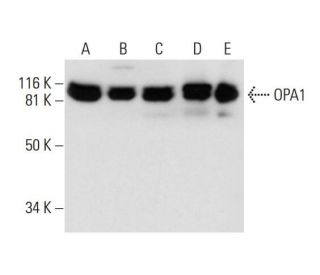
  • OPA1 Antibody (D-9) is a mouse monoclonal IgG1 κ OPA1 antibody, cited in 62 publications, provided at 200 µg/ml
  • raised against amino acids 647-780 mapping within an internal region of OPA1 of human origin
  • OPA1 Antibody (D-9) is recommended for detection of OPA1 of mouse, rat and human origin by WB, IP, IF and ELISA; also reactive with additional species, including and equine, canine, bovine and porcine
  • Anti-OPA1 Antibody (D-9) is available conjugated to agarose for IP; HRP for WB, IHC(P) and ELISA; and to either phycoerythrin or FITC for IF, IHC(P) and FCM
  • also available conjugated to Alexa Fluor® 488, Alexa Fluor® 546, Alexa Fluor® 594 or Alexa Fluor® 647 for WB (RGB), IF, IHC(P) and FCM, and for use with RGB fluorescent imaging systems, such as iBright™ FL1000, FluorChem™, Typhoon, Azure and other comparable systems
  • also available conjugated to Alexa Fluor® 680 or Alexa Fluor® 790 for WB (NIR), IF and FCM; for use with Near-Infrared (NIR) detection systems, such as LI-COR®Odyssey®, iBright™ FL1000, FluorChem™, Typhoon, Azure and other comparable systems
  • m-IgG Fc BP-HRP and m-IgGκ BP-HRP are the preferred secondary detection reagents for OPA1 Antibody (D-9) for WB applications. These reagents are now offered in bundles with OPA1 Antibody (D-9) (see ordering information below).

Gene Editing Promo Banner

QUICK LINKS

SEE ALSO...

OPA1 Antibody (D-9) is a mouse monoclonal IgG1 kappa light chain antibody that detects OPA1 protein of mouse, rat, and human origin by western blotting (WB), immunoprecipitation (IP), immunofluorescence (IF), and enzyme-linked immunosorbent assay (ELISA). OPA1 Antibody (D-9) is available in both non-conjugated and various conjugated forms, including agarose, horseradish peroxidase (HRP), phycoerythrin (PE), fluorescein isothiocyanate (FITC), and multiple Alexa Fluor® conjugates. OPA1, encoded by the optic atrophy 1 gene located on chromosome 3q29, plays a crucial role in mitochondrial dynamics, particularly in regulating mitochondrial fusion and maintaining mitochondrial morphology. This function is vital for cellular energy production and overall cell health, helping ensure mitochondria can efficiently adapt to changes in energy demand and stress conditions. Defects in OPA1 are associated with optic atrophy type 1, leading to vision loss, and OPA1 is predominantly expressed in the retina, although also found in the brain, testis, heart, and skeletal muscles. OPA1′s ability to interact with other proteins involved in mitochondrial function further underscores OPA1′s importance in cellular metabolism and the pathophysiology of mitochondrial diseases.

For Research Use Only. Not Intended for Diagnostic or Therapeutic Use.

Alexa Fluor® is a trademark of Molecular Probes Inc., OR., USA

LI-COR® and Odyssey® are registered trademarks of LI-COR Biosciences

OPA1 Antibody (D-9) References:

  1. Nuclear gene OPA1, encoding a mitochondrial dynamin-related protein, is mutated in dominant optic atrophy.  |  Delettre, C., et al. 2000. Nat Genet. 26: 207-10. PMID: 11017079
  2. Spectrum, frequency and penetrance of OPA1 mutations in dominant optic atrophy.  |  Toomes, C., et al. 2001. Hum Mol Genet. 10: 1369-78. PMID: 11440989
  3. Mutation spectrum and splicing variants in the OPA1 gene.  |  Delettre, C., et al. 2001. Hum Genet. 109: 584-91. PMID: 11810270
  4. Differential sublocalization of the dynamin-related protein OPA1 isoforms in mitochondria.  |  Satoh, M., et al. 2003. Biochem Biophys Res Commun. 300: 482-93. PMID: 12504110
  5. Roles of the mammalian mitochondrial fission and fusion mediators Fis1, Drp1, and Opa1 in apoptosis.  |  Lee, YJ., et al. 2004. Mol Biol Cell. 15: 5001-11. PMID: 15356267
  6. OPA1 requires mitofusin 1 to promote mitochondrial fusion.  |  Cipolat, S., et al. 2004. Proc Natl Acad Sci U S A. 101: 15927-32. PMID: 15509649
  7. OPA1, associated with autosomal dominant optic atrophy, is widely expressed in the human brain.  |  Bette, S., et al. 2005. Acta Neuropathol. 109: 393-9. PMID: 15700187
  8. Refinement of the dominant optic atrophy locus (OPA1) to a 1.4-cM interval on chromosome 3q28-3q29, within a 3-Mb YAC contig.  |  Jonasdottir, A., et al. 1997. Hum Genet. 99: 115-20. PMID: 9003507

Ordering Information

Product NameCatalog #UNITPriceQtyFAVORITES

OPA1 Antibody (D-9)

sc-393296
200 µg/ml
$322.00

OPA1 Antibody (D-9): m-IgG Fc BP-HRP Bundle

sc-530422
200 µg Ab; 10 µg BP
$361.00

OPA1 Antibody (D-9): m-IgGκ BP-HRP Bundle

sc-523893
200 µg Ab, 40 µg BP
$361.00

OPA1 Antibody (D-9) AC

sc-393296 AC
500 µg/ml, 25% agarose
$424.00

OPA1 Antibody (D-9) HRP

sc-393296 HRP
200 µg/ml
$322.00

OPA1 Antibody (D-9) FITC

sc-393296 FITC
200 µg/ml
$336.00

OPA1 Antibody (D-9) PE

sc-393296 PE
200 µg/ml
$349.00

OPA1 Antibody (D-9) Alexa Fluor® 488

sc-393296 AF488
200 µg/ml
$364.00

OPA1 Antibody (D-9) Alexa Fluor® 546

sc-393296 AF546
200 µg/ml
$364.00

OPA1 Antibody (D-9) Alexa Fluor® 594

sc-393296 AF594
200 µg/ml
$364.00

OPA1 Antibody (D-9) Alexa Fluor® 647

sc-393296 AF647
200 µg/ml
$364.00

OPA1 Antibody (D-9) Alexa Fluor® 680

sc-393296 AF680
200 µg/ml
$364.00

OPA1 Antibody (D-9) Alexa Fluor® 790

sc-393296 AF790
200 µg/ml
$364.00

I am currently looking for antibodies for OPA1 for immunofluorescence. I would like to ask if it is possible to get a trial sample to try? We have OPA1 ko cells so if it works, I could upload some photos and protocols to share. Many thanks in advance!

Asked by: Xiaotong
Please contact our Technical Service Department for more information on how to receive a free 10 ug sample of this monoclonal antibody.
Answered by: Technical Support
Date published: 2020-07-24

As I am unhappy with the current OPA1-antibody we are using (other manufacturer), I am looking to buy a new one. Would it be possible to get a free sample of this antibody for testing?

Asked by: Christiaan
Thank you for your question. Please contact Technical Service for information on how to receive a free 10 ug sample of this monoclonal antibody.
Answered by: Tech Service
Date published: 2020-02-06

8% separation gel, first antibody 1:100, 4℃,overnight. second antibody 1:1000,room temperature, 1 hour. But I think the band (130-250kDa) is not right.

Asked by: Anonymous
Thank you for your question. Please contact your local distributor or Technical Service directly for assistance regarding your WB results, we are happy to discuss your results with you.
Answered by: Tech Service
Date published: 2019-04-26

what buffer does the opa1 antibody work best in? I tried probing a blot of mouse heart tissue with opa1 at 1:1000 in 5%milk/ TBST and the blot is there is a lot of background. I checked the publications cited and they lack the buffer details

Asked by: Dr C
Thank you for your question. The optimal blocking buffer and antibody diluent depends on which type of Western blot detection method you are using. If you are using an HRP conjugated secondary for chemiluminescent detection, then we recommend Blotto, or 5% nonfat milk in TBST (1X TBST + 0.05% Tween-20) for blocking, and for incubating both primary and secondary antibodies. If you are using a fluorescent or NIR (Near-Infrared) detection method, for optimal results, use low fluorescence PVDF membranes, such as Immobilon®-FL PVDF: sc-516541, and UltraCruz® Blocking Reagent: sc-516214 for all blocking, primary antibody and secondary antibody incubations.
Answered by: Technical Support
Date published: 2022-04-27

I would like to know your OPA1 antibody (D9): sc-393296 could use with immunofluorescence? How long to be shipped to Korea, the volume and the price to my university in Korea. Thank you very much!

Asked by: Trang
Thank you for your question. We have not yet tested this mouse monoclonal antibody, OPA1 (D-9): sc-393296, in immunofluorescent staining applications. However, based on the antibody's performance in other applications, we do recommend and warranty the antibody for IF, or immunofluorescent staining of fresh or frozen tissues or cells, fixed in methanol or acetone. Please contact one of our authorized distributors in Korea to inquire about shipping times and to receive a quote to ship to a University in Korea. A link is provided below to search for our distributors. https://www.scbt.com/scbt/resources/distributors For a limited time, we are offering a free 10 µg sample of this antibody. Please contact us if you would like to request a sample to test in your application. Please call our Asian Support office toll-free at 800-820-8626, email asia@scbio.cn, or contact us by live chat.
Answered by: Technical Support
Date published: 2017-05-25

Can OPA1 Antibody (D-9): sc-393296 be used for detection of OPA1 of chicken origin?

Asked by: jenni
Thank you for your inquiry. Please contact our Technical Service Department and we would be happy to perform sequence analysis and review our data to answer any questions you may have about additional species reactivity. We are available by phone, e-mail or chat.
Answered by: Technical Support 3
Date published: 2017-01-09
  • y_2026, m_4, d_23, h_7CST
  • bvseo_bulk, prod_bvqa, vn_bulk_3.0.43
  • cp_1, bvpage1
  • co_hasquestionsanswers, tq_6
  • loc_en_US, sid_393296, prod, sort_[SortEntry(order=LAST_APPROVED_ANSWER_SUBMISSION_TIME, direction=DESCENDING)]
  • clientName_scbt
  • bvseo_sdk, java_sdk, bvseo-4.0.0
  • CLOUD, getContent, 103ms
  • QUESTIONS, PRODUCT
Rated 1 out of 5 by from it does not worksMaybe it works in lysates from tissue but does not works in cell lysates, not even at 1:100.
Date published: 2023-04-24
Rated 1 out of 5 by from very poor quality.Purchased this antibody for studying mitochondrial dynamics, very faint signal and a huge background noise, I used 1/100 dilution. after 4 times trying with different gels and samples, I gave up.
Date published: 2021-04-01
Rated 4 out of 5 by from goodSingle extremely weak band detected with muscle cells, but strong single in muscle tissue.
Date published: 2020-02-06
Rated 4 out of 5 by from Good Inner mitochondrial membrane protein markerCan be used in 1:500 dilution for western blotting to look at mouse mitochondrial extracts.
Date published: 2019-10-05
Rated 5 out of 5 by from good signalI loaded total homogenate from mouse brain 5-10-20-30 ug, good signal with 20 and 30 ug. I recommend this antibody for WB.
Date published: 2019-01-28
Rated 3 out of 5 by from Not quite strong band1:200 diluted for wb of rat protein,the band is not quite clear
Date published: 2018-06-12
Rated 3 out of 5 by from WBTested in SHSY-5Y human neuroblastoma cells (~15-20ug/lane), dilution 1:1000 in 3% milk in TBST. Got a single clear band at expected size after very long exposure.
Date published: 2018-05-15
Rated 4 out of 5 by from Great featuresI bought it a month ago, it works well as I recent run in WB.
Date published: 2017-10-30
  • y_2026, m_4, d_23, h_7
  • bvseo_bulk, prod_bvrr, vn_bulk_3.0.43
  • cp_1, bvpage1
  • co_hasreviews, tv_0, tr_22
  • loc_en_US, sid_393296, prod, sort_[SortEntry(order=SUBMISSION_TIME, direction=DESCENDING)]
  • clientName_scbt
  • bvseo_sdk, java_sdk, bvseo-4.0.0
  • CLOUD, getReviews, 13ms
  • REVIEWS, PRODUCT
OPA1 Antibody (D-9) is rated 4.0 out of 5 by 22.
  • y_2026, m_4, d_23, h_7
  • bvseo_bulk, prod_bvrr, vn_bulk_3.0.43
  • cp_1, bvpage1
  • co_hasreviews, tv_0, tr_22
  • loc_en_US, sid_393296, prod, sort_[SortEntry(order=SUBMISSION_TIME, direction=DESCENDING)]
  • clientName_scbt
  • bvseo_sdk, java_sdk, bvseo-4.0.0
  • CLOUD, getAggregateRating, 99ms
  • REVIEWS, PRODUCT