
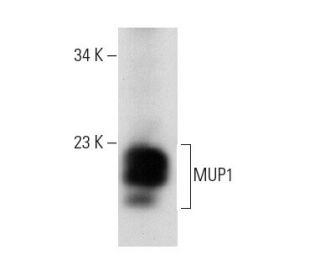


MUP Antibody (C-7): sc-166429
- MUP Antibody (C-7) is a mouse monoclonal IgG1 κ, cited in 3 publications, provided at 200 µg/ml
- raised against amino acids 1-180 representing full length MUP of mouse origin
- MUP Antibody (C-7) is recommended for detection of a broad range of MUP proteins of mouse origin by WB, IP, IF, IHC(P) and ELISA
- Anti-MUP Antibody (C-7) is available conjugated to agarose for IP; HRP for WB, IHC(P) and ELISA; and to either phycoerythrin or FITC for IF, IHC(P) and FCM
- also available conjugated to Alexa Fluor® 488, Alexa Fluor® 546, Alexa Fluor® 594 or Alexa Fluor® 647 for WB (RGB), IF, IHC(P) and FCM, and for use with RGB fluorescent imaging systems, such as iBright™ FL1000, FluorChem™, Typhoon, Azure and other comparable systems
- also available conjugated to Alexa Fluor® 680 or Alexa Fluor® 790 for WB (NIR), IF and FCM; for use with Near-Infrared (NIR) detection systems, such as LI-COR®Odyssey®, iBright™ FL1000, FluorChem™, Typhoon, Azure and other comparable systems
- m-IgG Fc BP-HRP, m-IgG1 BP-HRP and m-IgGκ BP-HRP are the preferred secondary detection reagents for MUP Antibody (C-7) for WB and IHC(P) applications. These reagents are now offered in bundles with MUP Antibody (C-7) (see ordering information below).

QUICK LINKS
SEE ALSO...
MUP Antibody (C-7) is a mouse monoclonal IgG1 kappa light chain antibody that detects Major Urinary Protein (MUP) of mouse origin by western blotting (WB), immunoprecipitation (IP), immunofluorescence (IF), immunohistochemistry, and enzyme-linked immunosorbent assay (ELISA). MUP (C-7) antibody is available in both non-conjugated and various conjugated forms, including agarose, horseradish peroxidase (HRP), phycoerythrin (PE), fluorescein isothiocyanate (FITC), and multiple Alexa Fluor® conjugates. Major urinary proteins are crucial pheromone-binding proteins that play a significant role in influencing the physiology and behavior of mice through their excretion in urine. These proteins are primarily synthesized in the liver and several secretory tissues, such as the lachrymal, submaxillary, and mammary glands, highlighting their importance in various biological processes. MUP proteins are derived from a multi-gene family that exhibits diverse tissue-specific expression, developmental regulation, and hormonal control, with several isoforms being expressed and secreted predominantly by sexually mature male mice. The structure of MUP proteins, characterized by a beta-barrel motif, is essential for their ability to bind a wide range of pheromones, which are believed to be accommodated within this structural framework. Notably, testosterone treatment can significantly influence the MUP phenotype by enhancing MUP excretion and altering the relative proportions of each isoform, thereby affecting olfactory cues and mediating differential pheromone-binding profiles.
Alexa Fluor® is a trademark of Molecular Probes Inc., OR., USA
LI-COR® and Odyssey® are registered trademarks of LI-COR Biosciences
MUP Antibody (C-7) References:
- Thermodynamic analysis of binding between mouse major urinary protein-I and the pheromone 2-sec-butyl-4,5-dihydrothiazole. | Sharrow, SD., et al. 2003. Biochemistry. 42: 6302-9. PMID: 12755635
- Major urinary protein regulation of chemical communication and nutrient metabolism. | Zhou, Y. and Rui, L. 2010. Vitam Horm. 83: 151-63. PMID: 20831945
- Zhx2 (zinc fingers and homeoboxes 2) regulates major urinary protein gene expression in the mouse liver. | Jiang, J., et al. 2017. J Biol Chem. 292: 6765-6774. PMID: 28258223
- Major urinary protein levels are associated with social status and context in mouse social hierarchies. | Lee, W., et al. 2017. Proc Biol Sci. 284: PMID: 28931741
- Sequence structures of a mouse major urinary protein gene and pseudogene compared. | Clark, AJ., et al. 1985. EMBO J. 4: 3159-65. PMID: 3004935
- Evolutionary patterns of major urinary protein scent signals in house mice and relatives. | Sheehan, MJ., et al. 2019. Mol Ecol. 28: 3587-3601. PMID: 31232499
- Major urinary protein excreted in rodent hindpaw sweat. | Poitras, T., et al. 2021. J Anat. 239: 529-535. PMID: 33686663
- Repurposed major urinary protein pheromones and adult sensory neurons: roles in neuron plasticity and experimental diabetes. | Poitras, T., et al. 2022. Am J Physiol Endocrinol Metab. 323: E53-E68. PMID: 35635311
- The major urinary protein gene cluster knockout mouse as a novel model for translational metabolism research. | Greve, S., et al. 2022. Sci Rep. 12: 13161. PMID: 35915220
- Cystathionine β-synthase gene inactivation dysregulates major urinary protein biogenesis and impairs sexual signaling in mice. | Bretes, E., et al. 2022. FASEB J. 36: e22547. PMID: 36098436
Ordering Information
| Product Name | Catalog # | UNIT | Price | Qty | FAVORITES | |
MUP Antibody (C-7) | sc-166429 | 200 µg/ml | $322.00 | |||
MUP Antibody (C-7): m-IgG Fc BP-HRP Bundle | sc-528966 | 200 µg Ab; 10 µg BP | $361.00 | |||
MUP Antibody (C-7): m-IgGκ BP-HRP Bundle | sc-521606 | 200 µg Ab, 40 µg BP | $361.00 | |||
MUP Antibody (C-7): m-IgG1 BP-HRP Bundle | sc-543242 | 200 µg Ab; 20 µg BP | $361.00 | |||
MUP Antibody (C-7) AC | sc-166429 AC | 500 µg/ml, 25% agarose | $424.00 | |||
MUP Antibody (C-7) HRP | sc-166429 HRP | 200 µg/ml | $322.00 | |||
MUP Antibody (C-7) FITC | sc-166429 FITC | 200 µg/ml | $336.00 | |||
MUP Antibody (C-7) PE | sc-166429 PE | 200 µg/ml | $349.00 | |||
MUP Antibody (C-7) Alexa Fluor® 488 | sc-166429 AF488 | 200 µg/ml | $364.00 | |||
MUP Antibody (C-7) Alexa Fluor® 546 | sc-166429 AF546 | 200 µg/ml | $364.00 | |||
MUP Antibody (C-7) Alexa Fluor® 594 | sc-166429 AF594 | 200 µg/ml | $364.00 | |||
MUP Antibody (C-7) Alexa Fluor® 647 | sc-166429 AF647 | 200 µg/ml | $364.00 | |||
MUP Antibody (C-7) Alexa Fluor® 680 | sc-166429 AF680 | 200 µg/ml | $364.00 | |||
MUP Antibody (C-7) Alexa Fluor® 790 | sc-166429 AF790 | 200 µg/ml | $364.00 |