
Date published: 2026-4-29

1-800-457-3801

SCBT Portrait Logo
Seach Input

MRP1 Antibody (QCRL-3): sc-18873

4.0(4)
Write a reviewAsk a question

Datasheets
  • MRP1 Antibody (QCRL-3) is a mouse monoclonal IgG2a κ, cited in 5 publications, provided at 200 µg/ml
  • raised against membranes prepared from the human small cell lung cancer cell line, H69AR, which highly overexpresses MRP1
  • recommended for detection of MRP1 of human origin by IF and FCM
  • available conjugated to either phycoerythrin or FITC for IF, IHC(P) and FCM
  • See MRP1 (QCRL-1): sc-18835 for MRP1 antibody conjugates, including AC, HRP, FITC, PE, Alexa Fluor® 488, 594, 647, 680 and 790.
  • m-IgG Fc BP-HRP, m-IgG2a BP-HRP and m-IgGκ BP-HRP are the preferred secondary detection reagents for MRP1 Antibody (QCRL-3). These reagents are now offered in bundles with MRP1 Antibody (QCRL-3) (see ordering information below).

Gene Editing Promo Banner

QUICK LINKS

SEE ALSO...

MRP1 Antibody (QCRL-3) is a mouse monoclonal IgG2a antibody that detects MRP1 in human samples through immunofluorescence (IF) and flow cytometry (FCM) applications. MRP1, or multidrug-resistance protein 1, plays a crucial role in the cellular defense mechanism against toxic compounds, including chemotherapeutic agents, by actively transporting a variety of substrates out of cells. This function is particularly important in the context of cancer, where overexpression of MRP1 can lead to multidrug resistance, making MRP1 a significant target for therapeutic intervention. MRP1 is primarily localized in the plasma membrane of various cell types, including those in the lungs, testis, and peripheral blood, which underscores MRP1′s importance in protecting these tissues from harmful substances. MRP1′s structure features an Mdr-like core and a unique N-terminal membrane-bound region, which are essential for transport activity and substrate specificity. Understanding the localization and function of MRP1 is vital for developing strategies to overcome drug resistance in cancer therapy, making MRP1 monoclonal antibody (QCRL-3) an invaluable tool for researchers studying multidrug resistance mechanisms in human cells.

For Research Use Only. Not Intended for Diagnostic or Therapeutic Use.

Ordering Information

Product NameCatalog #UNITPriceQtyFAVORITES

MRP1 Antibody (QCRL-3)

sc-18873
200 µg/ml
$322.00

MRP1 Antibody (QCRL-3): m-IgG Fc BP-HRP Bundle

sc-536604
200 µg Ab; 10 µg BP
$361.00

MRP1 Antibody (QCRL-3): m-IgGκ BP-HRP Bundle

sc-533759
200 µg Ab; 40 µg BP
$361.00

MRP1 Antibody (QCRL-3): m-IgG2a BP-HRP Bundle

sc-547842
200 µg Ab; 10 µg BP
$361.00

MRP1 Antibody (QCRL-3) FITC

sc-18873 FITC
200 µg/ml
$336.00

MRP1 Antibody (QCRL-3) PE

sc-18873 PE
200 µg/ml
$349.00

I was wondering if the antibody MRP1 (xQRCL-3): sc-18873 recognizes an extra or intracellular epitope ? Because we want to use it for flux cytometry, but we do not want to permeabilize our cells. Thank you

Asked by: Hugosugier
Thank you for your question. This antibody was raised against membranes prepared from the human small cell lung cancer cell line, H69AR, which highly overexpresses MRP1. The exact epitope has not been mapped, so further information is not available.
Answered by: Tech Service
Date published: 2019-07-03

what is the difference between MRP1 Antibody (xQCRL3):sc-18873 and (QCRL1):sc-18835? My target is H69AR resistant to adryamycin, which one is better? I'll use FCM technique, better to buy sc-18873 FITC or buy m-IgGκ BP-FITC: sc-516140 separately? thanks

Asked by: leonardo23
Thank you for your question. These are two different monoclonal antibodies. They recognize distinct epitopes and are suitable for different applications. We do not have any recommendation for antibodies to detect H69AR resistant to adryamycin. If you would like to detect MRP1 by FCM then we do recommend using a directly conjugated primary antibody. For example, sc-18873 FITC, or sc-18835 FITC.
Answered by: Technical Support
Date published: 2019-01-26

How can MRP1 (QCRL-3): sc-18873 mouse monoclonal antibody be used for double or triple staining, if the other primary antibodies are also raised in mouse?

Asked by: Germaine
In this case, we recommend using a directly conjugated mouse monoclonal primary antibody. This antibody is available conjugated to phycoerythrin (sc-18873 PE) or fluoroscein (sc-18873 FITC).
Answered by: Technical Support
Date published: 2017-02-28
  • y_2026, m_4, d_23, h_7CST
  • bvseo_bulk, prod_bvqa, vn_bulk_3.0.43
  • cp_1, bvpage1
  • co_hasquestionsanswers, tq_3
  • loc_en_US, sid_18873, prod, sort_[SortEntry(order=LAST_APPROVED_ANSWER_SUBMISSION_TIME, direction=DESCENDING)]
  • clientName_scbt
  • bvseo_sdk, java_sdk, bvseo-4.0.0
  • CLOUD, getContent, 102ms
  • QUESTIONS, PRODUCT
Rated 4 out of 5 by from Published IHC(P) data for use in human liverPublished IHC(P) data for use in human liver. -SCBT Publication Review
Date published: 2015-03-22
Rated 4 out of 5 by from Published data for WB in human CL3 cellsPublished data for WB in human CL3 cells. -SCBT Publication Review
Date published: 2015-03-15
Rated 4 out of 5 by from Produced wonderful immunofluorescence membraneProduced wonderful immunofluorescence membrane staining in methanol-fixed T98G cells. -SCBT QC
Date published: 2015-02-19
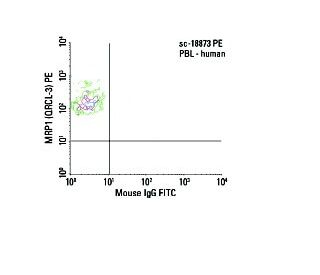
Rated 4 out of 5 by from Great FCM data of human peripheral bloodGreat FCM data of human peripheral blood leukocytes. -SCBT QC
Date published: 2014-08-21
  • y_2026, m_4, d_23, h_7
  • bvseo_bulk, prod_bvrr, vn_bulk_3.0.43
  • cp_1, bvpage1
  • co_hasreviews, tv_0, tr_4
  • loc_en_US, sid_18873, prod, sort_[SortEntry(order=SUBMISSION_TIME, direction=DESCENDING)]
  • clientName_scbt
  • bvseo_sdk, java_sdk, bvseo-4.0.0
  • CLOUD, getReviews, 16ms
  • REVIEWS, PRODUCT
MRP1 Antibody (QCRL-3) is rated 4.0 out of 5 by 4.
  • y_2026, m_4, d_23, h_7
  • bvseo_bulk, prod_bvrr, vn_bulk_3.0.43
  • cp_1, bvpage1
  • co_hasreviews, tv_0, tr_4
  • loc_en_US, sid_18873, prod, sort_[SortEntry(order=SUBMISSION_TIME, direction=DESCENDING)]
  • clientName_scbt
  • bvseo_sdk, java_sdk, bvseo-4.0.0
  • CLOUD, getAggregateRating, 100ms
  • REVIEWS, PRODUCT