
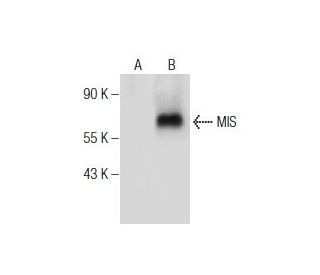

MIS Antikörper (A-9): sc-377140
- MIS Antikörper (A-9) ist ein Maus monoklonales IgG1 κ, verwendet in 1 wissenschaftlichen Veröffentlichungen, in einer Menge von 200 µg/ml
- gezogen gegen die Aminosäuresequenz 46-345 lokalisiert innerhalb einer internen Region von MIS aus der Spezies human
- Empfohlen für die Detektion von MIS aus der Spezies human per WB, IP, IF und ELISA
- Als Direktkonjugat zur Detektion von MIS wird MIS (B-11): sc-166752 angeboten; Primärantikörper konjugiert mit AC, HRP, FITC, PE, Alexa Fluor® 488, 594, 647, 680 und 790.
- m-IgG Fc BP-HRP, 1 BP-HRP">m-IgG1 BP-HRP und m-IgGκ BP-HRP sind die bevorzugten sekundären Nachweisreagenzien für MIS Antikörper (A-9) für WB-Anwendungen. Diese Reagenzien werden jetzt in Bündeln mit MIS Antikörper (A-9) angeboten(siehe Bestellinformationen unten).

Direktverknüpfungen
Siehe auch...
Die Transforming Growth Factor β (TGFβ)-Superfamilie besteht aus zahlreichen Wachstums- und Differenzierungsfaktoren, einschließlich TGFβ1-3, Mullerian inhibiting Substance (MIS), Growth/Differentiation Factor (GDF) 1-9, Bone Morphogenic Protein (BMP) 2-8, Glial Cell Line-Derived Neurotrophic Factor (GDNF), Inhibin α, β-A, β-B und β-C, Lefty und Nodal. Mitglieder der TGFβ-Superfamilie sind an der embryonalen Entwicklung und der Erhaltung des Erwachsenengewebes beteiligt. Das MIS-Glykoprotein wird von den Sertoli-Zellen des Hodens produziert. Der fetaler Hoden produziert sowohl MIS als auch Testosteron, deren Vorhandensein zur Entstehung männlicher Nachkommen führt. Fehlt MIS und Testosteron in einem sich entwickelnden Fötus, führt dies zur Induktion der Differenzierung des Müller-Ducts, während die Entwicklung des Wolff-Ducts nicht induziert wird. Testosteron induziert die Differenzierung des Wolff-Ducts, während MIS die Regression des Müller-Ducts verursacht. MIS hemmt das Wachstum von Tumoren, die aus Geweben des Müller-Ducts stammen. MIS kann auch die Autophosphorylierung des EGF-Rezeptors in vitro hemmen. Defekte des Anti-Müller-Hormons sind die Ursache des persistierenden Müller-Duct-Syndroms Typ I (PMDS-1). PMDS-1 ist eine Form des männlichen Pseudohermaphroditismus, die durch ein Versagen der Regression des Müller-Ducts bei ansonsten normalen Männern gekennzeichnet ist.
Alexa Fluor® ist ein Markenzeichen von Molecular Probes Inc., OR., USA
LI-COR® und Odyssey® sind Markenzeichen von LI-COR Biosciences
MIS Antikörper (A-9) Literaturhinweise:
- Müllerinhemmende Substanz im Serum bei Schwangerschaften mit Down-Syndrom. | Seifer, DB., et al. 2007. Hum Reprod. 22: 1017-20. PMID: 17218369
- Mullerian inhibiting substance hemmt die Invasion und Migration von Epithelkrebs-Zelllinien. | Chang, HL., et al. 2011. Gynecol Oncol. 120: 128-34. PMID: 21056908
- Mullerian inhibiting substance rekrutiert ALK3, um die Differenzierung der Leydig-Zellen zu regulieren. | Wu, X., et al. 2012. Endocrinology. 153: 4929-37. PMID: 22872577
- Serumspiegel der müllerianhemmenden Substanz bei Jungen von der Geburt bis zum 18. Lebensjahr, bestimmt mittels Enzymimmunoassay. | Baker, ML., et al. 1990. J Clin Endocrinol Metab. 70: 11-5. PMID: 2403569
- Müllerian hemmende Substanz als Meiosehemmer für Eizellen. | Takahashi, M., et al. 1986. Mol Cell Endocrinol. 47: 225-34. PMID: 2428679
- Muster der Müllerin hemmenden Substanz Typ II und kandidierender Typ-I-Rezeptoren in epithelialem Eierstockkrebs. | Basal, E., et al. 2016. Curr Mol Med. 16: 222-31. PMID: 26917267
- Müllerian hemmende Substanz/Anti-Müllerian-Hormon Typ II-Rezeptorprotein und mRNA-Expression in gesunden und kanzerösen Endometrien. | Kim, SM., et al. 2019. Oncol Lett. 17: 532-538. PMID: 30655798
- Spiegel der mullerianhemmenden Substanz, des Sexualhormon-bindenden Globulins und der Sexualhormone bei Stimulanzien-naiven, erstdiagnostizierten präpubertären Jungen mit Aufmerksamkeitsdefizit-/Hyperaktivitätsstörung: Vergleich mit angepassten gesunden Kontrollen sowie vor und nach der Behandlung mit Oros-Methylpenidat. | Gokcen, C., et al. 2019. Int J Psychiatry Clin Pract. 23: 251-257. PMID: 31339400
- Funktion der Müllerin hemmenden Substanz während der sexuellen Entwicklung von Säugetieren. | Behringer, RR., et al. 1994. Cell. 79: 415-25. PMID: 7954809
- Messung der müllerianhemmenden Substanz im Serum bei der Beurteilung von Kindern mit nicht palpablen Gonaden. | Lee, MM., et al. 1997. N Engl J Med. 336: 1480-6. PMID: 9154766
Bestellinformation
| Produkt | Katalog # | EINHEIT | Preis | ANZAHL | Favoriten | |
MIS Antikörper (A-9) | sc-377140 | 200 µg/ml | $322.00 | |||
MIS (A-9): m-IgG Fc BP-HRP Bundle | sc-553242 | 200 µg Ab; 10 µg BP | $361.00 | |||
MIS (A-9): m-IgGκ BP-HRP Bundle | sc-553241 | 200 µg Ab; 40 µg BP | $361.00 | |||
MIS (A-9): m-IgG1 BP-HRP Bundle | sc-553243 | 200 µg Ab; 20 µg BP | $361.00 |