
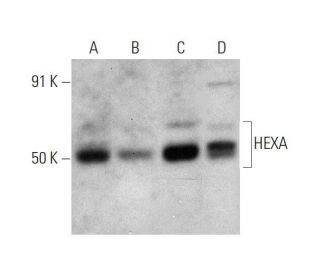
HEXA Antibody (D-2): sc-376777
- HEXA Antibody (D-2) is a mouse monoclonal IgG2b κ HEXA antibody, cited in 3 publications, provided at 200 µg/ml
- raised against amino acids 377-416 mapping within an internal region of HEXA of human origin
- HEXA Antibody (D-2) is recommended for detection of HEXA of mouse, rat and human origin by WB, IP, IF, IHC(P) and ELISA
- Anti-HEXA Antibody (D-2) is available conjugated to agarose for IP; HRP for WB, IHC(P) and ELISA; and to either phycoerythrin or FITC for IF, IHC(P) and FCM
- also available conjugated to Alexa Fluor® 488, Alexa Fluor® 546, Alexa Fluor® 594 or Alexa Fluor® 647 for WB (RGB), IF, IHC(P) and FCM, and for use with RGB fluorescent imaging systems, such as iBright™ FL1000, FluorChem™, Typhoon, Azure and other comparable systems
- also available conjugated to Alexa Fluor® 680 or Alexa Fluor® 790 for WB (NIR), IF and FCM; for use with Near-Infrared (NIR) detection systems, such as LI-COR®Odyssey®, iBright™ FL1000, FluorChem™, Typhoon, Azure and other comparable systems
- m-IgG Fc BP-HRP and m-IgG2b BP-HRP are the preferred secondary detection reagents for HEXA Antibody (D-2) for WB and IHC(P) applications. These reagents are now offered in bundles with HEXA Antibody (D-2) (see ordering information below).

QUICK LINKS
HEXA Antibody (D-2) is a mouse monoclonal IgG2b kappa light chain antibody that detects HEXA protein of mouse, rat, and human origin by western blotting (WB), immunoprecipitation (IP), immunofluorescence (IF), immunohistochemistry with paraffin-embedded sections (IHCP), and enzyme-linked immunosorbent assay (ELISA). HEXA (D-2) antibody is available in both non-conjugated and various conjugated forms, including agarose, horseradish peroxidase (HRP), phycoerythrin (PE), fluorescein isothiocyanate (FITC), and multiple Alexa Fluor® conjugates. HEXA protein, also known as beta-Hexosaminidase A, plays a crucial role in lysosomal function by degrading GM2 ganglioside and other molecules containing terminal N-acetyl hexosamines, particularly in brain and other tissues. This enzymatic activity maintains cellular homeostasis, as GM2 ganglioside accumulation due to HEXA deficiency can lead to severe neurological disorders, such as Tay-Sachs disease, a fatal autosomal recessive lysosomal storage disorder characterized by progressive destruction of the central nervous system. HEXA protein forms a trimer composed of one α chain and two β chains (β-A and β-B), and proper functioning prevents toxic buildup of GM2 gangliosides, which can devastate neuronal health and function.
Alexa Fluor® is a trademark of Molecular Probes Inc., OR., USA
LI-COR® and Odyssey® are registered trademarks of LI-COR Biosciences
HEXA Antibody (D-2) References:
- Molecular basis of hexosaminidase A deficiency and pseudodeficiency in the Berks County Pennsylvania Dutch. | Mules, EH., et al. 1992. Hum Mutat. 1: 298-302. PMID: 1301937
- Pathogenic significance of alpha-N-acetylgalactosaminidase activity found in the hemagglutinin of influenza virus. | Yamamoto, N. and Urade, M. 2005. Microbes Infect. 7: 674-81. PMID: 15848273
- N-acetyl-beta-D-hexosaminidase from Trichomonas vaginalis: substrate specificity and activity of inhibitors. | Sanon, A., et al. 2005. Biomed Pharmacother. 59: 245-8. PMID: 15890491
- Beta-hexosaminidase isoenzyme profiles in serum, plasma, platelets and mononuclear, polymorphonuclear and unfractionated total leukocytes. | Casal, JA., et al. 2005. Clin Biochem. 38: 938-42. PMID: 16024010
- Sequence of DNA flanking the exons of the HEXA gene, and identification of mutations in Tay-Sachs disease. | Triggs-Raine, BL., et al. 1991. Am J Hum Genet. 49: 1041-54. PMID: 1833974
- Mice doubly-deficient in lysosomal hexosaminidase A and neuraminidase 4 show epileptic crises and rapid neuronal loss. | Seyrantepe, V., et al. 2010. PLoS Genet. 6: e1001118. PMID: 20862357
- Hexosaminidase-A and hexosaminidase-B: studies in Tay-Sachs' and Sandhoff's disease. | Srivastava, SK. and Beutler, E. 1973. Nature. 241: 463. PMID: 4122341
- Identification of a possible subunit of hexosaminidase A and B. | Robinson, D., et al. 1973. Nature. 243: 415-6. PMID: 4743635
- Characterization of heteropolymeric hexosaminidase A in human X mouse hybrid cells. | Chern, J., et al. 1976. Proc Natl Acad Sci U S A. 73: 3637-40. PMID: 62363
- Deficiency of the hexosaminidase A activator protein in a case of GM2 gangliosidosis; variant AB. | Hechtman, P., et al. 1982. Pediatr Res. 16: 217-22. PMID: 6801612
- Characterization of unusual hexosaminidase A (HEX A) deficient human mutants. | O'Brien, JS., et al. 1978. Am J Hum Genet. 30: 602-8. PMID: 747188
- Targeted disruption of the Hexa gene results in mice with biochemical and pathologic features of Tay-Sachs disease. | Yamanaka, S., et al. 1994. Proc Natl Acad Sci U S A. 91: 9975-9. PMID: 7937929
Ordering Information
| Product Name | Catalog # | UNIT | Price | Qty | FAVORITES | |
HEXA Antibody (D-2) | sc-376777 | 200 µg/ml | $322.00 | |||
HEXA Antibody (D-2): m-IgG Fc BP-HRP Bundle | sc-526050 | 200 µg Ab; 10 µg BP | $361.00 | |||
HEXA Antibody (D-2): m-IgG2b BP-HRP Bundle | sc-549668 | 200 µg Ab; 10 µg BP | $361.00 | |||
HEXA Antibody (D-2) AC | sc-376777 AC | 500 µg/ml, 25% agarose | $424.00 | |||
HEXA Antibody (D-2) HRP | sc-376777 HRP | 200 µg/ml | $322.00 | |||
HEXA Antibody (D-2) FITC | sc-376777 FITC | 200 µg/ml | $336.00 | |||
HEXA Antibody (D-2) PE | sc-376777 PE | 200 µg/ml | $349.00 | |||
HEXA Antibody (D-2) Alexa Fluor® 488 | sc-376777 AF488 | 200 µg/ml | $364.00 | |||
HEXA Antibody (D-2) Alexa Fluor® 546 | sc-376777 AF546 | 200 µg/ml | $364.00 | |||
HEXA Antibody (D-2) Alexa Fluor® 594 | sc-376777 AF594 | 200 µg/ml | $364.00 | |||
HEXA Antibody (D-2) Alexa Fluor® 647 | sc-376777 AF647 | 200 µg/ml | $364.00 | |||
HEXA Antibody (D-2) Alexa Fluor® 680 | sc-376777 AF680 | 200 µg/ml | $364.00 | |||
HEXA Antibody (D-2) Alexa Fluor® 790 | sc-376777 AF790 | 200 µg/ml | $364.00 |