
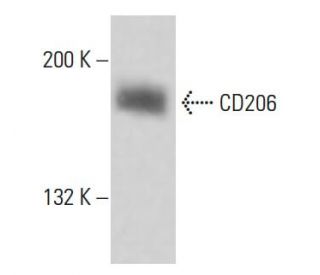

CD206/Mannose Receptor/MMR Antibody (3H1994): sc-70586
- CD206/Mannose Receptor/MMR Antibody (3H1994) is a mouse monoclonal IgG1 κ, cited in 4 publications, provided at 200 µg/ml
- raised against CD206 of human origin
- recommended for detection of CD206 of mouse, rat and human origin by WB, IP, IF and FCM
- See CD206/Mannose Receptor/MMR (D-1): sc-376108 for CD206/Mannose Receptor/MMR antibody conjugates, including AC, HRP, FITC, PE, Alexa Fluor® 488, 594, 647, 680 and 790.
- m-IgG Fc BP-HRP and m-IgG1 BP-HRP are the preferred secondary detection reagents for CD206/Mannose Receptor/MMR Antibody (3H1994) for WB applications. These reagents are now offered in bundles with CD206/Mannose Receptor/MMR Antibody (3H1994) (see ordering information below).

QUICK LINKS
SEE ALSO...
CD206 Antibody (3H1994) is a mouse monoclonal IgG1 kappa light chain antibody raised against CD206 of human origin, capable of detecting CD206 from mouse, rat, and human origins by western blotting (WB), immunoprecipitation (IP), immunofluorescence (IF), and flow cytometry (FCM). CD206, also known as the Mannose Receptor (MR), Macrophage Mannose Receptor (MMR), or Mannose Receptor C Type 1 (MRC1), is a type I membrane receptor protein predominantly expressed on macrophages, immature dendritic cells, hepatic and lymphatic endothelial cells, retinal pigment epithelium (RPE), and mesangial cells. Structurally, CD206 features an extracellular domain composed of a cysteine-rich region, a fibronectin type II domain, and eight C-type lectin-like carbohydrate recognition domains (CRDs), which are clustered to provide high-affinity binding to a variety of saccharides. This complex structure enables CD206 to recognize and bind to diverse carbohydrate ligands on the surfaces of pathogens, such as bacteria, fungi, and viruses, facilitating their endocytosis and subsequent neutralization by phagocytic engulfment. The presence of multiple CRDs in CD206 distinguishes CD206 from other C-type lectins and enhances versatility in pathogen recognition, playing a critical role in innate immunity and the rapid clearance of mannose-bearing serum glycoproteins during inflammation. Anti-CD206 antibody (3H1994) serves as a valuable tool for researchers studying the expression and function of CD206 across multiple species, aiding advancements in immunological research and potential therapeutic developments.
Alexa Fluor® is a trademark of Molecular Probes Inc., OR., USA
LI-COR® and Odyssey® are registered trademarks of LI-COR Biosciences
CD206/Mannose Receptor/MMR Antibody (3H1994) References:
- CD206-positive myeloid cells bind galectin-9 and promote a tumor-supportive microenvironment. | Enninga, EAL., et al. 2018. J Pathol. 245: 468-477. PMID: 29732570
- CD206+ tumor-associated macrophages promote proliferation and invasion in oral squamous cell carcinoma via EGF production. | Haque, ASMR., et al. 2019. Sci Rep. 9: 14611. PMID: 31601953
- CD86+/CD206+ tumor-associated macrophages predict prognosis of patients with intrahepatic cholangiocarcinoma. | Sun, D., et al. 2020. PeerJ. 8: e8458. PMID: 32002338
- Exploiting Manipulated Small Extracellular Vesicles to Subvert Immunosuppression at the Tumor Microenvironment through Mannose Receptor/CD206 Targeting. | Fiani, ML., et al. 2020. Int J Mol Sci. 21: PMID: 32878276
- Human CD206+ Macrophages Show Antifibrotic Effects on Human Fibroblasts through an IL-6-Dependent Mechanism In Vitro. | Kurachi, I., et al. 2021. Plast Reconstr Surg. 147: 231e-239e. PMID: 33235042
- CD206+ macrophage is an accelerator of endometriotic-like lesion via promoting angiogenesis in the endometriosis mouse model. | Ono, Y., et al. 2021. Sci Rep. 11: 853. PMID: 33441630
- CD163 and CD206 expression define distinct macrophage subsets involved in active ANCA-associated glomerulonephritis. | Aendekerk, JP., et al. 2022. J Autoimmun. 133: 102914. PMID: 36183584
- CD206+CD68+ mono-macrophages and serum soluble CD206 level are increased in antineutrophil cytoplasmic antibodies associated glomerulonephritis. | An, XN., et al. 2022. BMC Immunol. 23: 55. PMID: 36376784
- CD206+ tumor-associated macrophages interact with CD4+ tumor-infiltrating lymphocytes and predict adverse patient outcome in human laryngeal squamous cell carcinoma. | Heng, Y., et al. 2023. J Transl Med. 21: 167. PMID: 36864443
- A Distinct Microglial Cell Population Expressing Both CD86 and CD206 Constitutes a Dominant Type and Executes Phagocytosis in Two Mouse Models of Retinal Degeneration. | Zhang, Y., et al. 2023. Int J Mol Sci. 24: PMID: 37762541
Ordering Information
| Product Name | Catalog # | UNIT | Price | Qty | FAVORITES | |
CD206/Mannose Receptor/MMR Antibody (3H1994) | sc-70586 | 200 µg/ml | $322.00 | |||
CD206/Mannose Receptor/MMR Antibody (3H1994): m-IgG Fc BP-HRP Bundle | sc-539297 | 200 µg Ab; 10 µg BP | $361.00 | |||
CD206/Mannose Receptor/MMR Antibody (3H1994): m-IgG1 BP-HRP Bundle | sc-541388 | 200 µg Ab; 20 µg BP | $361.00 |