
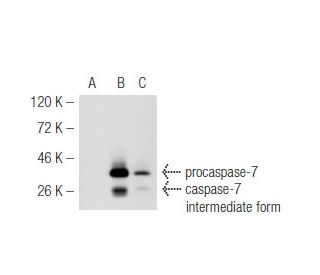

caspase-7 Antibody (11.1.56): sc-81655
- caspase-7 Antibody (11.1.56) is a mouse monoclonal IgG1 κ, cited in 1 publications, provided at 200 µg/ml
- raised against full-length recombinant caspase-7 of human origin
- recommended for detection of caspase-7 of mouse, rat and human origin by WB and IP
- m-IgG1 BP-HRP is the preferred secondary detection reagent for caspase-7 Antibody (11.1.56) for WB applications. This reagent is now offered in a bundle with caspase-7 Antibody (11.1.56) (see ordering information below).

QUICK LINKS
SEE ALSO...
Caspase-7 Antibody (11.1.56) is a mouse monoclonal IgG1 antibody that detects caspase-7 in mouse, rat, and human samples through applications such as western blotting (WB) and immunoprecipitation (IP). Caspase-7 is a crucial member of the Ced-3/caspase-1 family of cysteine proteases, which are integral to the apoptotic process, facilitating programmed cell death by cleaving specific target proteins that regulate cellular longevity. Notably, caspase-7 cleaves poly(ADP-ribose) polymerase (PARP), a nuclear protein playing a vital role in DNA repair and cellular stress responses. PARP cleavage by caspase-7 generates an apoptotic fragment, marking apoptosis and signaling programmed cell death. This process maintains tissue homeostasis and prevents damaged cell proliferation, playing a significant role in cancer biology and neurodegenerative diseases. Caspase-7 interacts with other caspases, such as caspase-3, to amplify apoptotic signaling, making caspase-7 a key player in cellular death pathways. Anti-caspase-7 antibody (11.1.56) serves as an invaluable tool for researchers studying apoptosis and related cellular processes.
Alexa Fluor® is a trademark of Molecular Probes Inc., OR., USA
LI-COR® and Odyssey® are registered trademarks of LI-COR Biosciences
caspase-7 Antibody (11.1.56) References:
- Structural basis of caspase-7 inhibition by XIAP. | Chai, J., et al. 2001. Cell. 104: 769-80. PMID: 11257230
- Inhibition of nuclear transport of caspase-7 by its prodomain. | Yaoita, Y. 2002. Biochem Biophys Res Commun. 291: 79-84. PMID: 11829465
- Teratogen-induced activation of caspase-6 and caspase-7 in early postimplantation mouse embryos. | Little, SA., et al. 2003. Cell Biol Toxicol. 19: 215-26. PMID: 14686614
- Possible involvement of caspase-7 in cell cycle progression at mitosis. | Hashimoto, T., et al. 2008. Genes Cells. 13: 609-21. PMID: 18459962
- Proteome-wide substrate analysis indicates substrate exclusion as a mechanism to generate caspase-7 versus caspase-3 specificity. | Demon, D., et al. 2009. Mol Cell Proteomics. 8: 2700-14. PMID: 19759058
- Identification of functional regions defining different activity in caspase-3 and caspase-7 within cells. | Nakatsumi, H. and Yonehara, S. 2010. J Biol Chem. 285: 25418-25. PMID: 20566630
- The catalytic subunit of human telomerase is a unique caspase-6 and caspase-7 substrate. | Soares, J., et al. 2011. Biochemistry. 50: 9046-55. PMID: 21936563
- Glucose deprivation induces reticulum stress by the PERK pathway and caspase-7- and calpain-mediated caspase-12 activation. | de la Cadena, SG., et al. 2014. Apoptosis. 19: 414-27. PMID: 24185830
- Genetic ablation of caspase-7 promotes solar-simulated light-induced mouse skin carcinogenesis: the involvement of keratin-17. | Lee, MH., et al. 2015. Carcinogenesis. 36: 1372-80. PMID: 26271098
- Gasdermin-D and Caspase-7 are the key Caspase-1/8 substrates downstream of the NAIP5/NLRC4 inflammasome required for restriction of Legionella pneumophila. | Gonçalves, AV., et al. 2019. PLoS Pathog. 15: e1007886. PMID: 31251782
Ordering Information
| Product Name | Catalog # | UNIT | Price | Qty | FAVORITES | |
caspase-7 Antibody (11.1.56) | sc-81655 | 200 µg/ml | $322.00 | |||
caspase-7 Antibody (11.1.56): m-IgG1 BP-HRP Bundle | sc-542628 | 200 µg Ab; 20 µg BP | $361.00 |