
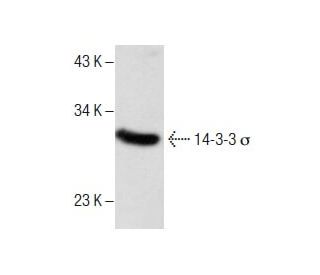
Anticorps 14-3-3 σ (E-11): sc-166473
- L'anticorps 14-3-3 sigma E-11 est un monoclonal IgG3 κ L'Anticorps 14-3-3 σ, cité dans 11 publications, fourni en 200 µg/ml
- spécifique d'un épitope situé entre les acides aminés 25-38 au niveau N-terminus de 14-3-3 σ d'origine human
- recommandé pour la détection de 14-3-3 σ d'origine mouse, rat et human par WB, IP, IF, IHC(P) et ELISA
- Voir pan 14-3-3 (B-8): sc-133233 pour d'autres anticorps conjugués 14-3-3 σ, dont AC, HRP, FITC, PE, Alexa Fluor® 488, 594, 647, 680 et 790.
- Le m-IgG3 BP-HRP et le m-IgGκ BP-HRP sont les réactifs de détection secondaire préférés pour l'anticorps 14-3-3 σ (E-11) pour les applications WB et IHC(P). Ces réactifs sont désormais proposés en lots avec l'anticorps 14-3-3 σ (E-11)(voir les informations relatives à la commande ci-dessous).

L'anticorps 14-3-3 σ (E-11) est un anticorps monoclonal IgG3 κ de souris 14-3-3 sigma (également appelé anticorps de la protéine 14-3-3, anticorps de la stratifine ou anticorps de la protéine sigma d'activation de la tyrosine 3-monooxygénase/tryptophane 5-monooxygénase) qui détecte la protéine 14-3-3 sigma de souris, de rat et d'origine humaine par WB, IP, IF, IHC(P) et ELISA. L'anticorps 14-3-3 σ (E-11) est disponible en tant qu'anticorps anti-14-3-3 sigma non conjugué. Les protéines 14-3-3 régulent de nombreux processus cellulaires pertinents pour la biologie du cancer, notamment l'apoptose, la signalisation mitogénique et les points de contrôle du cycle cellulaire. Sept isoformes, dénommées 14-3-3 β, γ, ε, ζ, η, θ et σ, constituent cette famille d'intermédiaires de signalisation. 14-3-3 σ, également connue sous le nom de SFN, stratifine, HME1 ou YWHAS, est une protéine adaptatrice sécrétée qui est impliquée dans la régulation de voies de signalisation générales et spécifiques. Exprimée principalement dans l'épithélium pavimenteux stratifié, la 14-3-3 σ est capable de se lier et de modifier l'activité d'un grand nombre de protéines, telles que la KRT17 (kératine 17), par la reconnaissance d'un motif phosphothréonine ou phosphosérine. Lorsqu'il est lié à la kératine 17, par exemple, le 14-3-3 σ agit pour stimuler la voie de signalisation Akt/mTOR en augmentant la synthèse des protéines et la croissance cellulaire. La 14-3-3 σ agit également comme médiateur positif de la progression du cycle cellulaire induite par l'IGF-I et peut se lier à divers facteurs d'initiation de la traduction, contrôlant ainsi la traduction mitotique. En réponse à la croissance tumorale, la 14-3-3 σ régule positivement le suppresseur de tumeur p53 et augmente le taux d'inhibition de la progression du cycle cellulaire G2/M régulé par p53. De multiples isoformes de 14-3-3 σ existent en raison d'événements d'épissage alternatif.
Alexa Fluor® est une marque déposée de Molecular Probes Inc., OR., USA
LI-COR® et Odyssey® sont marques déposées de LI-COR Biosciences
Anticorps 14-3-3 σ (E-11) Références:
- Inactivation épigénétique et protéolytique du 14-3-3sigma dans les cancers du sein et de la prostate. | Horie-Inoue, K. and Inoue, S. 2006. Semin Cancer Biol. 16: 235-9. PMID: 16682214
- Régulation de la voie p53-MDM2 par 14-3-3 sigma et d'autres protéines. | Lee, MH. and Lozano, G. 2006. Semin Cancer Biol. 16: 225-34. PMID: 16697215
- Silence épigénétique de 14-3-3sigma dans le cancer. | Lodygin, D. and Hermeking, H. 2006. Semin Cancer Biol. 16: 214-24. PMID: 16698281
- Le rôle et le mécanisme de régulation de 14-3-3 sigma dans le cancer du sein humain. | Ko, S., et al. 2014. J Breast Cancer. 17: 207-18. PMID: 25320618
- 14-3-3σ contribue à la radiorésistance en régulant la réparation de l'ADN et le cycle cellulaire via PARP1 et CHK2. | Chen, Y., et al. 2017. Mol Cancer Res. 15: 418-428. PMID: 28087741
- Le 14-3-3σ est un suppresseur de tumeurs intestinales. | Winter, M., et al. 2021. Cancer Res. 81: 3621-3634. PMID: 34224368
- La protéine 14-3-3 Sigma contribue à la prolifération et à l'invasion cellulaires médiées par le facteur de croissance des hépatocytes via la régulation de la métalloprotéinase matricielle-1 dans le cancer gastrique humain. | Jung, JY., et al. 2022. Anticancer Res. 42: 519-530. PMID: 34969762
- ZLM-7 bloque la progression du cancer du sein en inhibant MDM2 par le biais d'une régulation à la hausse de 14-3-3 Sigma. | Wen, M., et al. 2022. Pharmaceuticals (Basel). 15: PMID: 35890172
- Marquage fluorescent sélectif de l'isoforme 14-3-3σ par des fusicoccines contenant de l'acrylamide. | Tanaka, K., et al. 2023. Chemistry. 29: e202301059. PMID: 37170712
- Développement d'un test NanoBRET pour l'évaluation des colles moléculaires 14-3-3σ. | Vickery, HR., et al. 2024. SLAS Discov. 29: 100165. PMID: 38797286
Informations pour la commande
| Nom du produit | Ref. Catalogue | COND. | Prix HT | QTÉ | Favoris | |
Anticorps 14-3-3 σ (E-11) | sc-166473 | 200 µg/ml | $322.00 | |||
14-3-3 σ (E-11): m-IgGκ BP-HRP Kit | sc-521621 | 200 µg Ab, 40 µg BP | $361.00 | |||
14-3-3 σ (E-11): m-IgG3 BP-HRP Kit | sc-550334 | 200 µg Ab; 40 µg BP | $361.00 | |||
14-3-3 σ (E-11) peptide neutralisant | sc-166473 P | 100 µg/0.5 ml | $69.00 |