
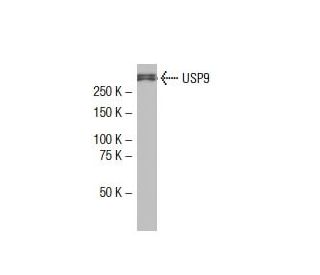


USP9 Antibody (5G-02): sc-100628
- USP9 Antibody (5G-02) is a mouse monoclonal IgG1 κ USP9 antibody, cited in 5 publications, provided at 100 µg/ml
- raised against recombinant USP9 of human origin
- recommended for detection of USP9 of human origin by WB, IP, IF and ELISA
- m-IgG Fc BP-HRP, m-IgG1 BP-HRP and m-IgGκ BP-HRP are the preferred secondary detection reagents for USP9 Antibody (5G-02) for WB applications. These reagents are now offered in bundles with USP9 Antibody (5G-02) (see ordering information below).

USP9 Antibody (5G-02) is a mouse monoclonal IgG1 kappa light chain antibody that detects USP9 protein of human origin by western blotting (WB), immunoprecipitation (IP), immunofluorescence (IF), and enzyme-linked immunosorbent assay (ELISA). Anti-USP9 antibody (5G-02) is available as a non-conjugated monoclonal isotype antibody. USP9 protein, also known as ubiquitin specific peptidase 9 or USP9X, plays a crucial role in the ubiquitin-proteasome pathway, which is essential for regulating various cellular processes, including signal transduction, transcriptional activation, and cell cycle progression. USP9 is located in the cytoplasm and nucleus, where USP9 is involved in the deubiquitination of target proteins, thus preventing their degradation and maintaining cellular homeostasis. USP9′s ability to interact with a variety of substrates, including those involved in cell cycle regulation and apoptosis, underscores USP9′s importance in cellular function and development. Notably, defects in USP9 have been linked to Turner syndrome, a genetic disorder that affects female development and is characterized by the failure of oocyte proliferation and ovarian degeneration. With a length of 2547 amino acids, USP9 is a member of the peptidase C19 family of ubiquitin proteases and is expressed in both fetal and adult tissues, highlighting USP9′s fundamental role in protein turnover and cellular regulation. Multiple isoforms of USP9 arise from alternative splicing, further emphasizing the complexity and regulatory potential of USP9 in various biological contexts.
Alexa Fluor® is a trademark of Molecular Probes Inc., OR., USA
LI-COR® and Odyssey® are registered trademarks of LI-COR Biosciences
USP9 Antibody (5G-02) References:
- Usp9y (ubiquitin-specific protease 9 gene on the Y) is associated with a functional promoter and encodes an intact open reading frame homologous to Usp9x that is under selective constraint. | Hall, NM., et al. 2003. Mamm Genome. 14: 437-47. PMID: 12925892
- Doublecortin interacts with the ubiquitin protease DFFRX, which associates with microtubules in neuronal processes. | Friocourt, G., et al. 2005. Mol Cell Neurosci. 28: 153-64. PMID: 15607950
- Spatially and temporally specific expression in mouse hippocampus of Usp9x, a ubiquitin-specific protease involved in synaptic development. | Xu, J., et al. 2005. J Neurosci Res. 80: 47-55. PMID: 15723417
- Age-related changes in Usp9x protein expression and DNA methylation in mouse brain. | Xu, J. 2005. Brain Res Mol Brain Res. 140: 17-24. PMID: 16023255
- 14-3-3 cooperates with LKB1 to regulate the activity and localization of QSK and SIK. | Al-Hakim, AK., et al. 2005. J Cell Sci. 118: 5661-73. PMID: 16306228
- The ubiquitin ligase itch is auto-ubiquitylated in vivo and in vitro but is protected from degradation by interacting with the deubiquitylating enzyme FAM/USP9X. | Mouchantaf, R., et al. 2006. J Biol Chem. 281: 38738-47. PMID: 17038327
- Control of AMPK-related kinases by USP9X and atypical Lys(29)/Lys(33)-linked polyubiquitin chains. | Al-Hakim, AK., et al. 2008. Biochem J. 411: 249-60. PMID: 18254724
- Characterisation of the coding sequence and fine mapping of the human DFFRY gene and comparative expression analysis and mapping to the Sxrb interval of the mouse Y chromosome of the Dffry gene. | Brown, GM., et al. 1998. Hum Mol Genet. 7: 97-107. PMID: 9384609
Ordering Information
| Product Name | Catalog # | UNIT | Price | Qty | FAVORITES | |
USP9 Antibody (5G-02) | sc-100628 | 100 µg/ml | $339.00 | |||
USP9 Antibody (5G-02): m-IgG Fc BP-HRP Bundle | sc-537280 | 100 µg Ab; 10 µg BP | $361.00 | |||
USP9 Antibody (5G-02): m-IgGκ BP-HRP Bundle | sc-534511 | 100 µg Ab; 40 µg BP | $361.00 | |||
USP9 Antibody (5G-02): m-IgG1 BP-HRP Bundle | sc-545123 | 100 µg Ab; 20 µg BP | $361.00 |