
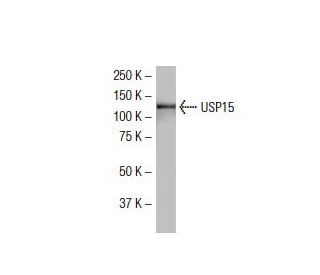
USP15 Antibody (2D5): sc-100629
- USP15 Antibody (2D5) is a mouse monoclonal IgG1 κ, cited in 12 publications, provided at 100 µg/ml
- raised against recombinant USP15 of human origin
- recommended for detection of USP15 of mouse, rat and human origin by WB, IP, IF and ELISA
- m-IgG Fc BP-HRP and m-IgG1 BP-HRP are the preferred secondary detection reagents for USP15 Antibody (2D5) for WB applications. These reagents are now offered in bundles with USP15 Antibody (2D5) (see ordering information below).

USP15 Antibody (2D5) is a mouse monoclonal IgG1 kappa light chain antibody that detects USP15 in mouse, rat, and human samples through applications such as western blotting (WB), immunoprecipitation (IP), immunofluorescence (IF), and enzyme-linked immunosorbent assay (ELISA). USP15 Antibody (2D5) is available in a non-conjugated form, allowing for versatile experimental use. USP15, also known as ubiquitin specific peptidase 15 or UNPH4, is a crucial member of the peptidase C19 family, playing a significant role in the ubiquitin-proteasome system, which is essential for regulating protein degradation and maintaining cellular homeostasis. USP15 is primarily located in the cytoplasm and nucleus, where USP15 performs its function as a deubiquitinating enzyme, cleaving ubiquitin residues from ubiquitinylated proteins and ubiquitin-fused precursors. By doing so, USP15 protects these proteins from proteasomal degradation, thereby influencing various cellular processes such as signal transduction, transcriptional activation, and cell cycle progression. USP15 is present in key tissues, including the kidney, liver, placenta, ovary, lung, thymus, heart, and skeletal muscle, underscoring USP15′s importance in diverse physiological functions. Additionally, USP15 contains one DUSP domain, which is integral to USP15′s interaction with the COP9 signalosome complex, further highlighting USP15′s regulatory capabilities within the cell. Notably, three isoforms of USP15 exist due to alternative splicing, adding another layer of complexity to USP15′s functional repertoire.
Alexa Fluor® is a trademark of Molecular Probes Inc., OR., USA
LI-COR® and Odyssey® are registered trademarks of LI-COR Biosciences
USP15 Antibody (2D5) References:
- Identification, functional characterization, and chromosomal localization of USP15, a novel human ubiquitin-specific protease related to the UNP oncoprotein, and a systematic nomenclature for human ubiquitin-specific proteases. | Baker, RT., et al. 1999. Genomics. 59: 264-74. PMID: 10444327
- Isolation and characterization of the mouse ubiquitin-specific protease Usp15. | Angelats, C., et al. 2003. Mamm Genome. 14: 31-46. PMID: 12532266
- The zinc finger of the CSN-associated deubiquitinating enzyme USP15 is essential to rescue the E3 ligase Rbx1. | Hetfeld, BK., et al. 2005. Curr Biol. 15: 1217-21. PMID: 16005295
- Solution structure of the human ubiquitin-specific protease 15 DUSP domain. | de Jong, RN., et al. 2006. J Biol Chem. 281: 5026-31. PMID: 16298993
- CSN controls NF-kappaB by deubiquitinylation of IkappaBalpha. | Schweitzer, K., et al. 2007. EMBO J. 26: 1532-41. PMID: 17318178
- Ubiquitin-dependent proteolysis of the microtubule end-binding protein 1, EB1, is controlled by the COP9 signalosome: possible consequences for microtubule filament stability. | Peth, A., et al. 2007. J Mol Biol. 368: 550-63. PMID: 17350042
- USP15 in Cancer and Other Diseases: From Diverse Functionsto Therapeutic Targets. | Li, YC., et al. 2022. Biomedicines. 10: PMID: 35203682
- USP15 negatively regulates lung cancer progression through the TRAF6-BECN1 signaling axis for autophagy induction. | Kim, MJ., et al. 2022. Cell Death Dis. 13: 348. PMID: 35422093
- Loss of the receptors ER, PR and HER2 promotes USP15-dependent stabilization of PARP1 in triple-negative breast cancer. | Sun, X., et al. 2023. Nat Cancer. 4: 716-733. PMID: 37012401
- TRIM21/USP15 balances ACSL4 stability and the imatinib resistance of gastrointestinal stromal tumors. | Cui, Z., et al. 2024. Br J Cancer. 130: 526-541. PMID: 38182686
- The deubiquitinase USP15 drives malignant progression of gastric cancer through glucose metabolism remodeling. | Huangfu, L., et al. 2024. J Exp Clin Cancer Res. 43: 235. PMID: 39164728
- Prediction of the coding sequences of unidentified human genes. IX. The complete sequences of 100 new cDNA clones from brain which can code for large proteins in vitro. | Nagase, T., et al. 1998. DNA Res. 5: 31-9. PMID: 9628581
Ordering Information
| Product Name | Catalog # | UNIT | Price | Qty | FAVORITES | |
USP15 Antibody (2D5) | sc-100629 | 100 µg/ml | $339.00 | |||
USP15 Antibody (2D5): m-IgG Fc BP-HRP Bundle | sc-539699 | 100 µg Ab; 10 µg BP | $361.00 | |||
USP15 Antibody (2D5): m-IgG1 BP-HRP Bundle | sc-541660 | 100 µg Ab; 20 µg BP | $361.00 |