
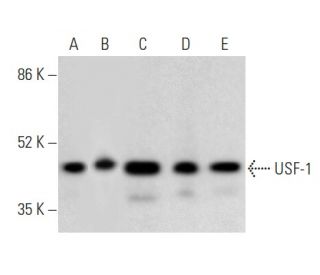
USF-1 Antibody (B-9): sc-390033
- USF-1 Antibody (B-9) is a mouse monoclonal IgG1 κ provided at 200 µg/ml
- raised against amino acids 75-160 of USF-1 of human origin
- recommended for detection of USF-1 of mouse, rat and human origin by WB, IP, IF and ELISA; also reactive with additional species, including and canine, bovine and porcine
- TransCruz reagent for ChIP application (sc-390033 X, 200 µg/0.1 ml)
- m-IgG Fc BP-HRP and m-IgG1 BP-HRP are the preferred secondary detection reagents for USF-1 Antibody (B-9) for WB applications. These reagents are now offered in bundles with USF-1 Antibody (B-9) (see ordering information below).

QUICK LINKS
USF-1 Antibody (B-9) is a mouse monoclonal IgG1 antibody that detects USF-1 in mouse, rat, and human samples through applications such as western blotting (WB), immunoprecipitation (IP), immunofluorescence (IF), and enzyme-linked immunosorbent assay (ELISA). USF-1, a member of the upstream stimulatory factor family, plays a crucial role in the regulation of gene expression by binding to specific DNA sequences, particularly the core sequence CACGTG found in the adenovirus late promoter. This binding is essential for the transcriptional activation of various genes, highlighting USF-1′s importance in cellular processes such as growth, differentiation, and response to environmental signals. USF-1′s ability to form homo- and heterodimers with USF-2 allows for a versatile regulatory mechanism, as different cell types exhibit varying ratios of these dimers, which can influence the transcriptional output. Additionally, USF-1 contains a helix-loop-helix domain and a leucine repeat that are critical for DNA binding efficiency, further underscoring USF-1′s significance in transcriptional regulation. Anti-USF-1 antibody (B-9) is an invaluable tool for researchers studying gene regulation and cellular signaling pathways.
Alexa Fluor® is a trademark of Molecular Probes Inc., OR., USA
LI-COR® and Odyssey® are registered trademarks of LI-COR Biosciences
USF-1 Antibody (B-9) References:
- DNA-binding activity of the transcription factor upstream stimulatory factor 1 (USF-1) is regulated by cyclin-dependent phosphorylation. | Cheung, E., et al. 1999. Biochem J. 344 Pt 1: 145-52. PMID: 10548544
- The Usf-1 transcription factor is a novel target for the stress-responsive p38 kinase and mediates UV-induced Tyrosinase expression. | Galibert, MD., et al. 2001. EMBO J. 20: 5022-31. PMID: 11532965
- Promoter I of the ovine acetyl-CoA carboxylase-alpha gene: an E-box motif at -114 in the proximal promoter binds upstream stimulatory factor (USF)-1 and USF-2 and acts as an insulin-response sequence in differentiating adipocytes. | Travers, MT., et al. 2001. Biochem J. 359: 273-84. PMID: 11583573
- HOXB7 expression is regulated by the transcription factors NF-Y, YY1, Sp1 and USF-1. | Meccia, E., et al. 2003. Biochim Biophys Acta. 1626: 1-9. PMID: 12697323
- UV-induced expression of key component of the tanning process, the POMC and MC1R genes, is dependent on the p-38-activated upstream stimulating factor-1 (USF-1). | Corre, S., et al. 2004. J Biol Chem. 279: 51226-33. PMID: 15358786
- Pea3 transcription factor cooperates with USF-1 in regulation of the murine bax transcription without binding to an Ets-binding site. | Firlej, V., et al. 2005. J Biol Chem. 280: 887-98. PMID: 15466854
- Upstream stimulatory factors (USF-1/USF-2) regulate human cGMP-dependent protein kinase I gene expression in vascular smooth muscle cells. | Sellak, H., et al. 2005. J Biol Chem. 280: 18425-33. PMID: 15741164
- Regulation of IL-10 expression by upstream stimulating factor (USF-1) in glioma-associated microglia. | Zhang, L., et al. 2007. J Neuroimmunol. 184: 188-97. PMID: 17289164
- In vivo and in vitro tools to identify and study transcriptional regulation of USF-1 target genes. | Galibert, MD. and Corre, S. 2010. Methods Mol Biol. 647: 339-55. PMID: 20694678
- Activation of the MHC class II transactivator CIITA by interferon-gamma requires cooperative interaction between Stat1 and USF-1. | Muhlethaler-Mottet, A., et al. 1998. Immunity. 8: 157-66. PMID: 9491997
Ordering Information
| Product Name | Catalog # | UNIT | Price | Qty | FAVORITES | |
USF-1 Antibody (B-9) | sc-390033 | 200 µg/ml | $322.00 | |||
USF-1 Antibody (B-9): m-IgG Fc BP-HRP Bundle | sc-540744 | 200 µg Ab; 10 µg BP | $361.00 | |||
USF-1 Antibody (B-9): m-IgG1 BP-HRP Bundle | sc-542342 | 200 µg Ab; 20 µg BP | $361.00 | |||
USF-1 Antibody (B-9) X | sc-390033 X | 200 µg/0.1 ml | $322.00 |