
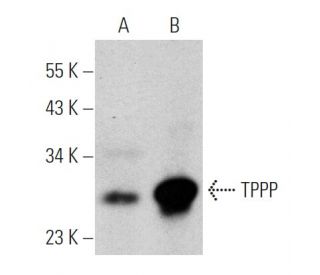
TPPP Antibody (A-6): sc-515819
- TPPP Antibody (A-6) is a mouse monoclonal IgG1 κ TPPP antibody, cited in 2 publications, provided at 200 µg/ml
- raised against amino acids 1-77 mapping at the N-terminus of TPPP of human origin
- TPPP Antibody (A-6) is recommended for detection of TPPP of mouse, rat and human origin by WB, IP, IF and ELISA
- Anti-TPPP Antibody (A-6) is available conjugated to agarose for IP; HRP for WB, IHC(P) and ELISA; and to either phycoerythrin or FITC for IF, IHC(P) and FCM
- also available conjugated to Alexa Fluor® 488, Alexa Fluor® 546, Alexa Fluor® 594 or Alexa Fluor® 647 for WB (RGB), IF, IHC(P) and FCM, and for use with RGB fluorescent imaging systems, such as iBright™ FL1000, FluorChem™, Typhoon, Azure and other comparable systems
- also available conjugated to Alexa Fluor® 680 or Alexa Fluor® 790 for WB (NIR), IF and FCM; for use with Near-Infrared (NIR) detection systems, such as LI-COR®Odyssey®, iBright™ FL1000, FluorChem™, Typhoon, Azure and other comparable systems
- m-IgG Fc BP-HRP and m-IgGκ BP-HRP are the preferred secondary detection reagents for TPPP Antibody (A-6) for WB applications. These reagents are now offered in bundles with TPPP Antibody (A-6) (see ordering information below).

QUICK LINKS
SEE ALSO...
TPPP Antibody (A-6) is a mouse monoclonal IgG1 kappa light chain antibody that detects TPPP protein of mouse, rat, and human origin by western blotting (WB), immunoprecipitation (IP), immunofluorescence (IF), and enzyme-linked immunosorbent assay (ELISA). Anti-TPPP antibody (A-6) is available in both non-conjugated and various conjugated forms, including agarose, horseradish peroxidase (HRP), phycoerythrin (PE), fluorescein isothiocyanate (FITC), and multiple Alexa Fluor® conjugates. TPPP protein, also known as tubulin polymerization-promoting protein, p24, or p25, is a 219 amino acid protein predominantly located in the perinuclear region of the cytoplasm, where TPPP plays a crucial role in the assembly of microtubules. Microtubules are essential structural components that facilitate vital cellular processes such as mitosis, cytokinesis, and vesicle transport. TPPP functions by promoting the polymerization of tubulin into various structures, including double-walled tubules and stabilized aggregates, which are critical for maintaining cellular integrity during division. Notably, overexpression of TPPP can disrupt the formation of the mitotic spindle and hinder the breakdown of the nuclear envelope, highlighting TPPP′s importance in cell cycle regulation. Additionally, TPPP is subject to phosphorylation by TPK II, a modification that can influence TPPP′s activity and interactions. The gene encoding TPPP is located on human chromosome 5, which encompasses 181 million base pairs and represents nearly 6% of the human genome, underscoring TPPP′s evolutionary significance and potential implications in various biological processes.
Alexa Fluor® is a trademark of Molecular Probes Inc., OR., USA
LI-COR® and Odyssey® are registered trademarks of LI-COR Biosciences
TPPP Antibody (A-6) References:
- P25alpha/Tubulin polymerization promoting protein expression by myelinating oligodendrocytes of the developing rat brain. | Skjoerringe, T., et al. 2006. J Neurochem. 99: 333-42. PMID: 16879710
- Tubulin polymerization promoting proteins (TPPPs): members of a new family with distinct structures and functions. | Vincze, O., et al. 2006. Biochemistry. 45: 13818-26. PMID: 17105200
- TPPP/p25 in brain tumours: expression in non-neoplastic oligodendrocytes but not in oligodendroglioma cells. | Preusser, M., et al. 2007. Acta Neuropathol. 113: 213-5. PMID: 17136548
- A new entry to polycyclic indole derivatives via intramolecular imino Diels-Alder reaction: observation of unexpected reaction. | Gaddam, V. and Nagarajan, R. 2007. J Org Chem. 72: 3573-6. PMID: 17408284
- A quantitative atlas of mitotic phosphorylation. | Dephoure, N., et al. 2008. Proc Natl Acad Sci U S A. 105: 10762-7. PMID: 18669648
- [Lipodystrophia diabetica]. | Libman, E., et al. 1981. Med Pregl. 34: 49-53. PMID: 7027006
Ordering Information
| Product Name | Catalog # | UNIT | Price | Qty | FAVORITES | |
TPPP Antibody (A-6) | sc-515819 | 200 µg/ml | $322.00 | |||
TPPP Antibody (A-6): m-IgG Fc BP-HRP Bundle | sc-531526 | 200 µg Ab; 10 µg BP | $361.00 | |||
TPPP Antibody (A-6): m-IgGκ BP-HRP Bundle | sc-525237 | 200 µg Ab, 40 µg BP | $361.00 | |||
TPPP Antibody (A-6) AC | sc-515819 AC | 500 µg/ml, 25% agarose | $424.00 | |||
TPPP Antibody (A-6) HRP | sc-515819 HRP | 200 µg/ml | $322.00 | |||
TPPP Antibody (A-6) FITC | sc-515819 FITC | 200 µg/ml | $336.00 | |||
TPPP Antibody (A-6) PE | sc-515819 PE | 200 µg/ml | $349.00 | |||
TPPP Antibody (A-6) Alexa Fluor® 488 | sc-515819 AF488 | 200 µg/ml | $364.00 | |||
TPPP Antibody (A-6) Alexa Fluor® 546 | sc-515819 AF546 | 200 µg/ml | $364.00 | |||
TPPP Antibody (A-6) Alexa Fluor® 594 | sc-515819 AF594 | 200 µg/ml | $364.00 | |||
TPPP Antibody (A-6) Alexa Fluor® 647 | sc-515819 AF647 | 200 µg/ml | $364.00 | |||
TPPP Antibody (A-6) Alexa Fluor® 680 | sc-515819 AF680 | 200 µg/ml | $364.00 | |||
TPPP Antibody (A-6) Alexa Fluor® 790 | sc-515819 AF790 | 200 µg/ml | $364.00 |