
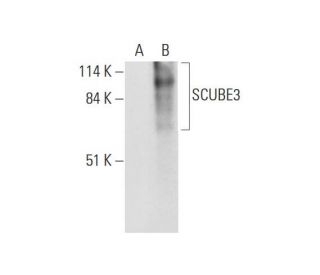

SCUBE3 Antibody (H-10): sc-514697
- SCUBE3 Antibody (H-10) is a mouse monoclonal IgG1 κ provided at 200 µg/ml
- raised against amino acids 398-489 mapping within an internal region of SCUBE3 of human origin
- recommended for detection of SCUBE3 of mouse, rat and human origin by WB, IP, IF and ELISA
- m-IgG Fc BP-HRP, m-IgG1 BP-HRP and m-IgGκ BP-HRP are the preferred secondary detection reagents for SCUBE3 Antibody (H-10) for WB applications. These reagents are now offered in bundles with SCUBE3 Antibody (H-10) (see ordering information below).

QUICK LINKS
SCUBE3 Antibody (H-10) is a mouse monoclonal IgG1 antibody that detects SCUBE3 in mouse, rat, and human samples through applications such as western blotting (WB), immunoprecipitation (IP), immunofluorescence (IF), and enzyme-linked immunosorbent assay (ELISA). SCUBE3, also known as CEGF3, is a novel secreted protein consisting of 993 amino acids that plays a crucial role in bone cell biology, particularly in osteoblast function and differentiation. Expression of SCUBE3 is predominantly observed in osteoblasts, with minimal presence in non-bone tissues, highlighting SCUBE3′s specificity and importance in skeletal development and maintenance. SCUBE3 is characterized by a unique structure, which includes one CUB domain and nine EGF-like domains, allowing participation in various cellular interactions and signaling pathways. Notably, SCUBE3 can form homo-oligomers and hetero-oligomers with SCUBE1, which may influence functional properties and interactions within the bone microenvironment. Additionally, SCUBE3 undergoes post-translational modifications, including C-terminal proteolytic cleavage and N-glycosylation, which can affect stability and activity. The gene encoding SCUBE3 is located on human chromosome 6p21.31, a region linked to Paget′s disease, underscoring potential implications in metabolic bone disorders. With specific reactivity and versatile applications, anti-SCUBE3 antibody (H-10) serves as an essential tool for researchers studying bone biology and related diseases.
Alexa Fluor® is a trademark of Molecular Probes Inc., OR., USA
LI-COR® and Odyssey® are registered trademarks of LI-COR Biosciences
SCUBE3 Antibody (H-10) References:
- SCUBE3 is an endogenous TGF-β receptor ligand and regulates the epithelial-mesenchymal transition in lung cancer. | Wu, YY., et al. 2011. Oncogene. 30: 3682-93. PMID: 21441952
- Scube3 is expressed in multiple tissues during development but is dispensable for embryonic survival in the mouse. | Xavier, GM., et al. 2013. PLoS One. 8: e55274. PMID: 23383134
- SCUBE3 overexpression predicts poor prognosis in non-small cell lung cancer. | Zhao, C., et al. 2013. Biosci Trends. 7: 264-9. PMID: 24390364
- SCUBE3 (signal peptide-CUB-EGF domain-containing protein 3) modulates fibroblast growth factor signaling during fast muscle development. | Tu, CF., et al. 2014. J Biol Chem. 289: 18928-42. PMID: 24849601
- The Expression of HSPD1, SCUBE3, CXCL14 and Its Relations with the Prognosis in Osteosarcoma. | Liang, W., et al. 2015. Cell Biochem Biophys. 73: 763-8. PMID: 27259322
- Activation of TGF-β1 Pathway by SCUBE3 Regulates TWIST1 Expression and Promotes Breast Cancer Progression. | Yang, X., et al. 2020. Cancer Biother Radiopharm. 35: 120-128. PMID: 31742430
- SCUBE3 Is Likely a Susceptibility Gene for Systemic Lupus Erythematosus for Chinese Populations. | Qi, YY., et al. 2020. J Immunol Res. 2020: 8897936. PMID: 33274247
- SCUBE3 serves as an independent poor prognostic factor in breast cancer. | Huo, Q., et al. 2021. Cancer Cell Int. 21: 268. PMID: 34006286
- DEPDC1B Promotes Melanoma Angiogenesis and Metastasis through Sequestration of Ubiquitin Ligase CDC16 to Stabilize Secreted SCUBE3. | Hu, F., et al. 2022. Adv Sci (Weinh). 9: e2105226. PMID: 35088579
- β-catenin/TCF4-induced SCUBE3 upregulation promotes ovarian cancer development via HIF-1 signaling pathway. | Shen, J., et al. 2024. Mol Cell Endocrinol. 582: 112127. PMID: 38109990
Ordering Information
| Product Name | Catalog # | UNIT | Price | Qty | FAVORITES | |
SCUBE3 Antibody (H-10) | sc-514697 | 200 µg/ml | $322.00 | |||
SCUBE3 Antibody (H-10): m-IgG Fc BP-HRP Bundle | sc-538685 | 200 µg Ab; 10 µg BP | $361.00 | |||
SCUBE3 Antibody (H-10): m-IgGκ BP-HRP Bundle | sc-536345 | 200 µg Ab; 40 µg BP | $361.00 | |||
SCUBE3 Antibody (H-10): m-IgG1 BP-HRP Bundle | sc-545830 | 200 µg Ab; 20 µg BP | $361.00 |