
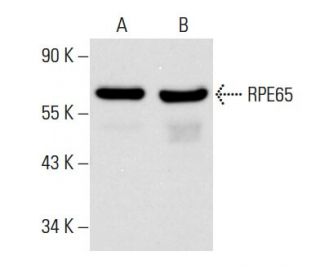

RPE65 Antibody (8B11): sc-53489
- RPE65 Antibody (8B11) is a mouse monoclonal IgG1 κ, cited in 5 publications, provided at 200 µg/ml
- raised against RPE microsomal membranes of bovine origin
- recommended for detection of RPE65 of mouse, rat, human and Xenopus origin by WB, IP and IF; also reactive with additional species, including bovine
- m-IgG Fc BP-HRP, m-IgG1 BP-HRP and m-IgGκ BP-HRP are the preferred secondary detection reagents for RPE65 Antibody (8B11) for WB applications. These reagents are now offered in bundles with RPE65 Antibody (8B11) (see ordering information below).

QUICK LINKS
SEE ALSO...
RPE65 Antibody (8B11) is a mouse monoclonal IgG1 antibody that detects RPE65 in mouse, rat, and human samples through applications such as western blotting (WB), immunoprecipitation (IP), and immunofluorescence (IF). RPE65 is a crucial 65 kDa protein that plays a vital role in the visual cycle, specifically in the production of 11-cis retinal, which is essential for the regeneration of visual pigments in photoreceptor cells. RPE65 is primarily located in the retinal pigment epithelium, where RPE65 is anchored to the membrane via a lipid modification known as palmitoylation, allowing RPE65 to interact effectively with other components of the visual cycle. The membrane-bound form of RPE65 is critical for its function, as RPE65 facilitates the conversion of all-trans-retinal to 11-cis retinal, a process that is indispensable for maintaining proper vision. Deficiencies or mutations in RPE65 can lead to severe retinal diseases, including autosomal dominant retinitis pigmentosa and Leber congenital amaurosis type 2, highlighting the importance of RPE65 in ocular health. Anti-RPE65 antibody (8B11) is an invaluable tool for researchers studying retinal biology and related disorders, providing insights into the mechanisms underlying visual impairment and potential therapeutic targets.
Alexa Fluor® is a trademark of Molecular Probes Inc., OR., USA
LI-COR® and Odyssey® are registered trademarks of LI-COR Biosciences
RPE65 Antibody (8B11) References:
- Successful RPE65 gene replacement and improved visual function in humans. | Koenekoop, RK. 2008. Ophthalmic Genet. 29: 89-91. PMID: 18766986
- Clinical gene therapy for the treatment of RPE65-associated Leber congenital amaurosis. | Stein, L., et al. 2011. Expert Opin Biol Ther. 11: 429-39. PMID: 21299439
- Efficacy and safety of voretigene neparvovec (AAV2-hRPE65v2) in patients with RPE65-mediated inherited retinal dystrophy: a randomised, controlled, open-label, phase 3 trial. | Russell, S., et al. 2017. Lancet. 390: 849-860. PMID: 28712537
- Clinical Perspective: Treating RPE65-Associated Retinal Dystrophy. | Maguire, AM., et al. 2021. Mol Ther. 29: 442-463. PMID: 33278565
- Durability of Voretigene Neparvovec for Biallelic RPE65-Mediated Inherited Retinal Disease: Phase 3 Results at 3 and 4 Years. | Maguire, AM., et al. 2021. Ophthalmology. 128: 1460-1468. PMID: 33798654
- Inherited Retinal Diseases Due to RPE65 Variants: From Genetic Diagnostic Management to Therapy. | Aoun, M., et al. 2021. Int J Mol Sci. 22: PMID: 34281261
- RPE65-related retinal dystrophy: Mutational and phenotypic spectrum in 45 affected patients. | Lopez-Rodriguez, R., et al. 2021. Exp Eye Res. 212: 108761. PMID: 34492281
- RPE65-Associated Retinal Dystrophies: Phenotypes and Treatment Effects with Voretigene Neparvovec. | Stingl, K., et al. 2024. Klin Monbl Augenheilkd. 241: 259-265. PMID: 38508214
- Voretigene neparvovec for inherited retinal dystrophy due to RPE65 mutations: a scoping review of eligibility and treatment challenges from clinical trials to real practice. | Testa, F., et al. 2024. Eye (Lond). 38: 2504-2515. PMID: 38627549
Ordering Information
| Product Name | Catalog # | UNIT | Price | Qty | FAVORITES | |
RPE65 Antibody (8B11) | sc-53489 | 200 µg/ml | $322.00 | |||
RPE65 Antibody (8B11): m-IgG Fc BP-HRP Bundle | sc-536972 | 200 µg Ab; 10 µg BP | $361.00 | |||
RPE65 Antibody (8B11): m-IgGκ BP-HRP Bundle | sc-534149 | 200 µg Ab; 40 µg BP | $361.00 | |||
RPE65 Antibody (8B11): m-IgG1 BP-HRP Bundle | sc-544932 | 200 µg Ab; 20 µg BP | $361.00 |