
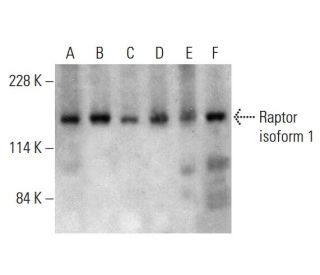


Raptor Antibody (10E10): sc-81537
- Raptor Antibody (10E10) is a mouse monoclonal IgG1 Raptor antibody, cited in 43 publications, provided at 50 µg/0.5 ml
- raised against a synthetic peptide corresponding to partial Raptor of human origin
- recommended for detection of Raptor of mouse, rat and human origin by WB and IP; also reactive with additional species, including canine
- m-IgG Fc BP-HRP, m-IgG1 BP-HRP and m-IgGκ BP-HRP are the preferred secondary detection reagents for Raptor Antibody (10E10) for WB applications. These reagents are now offered in bundles with Raptor Antibody (10E10) (see ordering information below).

QUICK LINKS
SEE ALSO...
Raptor Antibody (10E10) is a mouse monoclonal IgG1 kappa light chain antibody that detects Raptor protein of mouse, rat, and human origin by western blotting (WB) and immunoprecipitation (IP). Anti-Raptor antibody (10E10) is available as a non-conjugated format. Raptor protein, also known as regulatory associated protein of FRAP, plays a pivotal role in the mammalian target of rapamycin (mTOR) signaling pathway, which is crucial for regulating cell growth, proliferation, and survival in response to nutrient availability. Specifically, Raptor acts as a scaffold that facilitates interaction between mTOR and substrates, including 4E-BP1, thereby promoting phosphorylation and activation. This interaction is vital for cellular response to nutrient levels, as Raptor-mTOR complex is sensitive to changes in nutrient status, allowing cells to adapt growth and metabolism accordingly. Under nutrient-rich conditions, Raptor enhances mTOR activity, while in nutrient-deprived states, Raptor serves as a negative regulator, inhibiting mTOR signaling to conserve resources. Raptor is predominantly expressed in skeletal muscle, with lower levels found in brain, kidney, lung, and placenta, highlighting importance in tissues with high metabolic demands.
Alexa Fluor® is a trademark of Molecular Probes Inc., OR., USA
LI-COR® and Odyssey® are registered trademarks of LI-COR Biosciences
Raptor Antibody (10E10) References:
- mTOR interacts with raptor to form a nutrient-sensitive complex that signals to the cell growth machinery. | Kim, DH., et al. 2002. Cell. 110: 163-75. PMID: 12150925
- Raptor, a binding partner of target of rapamycin (TOR), mediates TOR action. | Hara, K., et al. 2002. Cell. 110: 177-89. PMID: 12150926
- The mammalian target of rapamycin (mTOR) partner, raptor, binds the mTOR substrates p70 S6 kinase and 4E-BP1 through their TOR signaling (TOS) motif. | Nojima, H., et al. 2003. J Biol Chem. 278: 15461-4. PMID: 12604610
- Raptor and mTOR: subunits of a nutrient-sensitive complex. | Kim, DH. and Sabatini, DM. 2004. Curr Top Microbiol Immunol. 279: 259-70. PMID: 14560962
- Raptor, a binding partner of target of rapamycin. | Yonezawa, K., et al. 2004. Biochem Biophys Res Commun. 313: 437-41. PMID: 14684181
- Dissociation of raptor from mTOR is a mechanism of rapamycin-induced inhibition of mTOR function. | Oshiro, N., et al. 2004. Genes Cells. 9: 359-66. PMID: 15066126
- Structure of S6 kinase 1 determines whether raptor-mTOR or rictor-mTOR phosphorylates its hydrophobic motif site. | Ali, SM. and Sabatini, DM. 2005. J Biol Chem. 280: 19445-8. PMID: 15809305
- Redox regulation of the nutrient-sensitive raptor-mTOR pathway and complex. | Sarbassov, DD. and Sabatini, DM. 2005. J Biol Chem. 280: 39505-9. PMID: 16183647
- AMPK phosphorylation of raptor mediates a metabolic checkpoint. | Gwinn, DM., et al. 2008. Mol Cell. 30: 214-26. PMID: 18439900
- The role of Raptor in lymphocytes differentiation and function. | Tang, J., et al. 2023. Front Immunol. 14: 1146628. PMID: 37283744
- Cathepsin K inhibition induces Raptor destabilization and mitochondrial dysfunction via Syk/SHP2/Src/OTUB1 axis-mediated signaling. | Seo, SU., et al. 2023. Cell Death Dis. 14: 366. PMID: 37330581
- O-GlcNAcylation of Raptor transduces glucose signals to mTORC1. | Xu, C., et al. 2023. Mol Cell. 83: 3027-3040.e11. PMID: 37541260
Ordering Information
| Product Name | Catalog # | UNIT | Price | Qty | FAVORITES | |
Raptor Antibody (10E10) | sc-81537 | 50 µg/0.5 ml | $322.00 | |||
Raptor Antibody (10E10): m-IgG Fc BP-HRP Bundle | sc-537248 | 50 µg Ab; 10 µg BP | $361.00 | |||
Raptor Antibody (10E10): m-IgGκ BP-HRP Bundle | sc-534473 | 50 µg Ab; 40 µg BP | $361.00 | |||
Raptor Antibody (10E10): m-IgG1 BP-HRP Bundle | sc-545104 | 50 µg Ab; 20 µg BP | $361.00 |