
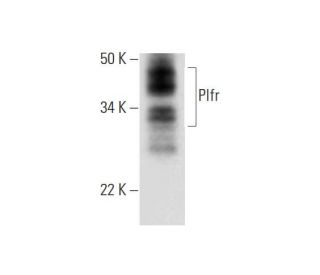

Plfr Antibody (F-8): sc-393277
- Plfr Antibody (F-8) is a mouse monoclonal IgG1 κ Plfr antibody provided at 200 µg/ml
- raised against amino acids 124-244 mapping at the C-terminus of Plfr of mouse origin
- Plfr Antibody (F-8) is recommended for detection of Plfr of mouse origin by WB, IP, IF and ELISA
- Anti-Plfr Antibody (F-8) is available conjugated to agarose for IP; HRP for WB, IHC(P) and ELISA; and to either phycoerythrin or FITC for IF, IHC(P) and FCM
- also available conjugated to Alexa Fluor® 488, Alexa Fluor® 546, Alexa Fluor® 594 or Alexa Fluor® 647 for WB (RGB), IF, IHC(P) and FCM, and for use with RGB fluorescent imaging systems, such as iBright™ FL1000, FluorChem™, Typhoon, Azure and other comparable systems
- also available conjugated to Alexa Fluor® 680 or Alexa Fluor® 790 for WB (NIR), IF and FCM; for use with Near-Infrared (NIR) detection systems, such as LI-COR®Odyssey®, iBright™ FL1000, FluorChem™, Typhoon, Azure and other comparable systems
- m-IgG Fc BP-HRP, m-IgG1 BP-HRP and m-IgGκ BP-HRP are the preferred secondary detection reagents for Plfr Antibody (F-8) for WB applications. These reagents are now offered in bundles with Plfr Antibody (F-8) (see ordering information below).

QUICK LINKS
SEE ALSO...
Plfr Antibody (F-8) is a mouse monoclonal IgG1 kappa light chain antibody that detects Plfr protein of mouse origin by western blotting (WB), immunoprecipitation (IP), immunofluorescence (IF), and enzyme-linked immunosorbent assay (ELISA). Plfr (F-8) antibody is available in both non-conjugated and various conjugated forms, including agarose, horseradish peroxidase (HRP), phycoerythrin (PE), fluorescein isothiocyanate (FITC), and multiple Alexa Fluor® conjugates. Plfr protein, also known as Proliferin-related protein, PRP, or Prolactin-7D1, is a glycoprotein that plays a crucial role in placental development and function. Plfr belongs to the somatotropin/prolactin family of growth hormones and is secreted by murine giant cells and spongiotrophoblasts during mid to late gestation, peaking around day 12. Notably, Plfr is recognized for antiangiogenic properties, which are essential for regulating placental blood vessel formation. While Proliferin promotes neovascularization, Plfr serves to limit endothelial invasiveness, thereby controlling the cessation of placental neovascularization. This function is vital for maintaining a proper balance in placental development and ensuring that maternal and fetal blood vessels don′t interfere with each other. Although a human counterpart of Plfr has not been fully characterized, studies indicate that mouse Plfr can exert antiangiogenic effects on human endothelial cells, suggesting a conserved signaling pathway between species.
Alexa Fluor® is a trademark of Molecular Probes Inc., OR., USA
LI-COR® and Odyssey® are registered trademarks of LI-COR Biosciences
Plfr Antibody (F-8) References:
- The placenta and the prolactin family of hormones: regulation of the physiology of pregnancy. | Linzer, DI. and Fisher, SJ. 1999. Mol Endocrinol. 13: 837-40. PMID: 10379883
- Identification of two new nonclassical members of the rat prolactin family. | Sahgal, N., et al. 2000. J Mol Endocrinol. 24: 95-108. PMID: 10657001
- Identification of three prolactin-related hormones as markers of invasive trophoblasts in the rat. | Toft, DJ. and Linzer, DI. 2000. Biol Reprod. 63: 519-25. PMID: 10906059
- Inhibition of tumor growth by the antiangiogenic placental hormone, proliferin-related protein. | Bengtson, NW. and Linzer, DI. 2000. Mol Endocrinol. 14: 1934-43. PMID: 11117524
- Adenovirus-mediated delivery of antiangiogenic genes as an antitumor approach. | Régulier, E., et al. 2001. Cancer Gene Ther. 8: 45-54. PMID: 11219493
- Differential expression of angiogenic and vasodilatory factors by invasive trophoblast giant cells depending on depth of invasion. | Hemberger, M., et al. 2003. Dev Dyn. 227: 185-91. PMID: 12761846
- A new member of the prolactin-growth hormone gene family expressed in mouse placenta. | Linzer, DI. and Nathans, D. 1985. EMBO J. 4: 1419-23. PMID: 4029117
- Stimulation and inhibition of angiogenesis by placental proliferin and proliferin-related protein. | Jackson, D., et al. 1994. Science. 266: 1581-4. PMID: 7527157
- Cyclic adenosine 3',5'-monophosphate stimulation of placental proliferin and proliferin-related protein secretion. | Yamaguchi, M., et al. 1995. Endocrinology. 136: 2040-6. PMID: 7720652
Ordering Information
| Product Name | Catalog # | UNIT | Price | Qty | FAVORITES | |
Plfr Antibody (F-8) | sc-393277 | 200 µg/ml | $322.00 | |||
Plfr Antibody (F-8): m-IgG Fc BP-HRP Bundle | sc-530416 | 200 µg Ab; 10 µg BP | $361.00 | |||
Plfr Antibody (F-8): m-IgGκ BP-HRP Bundle | sc-523885 | 200 µg Ab, 40 µg BP | $361.00 | |||
Plfr Antibody (F-8): m-IgG1 BP-HRP Bundle | sc-544042 | 200 µg Ab; 20 µg BP | $361.00 | |||
Plfr Antibody (F-8) AC | sc-393277 AC | 500 µg/ml, 25% agarose | $424.00 | |||
Plfr Antibody (F-8) HRP | sc-393277 HRP | 200 µg/ml | $322.00 | |||
Plfr Antibody (F-8) FITC | sc-393277 FITC | 200 µg/ml | $336.00 | |||
Plfr Antibody (F-8) PE | sc-393277 PE | 200 µg/ml | $349.00 | |||
Plfr Antibody (F-8) Alexa Fluor® 488 | sc-393277 AF488 | 200 µg/ml | $364.00 | |||
Plfr Antibody (F-8) Alexa Fluor® 546 | sc-393277 AF546 | 200 µg/ml | $364.00 | |||
Plfr Antibody (F-8) Alexa Fluor® 594 | sc-393277 AF594 | 200 µg/ml | $364.00 | |||
Plfr Antibody (F-8) Alexa Fluor® 647 | sc-393277 AF647 | 200 µg/ml | $364.00 | |||
Plfr Antibody (F-8) Alexa Fluor® 680 | sc-393277 AF680 | 200 µg/ml | $364.00 | |||
Plfr Antibody (F-8) Alexa Fluor® 790 | sc-393277 AF790 | 200 µg/ml | $364.00 |