
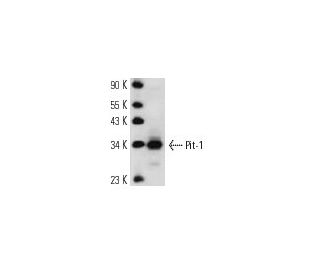
Pit-1 Antibody (5E4): sc-47762
- Pit-1 Antibody (5E4) is a mouse monoclonal IgG2a κ, cited in 1 publications, provided at 200 µg/ml
- raised against amino acids 30-146 of Pit-1 of rat origin
- recommended for detection of Pit-1 of mouse, rat, human, bovine and porcine origin by WB, IP and IF
- m-IgG Fc BP-HRP, m-IgG2a BP-HRP and m-IgGκ BP-HRP are the preferred secondary detection reagents for Pit-1 Antibody (5E4) for WB applications. These reagents are now offered in bundles with Pit-1 Antibody (5E4) (see ordering information below).

QUICK LINKS
SEE ALSO...
Pit-1 Antibody (5E4) is a mouse monoclonal IgG2a antibody that detects Pit-1 in mouse, rat, human, bovine, and porcine samples through applications such as western blotting (WB), immunoprecipitation (IP), and immunofluorescence (IF). Pit-1, also known as growth hormone factor-1 (GHF-1), is a pivotal transcriptional regulator that plays a crucial role in the development of the anterior pituitary gland, where Pit-1 is essential for the differentiation and function of somatotropes, lactotropes, and thyrotropes. Pit-1 (5E4) antibody recognizes a bipartite DNA binding domain, which allows specific DNA sequence interactions to regulate gene expression. Notably, Pit-1 is expressed in two alternatively spliced forms, Pit-1a and Pit-1b, which exhibit distinct trans-activation capabilities, thereby influencing the production of key hormones such as growth hormone and prolactin. Mutations in the Pit-1 gene can lead to combined pituitary hormone deficiency (CPHD), affecting growth hormone, prolactin, and thyroid-stimulating hormone levels, which underscores its critical function in endocrine health. The gene encoding Pit-1 is located on human chromosome 3p11, highlighting its genetic significance in developmental biology and endocrinology. Anti-Pit-1 antibody (5E4) is an invaluable tool for researchers studying pituitary function and related disorders.
Alexa Fluor® is a trademark of Molecular Probes Inc., OR., USA
LI-COR® and Odyssey® are registered trademarks of LI-COR Biosciences
Pit-1 Antibody (5E4) References:
- Structures of cDNAs encoding chum salmon pituitary-specific transcription factor, Pit-1/GHF-1. | Ono, M. and Takayama, Y. 1992. Gene. 116: 275-9. PMID: 1634120
- Vitamin D, Pit-1, GH, and PRL: possible roles in breast cancer development. | Perez-Fernandez, R., et al. 2007. Curr Med Chem. 14: 3051-8. PMID: 18220741
- The pituitary-specific transcription factor GHF-1 is a homeobox-containing protein. | Bodner, M., et al. 1988. Cell. 55: 505-18. PMID: 2902927
- Spironolactone dose‑dependently alleviates the calcification of aortic rings cultured in hyperphosphatemic medium with or without hyperglycemia by suppressing phenotypic transition of VSMCs through downregulation of Pit‑1. | Wang, P., et al. 2019. Mol Med Rep. 19: 3622-3632. PMID: 30896801
- Pit-1 binding to specific DNA sites as a monomer or dimer determines gene-specific use of a tyrosine-dependent synergy domain. | Holloway, JM., et al. 1995. Genes Dev. 9: 1992-2006. PMID: 7649480
- A novel pituitary transcription factor is produced by alternative splicing of the human GHF-1/PIT-1 gene. | Delhase, M., et al. 1995. Gene. 155: 273-5. PMID: 7721104
- Functional interaction of c-Ets-1 and GHF-1/Pit-1 mediates Ras activation of pituitary-specific gene expression: mapping of the essential c-Ets-1 domain. | Bradford, AP., et al. 1995. Mol Cell Biol. 15: 2849-57. PMID: 7739565
- The combination of Pit-1 and Pit-1T have a synergistic stimulatory effect on the thyrotropin beta-subunit promoter but not the growth hormone or prolactin promoters. | Haugen, BR., et al. 1994. Mol Endocrinol. 8: 1574-82. PMID: 7877626
- Ligand-dependent, Pit-1/growth hormone factor-1 (GHF-1)-independent transcriptional stimulation of rat growth hormone gene expression by thyroid hormone receptors in vitro. | Suen, CS. and Chin, WW. 1993. Mol Cell Biol. 13: 1719-27. PMID: 8441408
- Molecular cloning of gilthead seabream (Sparus aurata) pituitary transcription factor GHF-1/Pit-1. | Martínez-Barberá, JP., et al. 1997. Gene. 185: 87-93. PMID: 9034317
Ordering Information
| Product Name | Catalog # | UNIT | Price | Qty | FAVORITES | |
Pit-1 Antibody (5E4) | sc-47762 | 200 µg/ml | $322.00 | |||
Pit-1 Antibody (5E4): m-IgG Fc BP-HRP Bundle | sc-536811 | 200 µg Ab; 10 µg BP | $361.00 | |||
Pit-1 Antibody (5E4): m-IgGκ BP-HRP Bundle | sc-533976 | 200 µg Ab; 40 µg BP | $361.00 | |||
Pit-1 Antibody (5E4): m-IgG2a BP-HRP Bundle | sc-547875 | 200 µg Ab; 10 µg BP | $361.00 |