
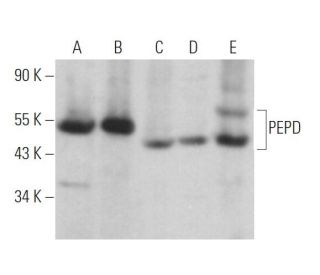
PEPD Antibody (A-3): sc-390042
- PEPD Antibody (A-3) is a mouse monoclonal IgG1 κ PEPD antibody, cited in 3 publications, provided at 200 µg/ml
- raised against amino acids 101-305 mapping within an internal region of PEPD of human origin
- PEPD Antibody (A-3) is recommended for detection of PEPD of mouse, rat and human origin by WB, IP, IF, IHC(P) and ELISA
- Anti-PEPD Antibody (A-3) is available conjugated to agarose for IP; HRP for WB, IHC(P) and ELISA; and to either phycoerythrin or FITC for IF, IHC(P) and FCM
- also available conjugated to Alexa Fluor® 488, Alexa Fluor® 546, Alexa Fluor® 594 or Alexa Fluor® 647 for WB (RGB), IF, IHC(P) and FCM, and for use with RGB fluorescent imaging systems, such as iBright™ FL1000, FluorChem™, Typhoon, Azure and other comparable systems
- also available conjugated to Alexa Fluor® 680 or Alexa Fluor® 790 for WB (NIR), IF and FCM; for use with Near-Infrared (NIR) detection systems, such as LI-COR®Odyssey®, iBright™ FL1000, FluorChem™, Typhoon, Azure and other comparable systems
- m-IgG Fc BP-HRP, m-IgG1 BP-HRP and m-IgGκ BP-HRP are the preferred secondary detection reagents for PEPD Antibody (A-3) for WB and IHC(P) applications. These reagents are now offered in bundles with PEPD Antibody (A-3) (see ordering information below).

QUICK LINKS
SEE ALSO...
PEPD Antibody (A-3) is a mouse monoclonal IgG1 kappa light chain antibody that detects PEPD protein of mouse, rat, and human origin by western blotting (WB), immunoprecipitation (IP), immunofluorescence (IF), immunohistochemistry with paraffin-embedded sections (IHCP), and enzyme-linked immunosorbent assay (ELISA). PEPD Antibody (A-3) is available in both non-conjugated and various conjugated forms, including agarose, horseradish peroxidase (HRP), phycoerythrin (PE), fluorescein isothiocyanate (FITC), and multiple Alexa Fluor® conjugates. PEPD, also known as prolidase, is a cytosolic dipeptidase that belongs to the peptidase M24B family and plays a crucial role in collagen metabolism and proline recycling, which is vital for protein synthesis and cellular function. This enzyme hydrolyzes di- and tripeptides containing proline or hydroxyproline at the C-terminus, functioning as a homodimer. Deficiencies in PEPD lead to prolidase deficiency, an autosomal recessive disorder characterized by iminodipeptiduria, skin ulcers, mental retardation, recurrent infections, and distinctive facial features. Mutations in PEPD have been implicated in systemic lupus erythematosus and necrosis-like cell death in fibroblasts, highlighting PEPD′s significance in various pathological conditions. Research suggests a strong association between prolidase polymorphisms and myotonic dystrophy trait, underscoring PEPD′s importance in both health and disease.
Alexa Fluor® is a trademark of Molecular Probes Inc., OR., USA
LI-COR® and Odyssey® are registered trademarks of LI-COR Biosciences
PEPD Antibody (A-3) References:
- A novel nonsense mutation of the PEPD gene in a Japanese patient with prolidase deficiency. | Kikuchi, S., et al. 2000. J Hum Genet. 45: 102-4. PMID: 10721675
- Mutation analysis of five new patients affected by prolidase deficiency: the lack of enzyme activity causes necrosis-like cell death in cultured fibroblasts. | Forlino, A., et al. 2002. Hum Genet. 111: 314-22. PMID: 12384772
- The promoter region of the Escherichia coli pepD gene: deletion analysis and control by phosphate concentration. | Henrich, B., et al. 1992. Mol Gen Genet. 232: 117-25. PMID: 1313142
- A nonsense mutation of PEPD in four Amish children with prolidase deficiency. | Wang, H., et al. 2006. Am J Med Genet A. 140: 580-5. PMID: 16470701
- Molecular basis of prolidase (peptidase D) deficiency. | Endo, F. and Matsuda, I. 1991. Mol Biol Med. 8: 117-27. PMID: 1943683
- Structural organization of the gene for human prolidase (peptidase D) and demonstration of a partial gene deletion in a patient with prolidase deficiency. | Tanoue, A., et al. 1990. J Biol Chem. 265: 11306-11. PMID: 1972707
- Prolidase deficiency: biochemical classification of alleles. | Boright, AP., et al. 1989. Am J Hum Genet. 44: 731-40. PMID: 2705457
- Prolidase deficiency in two siblings with chronic leg ulcerations. Clinical, biochemical, and morphologic aspects. | Leoni, A., et al. 1987. Arch Dermatol. 123: 493-9. PMID: 3827281
- Four novel PEPD alleles causing prolidase deficiency. | Ledoux, P., et al. 1994. Am J Hum Genet. 54: 1014-21. PMID: 8198124
Ordering Information
| Product Name | Catalog # | UNIT | Price | Qty | FAVORITES | |
PEPD Antibody (A-3) | sc-390042 | 200 µg/ml | $322.00 | |||
PEPD Antibody (A-3): m-IgG Fc BP-HRP Bundle | sc-530050 | 200 µg Ab; 10 µg BP | $361.00 | |||
PEPD Antibody (A-3): m-IgGκ BP-HRP Bundle | sc-523381 | 200 µg Ab, 40 µg BP | $361.00 | |||
PEPD Antibody (A-3): m-IgG1 BP-HRP Bundle | sc-543840 | 200 µg Ab; 20 µg BP | $361.00 | |||
PEPD Antibody (A-3) AC | sc-390042 AC | 500 µg/ml, 25% agarose | $424.00 | |||
PEPD Antibody (A-3) HRP | sc-390042 HRP | 200 µg/ml | $322.00 | |||
PEPD Antibody (A-3) FITC | sc-390042 FITC | 200 µg/ml | $336.00 | |||
PEPD Antibody (A-3) PE | sc-390042 PE | 200 µg/ml | $349.00 | |||
PEPD Antibody (A-3) Alexa Fluor® 488 | sc-390042 AF488 | 200 µg/ml | $364.00 | |||
PEPD Antibody (A-3) Alexa Fluor® 546 | sc-390042 AF546 | 200 µg/ml | $364.00 | |||
PEPD Antibody (A-3) Alexa Fluor® 594 | sc-390042 AF594 | 200 µg/ml | $364.00 | |||
PEPD Antibody (A-3) Alexa Fluor® 647 | sc-390042 AF647 | 200 µg/ml | $364.00 | |||
PEPD Antibody (A-3) Alexa Fluor® 680 | sc-390042 AF680 | 200 µg/ml | $364.00 | |||
PEPD Antibody (A-3) Alexa Fluor® 790 | sc-390042 AF790 | 200 µg/ml | $364.00 |