
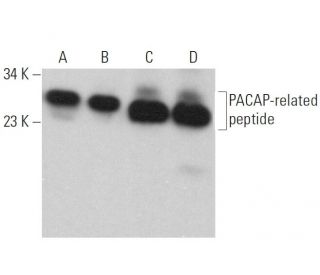
PACAP-related peptide Antibody (D-4): sc-365356
- PACAP-related peptide Antibody (D-4) is a mouse monoclonal IgG2b κ PACAP-related peptide antibody provided at 200 µg/ml
- specific for an epitope mapping between amino acids 75-103 within an internal region of PACAP-related peptide of human origin
- PACAP-related peptide Antibody (D-4) is recommended for detection of precursor and processed active PACAP related peptide of mouse, rat and human origin by WB, IP, IF, IHC(P) and ELISA
- Anti-PACAP-related peptide Antibody (D-4) is available conjugated to agarose for IP; HRP for WB, IHC(P) and ELISA; and to either phycoerythrin or FITC for IF, IHC(P) and FCM
- also available conjugated to Alexa Fluor® 488, Alexa Fluor® 546, Alexa Fluor® 594 or Alexa Fluor® 647 for WB (RGB), IF, IHC(P) and FCM, and for use with RGB fluorescent imaging systems, such as iBright™ FL1000, FluorChem™, Typhoon, Azure and other comparable systems
- also available conjugated to Alexa Fluor® 680 or Alexa Fluor® 790 for WB (NIR), IF and FCM; for use with Near-Infrared (NIR) detection systems, such as LI-COR®Odyssey®, iBright™ FL1000, FluorChem™, Typhoon, Azure and other comparable systems
- m-IgG2b BP-HRP and m-IgGκ BP-HRP are the preferred secondary detection reagents for PACAP-related peptide Antibody (D-4) for WB and IHC(P) applications. These reagents are now offered in bundles with PACAP-related peptide Antibody (D-4) (see ordering information below).

QUICK LINKS
PACAP-related peptide Antibody (D-4) is a mouse monoclonal IgG2b kappa light chain antibody that detects PACAP-related peptide of mouse, rat, and human origin by western blotting (WB), immunoprecipitation (IP), immunofluorescence (IF), immunohistochemistry, and enzyme-linked immunosorbent assay (ELISA). PACAP-related peptide (D-4) antibody is available in both non-conjugated and various conjugated forms, including agarose, horseradish peroxidase (HRP), phycoerythrin (PE), fluorescein isothiocyanate (FITC), and multiple Alexa Fluor® conjugates. PACAP-related peptide, also known as adenylate cyclase activating polypeptide 1, plays a crucial role in the neuroendocrine stress response and is part of a superfamily of peptide hormones that includes vasoactive intestinal peptide. PACAP-related peptide is primarily located in the central nervous system and peripheral tissues, where PACAP-related peptide is involved in various physiological processes, including neuronal differentiation modulation and immune response regulation. PACAP-related peptide localization in the brain is particularly significant, as PACAP-related peptide is implicated in neuroprotection, neurogenesis, and synaptic plasticity modulation, which are essential for learning and memory. PACAP-related peptide interacts with three G-protein coupled receptors—VPAC1, VPAC2, and PACAP receptor (PAC1-R)—which mediate diverse biological effects. PAC1-R, a seven transmembrane protein, produces multiple isoforms through alternative splicing, each associated with distinct signaling pathways and expression patterns, further underscoring PACAP-related peptide complexity and importance in both normal physiology and pathological conditions.
Alexa Fluor® is a trademark of Molecular Probes Inc., OR., USA
LI-COR® and Odyssey® are registered trademarks of LI-COR Biosciences
PACAP-related peptide Antibody (D-4) References:
- Pituitary adenylate cyclase-activating polypeptide and its receptors: from structure to functions. | Vaudry, D., et al. 2000. Pharmacol Rev. 52: 269-324. PMID: 10835102
- Overexpression of the human VPAC2 receptor in the suprachiasmatic nucleus alters the circadian phenotype of mice. | Shen, S., et al. 2000. Proc Natl Acad Sci U S A. 97: 11575-80. PMID: 11027354
- Expression of vasoactive intestinal peptide (VIP) receptors in human uterus. | Bajo, AM., et al. 2000. Peptides. 21: 1383-8. PMID: 11072126
- Vasoactive intestinal peptide: cardiovascular effects. | Henning, RJ. and Sawmiller, DR. 2001. Cardiovasc Res. 49: 27-37. PMID: 11121793
- Selective gene expression and activation-dependent regulation of vasoactive intestinal peptide receptor type 1 and type 2 in human T cells. | Lara-Marquez, M., et al. 2001. J Immunol. 166: 2522-30. PMID: 11160313
- Regulation of vasoactive intestinal peptide receptor expression in developing nervous systems. | Karacay, B., et al. 2000. Ann N Y Acad Sci. 921: 165-74. PMID: 11193820
- Pituitary adenylate cyclase-activating polypeptide (PACAP) and its receptors in the brain. | Shioda, S. 2000. Kaibogaku Zasshi. 75: 487-507. PMID: 11197592
- Expression of pituitary adenylate cyclase-activating polypeptide 1 and 2 receptor mRNA in gallbladder tissue of patients with gallstone or gallbladder polyps. | Zhang, ZH., et al. 2006. World J Gastroenterol. 12: 1468-71. PMID: 16552823
- The role of ADCYAP1, adenylate cyclase activating polypeptide 1, as a methylation biomarker for the early detection of cervical cancer. | Jung, S., et al. 2011. Oncol Rep. 25: 245-52. PMID: 21109983
- Interaction between kisspeptin and adenylate cyclase-activating polypeptide 1 on the expression of pituitary gonadotropin subunits: a study using mouse pituitary lbetaT2 cells. | Mijiddorj, T., et al. 2017. Biol Reprod. 96: 1043-1051. PMID: 28863434
- Adenylate cyclase-activating polypeptide 1 gene methylation predicts prognosis and the immune microenvironment of bladder cancer. | Xu, W., et al. 2021. Clin Transl Med. 11: e597. PMID: 34709747
- Pituitary adenylate cyclase activating peptide-38 (PACAP-38), PACAP-27, and PACAP related peptide (PRP) in the rat median eminence and pituitary. | Mikkelsen, JD., et al. 1995. J Neuroendocrinol. 7: 47-55. PMID: 7735297
Ordering Information
| Product Name | Catalog # | UNIT | Price | Qty | FAVORITES | |
PACAP-related peptide Antibody (D-4) | sc-365356 | 200 µg/ml | $322.00 | |||
PACAP-related peptide Antibody (D-4): m-IgGκ BP-HRP Bundle | sc-522219 | 200 µg Ab, 40 µg BP | $361.00 | |||
PACAP-related peptide Antibody (D-4): m-IgG2b BP-HRP Bundle | sc-549014 | 200 µg Ab; 10 µg BP | $361.00 | |||
PACAP-related peptide Antibody (D-4) AC | sc-365356 AC | 500 µg/ml, 25% agarose | $424.00 | |||
PACAP-related peptide Antibody (D-4) HRP | sc-365356 HRP | 200 µg/ml | $322.00 | |||
PACAP-related peptide Antibody (D-4) FITC | sc-365356 FITC | 200 µg/ml | $336.00 | |||
PACAP-related peptide Antibody (D-4) PE | sc-365356 PE | 200 µg/ml | $349.00 | |||
PACAP-related peptide Antibody (D-4) Alexa Fluor® 488 | sc-365356 AF488 | 200 µg/ml | $364.00 | |||
PACAP-related peptide Antibody (D-4) Alexa Fluor® 546 | sc-365356 AF546 | 200 µg/ml | $364.00 | |||
PACAP-related peptide Antibody (D-4) Alexa Fluor® 594 | sc-365356 AF594 | 200 µg/ml | $364.00 | |||
PACAP-related peptide Antibody (D-4) Alexa Fluor® 647 | sc-365356 AF647 | 200 µg/ml | $364.00 | |||
PACAP-related peptide Antibody (D-4) Alexa Fluor® 680 | sc-365356 AF680 | 200 µg/ml | $364.00 | |||
PACAP-related peptide Antibody (D-4) Alexa Fluor® 790 | sc-365356 AF790 | 200 µg/ml | $364.00 | |||
PACAP-related peptide (D-4) Neutralizing Peptide | sc-365356 P | 100 µg/0.5 ml | $69.00 |