
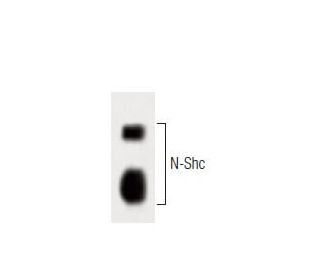


N-Shc Antibody (23): sc-135996
- N-Shc Antibody (23) is a mouse monoclonal IgG1 provided at 50 µg/0.5 ml
- raised against amino acids 239-374 of N-Shc of mouse origin
- recommended for detection of N-Shc of mouse, rat and human origin by WB, IP and IF; not recommended for IP
- At present, we have not yet completed the identification of the preferred secondary detection reagent(s) for N-Shc Antibody (23). This work is in progress.

QUICK LINKS
SEE ALSO...
N-Shc Antibody (23) is a mouse monoclonal IgG1 antibody that detects N-Shc in mouse, rat, and human samples through applications such as western blotting (WB), immunoprecipitation (IP), and immunofluorescence (IF). N-Shc is a critical adaptor protein that plays a significant role in cellular signaling pathways, particularly in the brain, where N-Shc is exclusively expressed. N-Shc contains two phosphotyrosine-binding (PTB) domains and a single Src homology 2 (SH2) domain, which allows N-Shc to interact with activated growth factor receptors and facilitate downstream signaling. The presence of these domains is essential for N-Shc′s function, as these domains enable N-Shc to bind to phosphorylated tyrosine residues on activated receptors, thereby linking them to various signaling intermediates. This interaction is crucial for the regulation of mitogenic signaling pathways, which are vital for processes such as cell growth, differentiation, and survival. By utilizing anti-N-Shc antibody (23), researchers can effectively study the dynamics of these signaling pathways and their implications in various physiological and pathological conditions, including cancer and neurodegenerative diseases.
Alexa Fluor® is a trademark of Molecular Probes Inc., OR., USA
LI-COR® and Odyssey® are registered trademarks of LI-COR Biosciences
N-Shc Antibody (23) References:
- Shc3 affects human high-grade astrocytomas survival. | Magrassi, L., et al. 2005. Oncogene. 24: 5198-206. PMID: 15870690
- EDG3 and SHC3 on chromosome 9q22 are co-amplified in human ependymomas. | Magrassi, L., et al. 2010. Cancer Lett. 290: 36-42. PMID: 19748727
- Cell density modulates SHC3 expression and survival of human glioblastoma cells through Fak activation. | Azzalin, A., et al. 2014. J Neurooncol. 120: 245-56. PMID: 25062668
- Involvement of the neuronal phosphotyrosine signal adaptor N-Shc in kainic acid-induced epileptiform activity. | Baba, S., et al. 2016. Sci Rep. 6: 27511. PMID: 27273072
- Demethylation-Induced Overexpression of Shc3 Drives c-Raf-Independent Activation of MEK/ERK in HCC. | Liu, Y., et al. 2018. Cancer Res. 78: 2219-2232. PMID: 29330146
- Shc3 promotes hepatocellular carcinoma stemness and drug resistance by interacting with β-catenin to inhibit its ubiquitin degradation pathway. | Liu, Y., et al. 2021. Cell Death Dis. 12: 278. PMID: 33723262
- The expression and prognostic value of Src homology 2 domain-containing transforming protein C3 (SHC3) and its potential role in colorectal cancer. | Zhao, C., et al. 2021. Transl Cancer Res. 10: 3418-3428. PMID: 35116646
- Shc3 facilitates breast cancer drug resistance by interacting with ErbB2 to initiate ErbB2/COX2/MDR1 axis. | Liu, Y., et al. 2023. Cancer Med. 12: 10768-10780. PMID: 36880347
- The Long Non-Coding RNA AC006329.1 Facilitates Hepatocellular Carcinoma Progression and Metastasis by Regulating miR-127-5p/SHC3/ERK Axis. | Kong, XX., et al. 2023. J Hepatocell Carcinoma. 10: 1085-1103. PMID: 37483310
- N-Shc and Sck, two neuronally expressed Shc adapter homologs. Their differential regional expression in the brain and roles in neurotrophin and Src signaling. | Nakamura, T., et al. 1998. J Biol Chem. 273: 6960-7. PMID: 9507002
Ordering Information
| Product Name | Catalog # | UNIT | Price | Qty | FAVORITES | |
N-Shc Antibody (23) | sc-135996 | 50 µg/0.5 ml | $322.00 |