
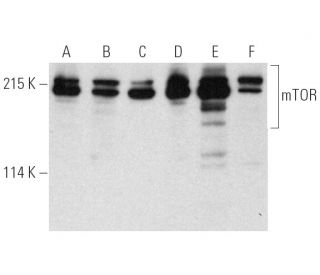
mTOR Antibody (30): sc-517464
- mTOR Antibody (30) is a mouse monoclonal IgG1 λ mTOR antibody, cited in 122 publications, provided at 200 µg/ml
- raised against amino acids 185-290 of mTOR of rat origin
- recommended for detection of mTOR of mouse, rat and human origin by WB, IP and IF
- available conjugated to agarose (sc-517464 AC), 500 µg/ml, 25% agarose, for IP; and to HRP (sc-517464 HRP), 200 µg/ml, for WB, IHC(P) and ELISA
- m-IgG Fc BP-HRP and m-IgG1 BP-HRP are the preferred secondary detection reagents for mTOR Antibody (30) for WB applications. These reagents are now offered in bundles with mTOR Antibody (30) (see ordering information below).

QUICK LINKS
SEE ALSO...
mTOR Antibody (30) is a mouse monoclonal IgG1 lambda light chain antibody engineered to detect the mechanistic target of rapamycin (mTOR) protein, recognizing the amino acid region 185-290 of rat origin. mTOR, also called SKS, FRAP, FRAP1, FRAP2, RAFT1, and RAPT1, is a pivotal serine/threonine kinase that plays a critical role in regulating cell growth, proliferation, metabolism, and autophagy by integrating signals from nutrients, growth factors, and cellular energy status. Located primarily in the cytoplasm, mTOR functions within two distinct complexes, mTORC1 and mTORC2, each orchestrating different cellular processes essential for maintaining cellular homeostasis and responding to environmental cues. The structure of mTOR, featuring a conserved kinase domain and multiple regulatory regions, is fundamental for its ability to phosphorylate downstream targets such as S6 kinase and 4E-BP1, thereby controlling protein synthesis and cell cycle progression. Post-translational modifications, including autophosphorylation at Ser2481 and phosphorylation at Ser2448 by p70S6 kinase, are crucial for regulating mTOR activity and its interactions with other proteins. mTOR interacts with a variety of proteins, including Raptor and Rictor, which are integral components of mTORC1 and mTORC2, respectively, as well as with regulatory proteins like TSC1/2 and AMPK that modulate its activity in response to cellular stress and nutrient availability. These interactions and modifications are essential for mTOR′s role in cellular signaling pathways that influence growth and survival, making mTOR a vital target for research in cancer, neurodegeneration, and metabolic diseases. Anti-mTOR antibody (30) is validated for use in western blotting (WB), immunoprecipitation (IP), and immunofluorescence (IF) across mouse, rat, and human samples, ensuring broad applicability in various experimental settings. Additionally, mTOR (30) antibody is available in both non-conjugated form and conjugated forms, including agarose and horseradish peroxidase (HRP), providing flexibility for diverse laboratory applications and facilitating the detection and study of mTOR in intricate cellular environments.
Alexa Fluor® is a trademark of Molecular Probes Inc., OR., USA
LI-COR® and Odyssey® are registered trademarks of LI-COR Biosciences
mTOR Antibody (30) References:
- mTOR interacts with raptor to form a nutrient-sensitive complex that signals to the cell growth machinery. | Kim, DH., et al. 2002. Cell. 110: 163-75. PMID: 12150925
- mTOR signalling and cellular metabolism are mutual determinants in cancer. | Mossmann, D., et al. 2018. Nat Rev Cancer. 18: 744-757. PMID: 30425336
- The mTOR-Autophagy Axis and the Control of Metabolism. | Deleyto-Seldas, N. and Efeyan, A. 2021. Front Cell Dev Biol. 9: 655731. PMID: 34277603
- The Translational Regulation in mTOR Pathway. | Yang, M., et al. 2022. Biomolecules. 12: PMID: 35740927
- Overview of Research into mTOR Inhibitors. | Mao, B., et al. 2022. Molecules. 27: PMID: 36014530
- Targeting mTOR for Anti-Aging and Anti-Cancer Therapy. | Fu, W. and Wu, G. 2023. Molecules. 28: PMID: 37049920
- mTOR in programmed cell death and its therapeutic implications. | Xie, Y., et al. 2023. Cytokine Growth Factor Rev. 71-72: 66-81. PMID: 37380596
- When is a lipid kinase not a lipid kinase? When it is a protein kinase. | Hunter, T. 1995. Cell. 83: 1-4. PMID: 7553860
- PIK-related kinases: DNA repair, recombination, and cell cycle checkpoints. | Keith, CT. and Schreiber, SL. 1995. Science. 270: 50-1. PMID: 7569949
- DNA-dependent protein kinase catalytic subunit: a relative of phosphatidylinositol 3-kinase and the ataxia telangiectasia gene product. | Hartley, KO., et al. 1995. Cell. 82: 849-56. PMID: 7671312
- Discovery of AT gene sparks biomedical research bonanza. | Nowak, R. 1995. Science. 268: 1700-1. PMID: 7792589
- A single ataxia telangiectasia gene with a product similar to PI-3 kinase. | Savitsky, K., et al. 1995. Science. 268: 1749-53. PMID: 7792600
Ordering Information
| Product Name | Catalog # | UNIT | Price | Qty | FAVORITES | |
mTOR Antibody (30) | sc-517464 | 200 µg/ml | $322.00 | |||
mTOR Antibody (30): m-IgG Fc BP-HRP Bundle | sc-528075 | 200 µg Ab; 10 µg BP | $361.00 | |||
mTOR Antibody (30): m-IgG1 BP-HRP Bundle | sc-533448 | 200 µg Ab; 20 µg BP | $361.00 | |||
mTOR Antibody (30) AC | sc-517464 AC | 500 µg/ml, 25% agarose | $424.00 | |||
mTOR Antibody (30) HRP | sc-517464 HRP | 200 µg/ml | $322.00 |