
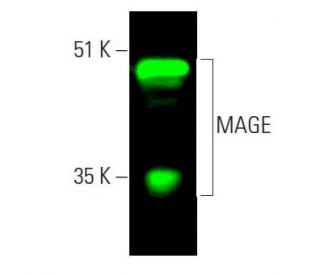
MAGE Antibody (6A111): sc-71537
- MAGE Antibody (6A111) is a mouse monoclonal IgG2a κ MAGE antibody, cited in 1 publications, provided at 200 µg/ml
- raised against a prokaryotic recombinant fusion protein corresponding to the full length MAGE-A1-A1
- recommended for detection of MAGE-1, MAGE-2, MAGE-3, MAGE-4, MAGE-6, MAGE-10 and MAGE-12 of human origin by WB, IP and IF
- m-IgG Fc BP-HRP, m-IgG2a BP-HRP and m-IgGκ BP-HRP are the preferred secondary detection reagents for MAGE Antibody (6A111) for WB applications. These reagents are now offered in bundles with MAGE Antibody (6A111) (see ordering information below).

MAGE Antibody (6A111) is a mouse monoclonal IgG2a kappa light chain antibody that detects the MAGE protein of human origin by western blotting (WB), immunoprecipitation (IP), and immunofluorescence (IF). Anti-MAGE antibody (6A111) is available as a non-conjugated format. The melanoma-associated antigen (MAGE) family comprises a group of antigens that are recognized by cytotoxic T lymphocytes, making MAGE proteins significant in cancer immunotherapy. MAGE genes are primarily expressed in various tumors, with expression being virtually exclusive to tumor tissues in adults, except for the testis and placenta. This unique expression pattern underscores MAGE proteins as potential targets for therapeutic interventions in cancer. MAGE proteins play a crucial role in eliciting immune responses against tumors, encoding tumor-rejection antigens that can stimulate T cell activity. Understanding MAGE protein interactions with specific immune cells is vital, as these interactions can influence the effectiveness of immunotherapeutic strategies. Ongoing research into MAGE proteins not only highlights their importance in tumor biology but also opens avenues for developing targeted therapies that harness the immune system to combat cancer more effectively.
Alexa Fluor® is a trademark of Molecular Probes Inc., OR., USA
LI-COR® and Odyssey® are registered trademarks of LI-COR Biosciences
MAGE Antibody (6A111) References:
- Mage-b4, a novel melanoma antigen (MAGE) gene specifically expressed during germ cell differentiation. | Osterlund, C., et al. 2000. Cancer Res. 60: 1054-61. PMID: 10706124
- A MAGE-A1 peptide is recognized on HLA-B7 human tumors by cytolytic T lymphocytes. | Luiten, R. and van der Bruggen, P. 2000. Tissue Antigens. 55: 149-52. PMID: 10746786
- Expression of MAGE, GAGE and BAGE genes in human liver diseases: utility as molecular markers for hepatocellular carcinoma. | Kobayashi, Y., et al. 2000. J Hepatol. 32: 612-7. PMID: 10782910
- Immunoreactivity with the anti-MAGE antibody 57B in malignant melanoma: frequency of expression and correlation with prognostic parameters. | Busam, KJ., et al. 2000. Mod Pathol. 13: 459-65. PMID: 10786815
- Comparative analysis of genetically modified dendritic cells and tumor cells as therapeutic cancer vaccines. | Klein, C., et al. 2000. J Exp Med. 191: 1699-708. PMID: 10811863
- Melanoma antigen genes 1 and 2 are differentially expressed in human gastric and cardial carcinomas. | Granelli, P., et al. 2000. Scand J Gastroenterol. 35: 528-33. PMID: 10868457
- Genetic detection for micrometastasis in lymph node of biliary tract carcinoma. | Okami, J., et al. 2000. Clin Cancer Res. 6: 2326-32. PMID: 10873083
Ordering Information
| Product Name | Catalog # | UNIT | Price | Qty | FAVORITES | |
MAGE Antibody (6A111) | sc-71537 | 200 µg/ml | $322.00 | |||
MAGE Antibody (6A111): m-IgG Fc BP-HRP Bundle | sc-528654 | 200 µg Ab; 10 µg BP | $361.00 | |||
MAGE Antibody (6A111): m-IgGκ BP-HRP Bundle | sc-521095 | 200 µg Ab, 40 µg BP | $361.00 | |||
MAGE Antibody (6A111): m-IgG2a BP-HRP Bundle | sc-547133 | 200 µg Ab; 10 µg BP | $361.00 |