
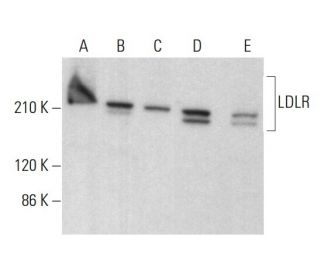
LDLR Antibody (C7): sc-18823
- LDLR Antibody (C7) is a mouse monoclonal IgG2b κ LDLR antibody, cited in 63 publications, provided at 200 µg/ml
- raised against partially purified adrenal LDL receptor of bovine origin
- LDLR Antibody (C7) is recommended for detection of LDLR of mouse, rat and human origin by WB, IP, IF and IHC(P); also reactive with additional species, including bovine
- LDLR Antibody (C7) is available conjugated to agarose for IP; and to either phycoerythrin or FITC for IF, IHC(P) and FCM
- also available conjugated to Alexa Fluor® 488, Alexa Fluor® 546, Alexa Fluor® 594 or Alexa Fluor® 647 for WB (RGB), IF, IHC(P) and FCM, and for use with RGB fluorescent imaging systems, such as iBright™ FL1000, FluorChem™, Typhoon, Azure and other comparable systems
- also available conjugated to Alexa Fluor® 680 or Alexa Fluor® 790 for WB (NIR), IF and FCM; for use with Near-Infrared (NIR) detection systems, such as LI-COR®Odyssey®, iBright™ FL1000, FluorChem™, Typhoon, Azure and other comparable systems
- m-IgG2b BP-HRP and m-IgGκ BP-HRP are the preferred secondary detection reagents for LDLR Antibody (C7) for WB and IHC(P) applications. These reagents are now offered in bundles with LDLR Antibody (C7) (see ordering information below).
QUICK LINKS
SEE ALSO...
LDLR Antibody (C7) is a mouse monoclonal IgG2b kappa light chain antibody that detects the LDLR protein of mouse, rat, and human origin by western blotting (WB), immunoprecipitation (IP), immunofluorescence (IF), and immunohistochemistry. LDLR monoclonal antibody (C7) is available in both non-conjugated and various conjugated forms, including agarose, phycoerythrin (PE), fluorescein isothiocyanate (FITC), and multiple Alexa Fluor® conjugates, providing versatility for different experimental needs. The LDLR, or low-density lipoprotein receptor, plays a crucial role in lipid metabolism by mediating the endocytosis of low-density lipoproteins, which are rich in cholesterol. This process is vital for maintaining cellular cholesterol homeostasis and preventing the accumulation of lipids in the bloodstream. The receptor′s structure includes a series of cysteine-rich class A repeats, epidermal growth factor-like repeats, and YWTD repeats, which are essential for its function and interaction with ligands. Importantly, mutations in the LDLR gene can lead to familial hypercholesterolemia, a genetic disorder characterized by high cholesterol levels and an increased risk of cardiovascular diseases. LDLR monoclonal antibody (C7) enables researchers to gain insights into the mechanisms of cholesterol regulation and the implications of LDLR dysfunction in various health conditions.
Alexa Fluor® is a trademark of Molecular Probes Inc., OR., USA
LI-COR® and Odyssey® are registered trademarks of LI-COR Biosciences
LDLR Antibody (C7) References:
- Reeler/Disabled-like disruption of neuronal migration in knockout mice lacking the VLDL receptor and ApoE receptor 2. | Trommsdorff, M., et al. 1999. Cell. 97: 689-701. PMID: 10380922
- Functional domains of the very low density lipoprotein receptor: molecular analysis of ligand binding and acid-dependent ligand dissociation mechanisms. | Mikhailenko, I., et al. 1999. J Cell Sci. 112 (Pt 19): 3269-81. PMID: 10504332
- Molecular genetics of the LDL receptor gene in familial hypercholesterolemia. | Hobbs, HH., et al. 1992. Hum Mutat. 1: 445-66. PMID: 1301956
- Low-density lipoprotein receptor (LDLR) family orchestrates cholesterol homeostasis. | Go, GW. and Mani, A. 2012. Yale J Biol Med. 85: 19-28. PMID: 22461740
- The low density lipoprotein receptor. Identification of amino acids in cytoplasmic domain required for rapid endocytosis. | Davis, CG., et al. 1987. J Biol Chem. 262: 4075-82. PMID: 3104336
- The LDLR, APOB, and PCSK9 Variants of Index Patients with Familial Hypercholesterolemia in Russia. | Meshkov, A., et al. 2021. Genes (Basel). 12: PMID: 33418990
- Identification of a PCSK9-LDLR disruptor peptide with in vivo function. | Brousseau, ME., et al. 2022. Cell Chem Biol. 29: 249-258.e5. PMID: 34547225
- LDLR is an entry receptor for Crimean-Congo hemorrhagic fever virus. | Xu, ZS., et al. 2024. Cell Res. 34: 140-150. PMID: 38182887
- LDLR is used as a cell entry receptor by multiple alphaviruses. | Zhai, X., et al. 2024. Nat Commun. 15: 622. PMID: 38245515
- The J.D. mutation in familial hypercholesterolemia: amino acid substitution in cytoplasmic domain impedes internalization of LDL receptors. | Davis, CG., et al. 1986. Cell. 45: 15-24. PMID: 3955657
- Spectrum of LDL receptor gene mutations in heterozygous familial hypercholesterolemia. | Day, IN., et al. 1997. Hum Mutat. 10: 116-27. PMID: 9259195
- Molecular basis of familial hypercholesterolaemia from structure of LDL receptor module. | Fass, D., et al. 1997. Nature. 388: 691-3. PMID: 9262405
Ordering Information
| Product Name | Catalog # | UNIT | Price | Qty | FAVORITES | |
LDLR Antibody (C7) | sc-18823 | 200 µg/ml | $316.00 | |||
LDLR Antibody (C7): m-IgGκ BP-HRP Bundle | sc-520685 | 200 µg Ab, 40 µg BP | $354.00 | |||
LDLR Antibody (C7): m-IgG2b BP-HRP Bundle | sc-548847 | 200 µg Ab; 10 µg BP | $354.00 | |||
LDLR Antibody (C7) AC | sc-18823 AC | 500 µg/ml, 25% agarose | $416.00 | |||
LDLR Antibody (C7) FITC | sc-18823 FITC | 200 µg/ml | $330.00 | |||
LDLR Antibody (C7) PE | sc-18823 PE | 200 µg/ml | $343.00 | |||
LDLR Antibody (C7) Alexa Fluor® 488 | sc-18823 AF488 | 200 µg/ml | $357.00 | |||
LDLR Antibody (C7) Alexa Fluor® 546 | sc-18823 AF546 | 200 µg/ml | $357.00 | |||
LDLR Antibody (C7) Alexa Fluor® 594 | sc-18823 AF594 | 200 µg/ml | $357.00 | |||
LDLR Antibody (C7) Alexa Fluor® 647 | sc-18823 AF647 | 200 µg/ml | $357.00 | |||
LDLR Antibody (C7) Alexa Fluor® 680 | sc-18823 AF680 | 200 µg/ml | $357.00 | |||
LDLR Antibody (C7) Alexa Fluor® 790 | sc-18823 AF790 | 200 µg/ml | $357.00 |