
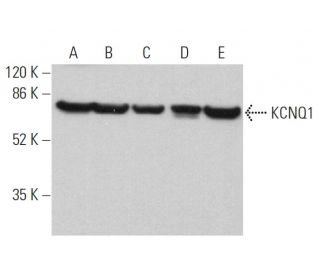
KCNQ1 Antibody (G-8): sc-365186
- KCNQ1 Antibody (G-8) is a mouse monoclonal IgG1 κ KCNQ1 antibody, cited in 7 publications, provided at 200 µg/ml
- specific for an epitope mapping between amino acids 649-676 at the C-terminus of KCNQ1 of human origin
- KCNQ1 Antibody (G-8) is recommended for detection of KCNQ1 isoforms 1 and 2 of mouse, rat and human origin by WB, IP, IF and ELISA
- Anti-KCNQ1 Antibody (G-8) is available conjugated to agarose for IP; HRP for WB, IHC(P) and ELISA; and to either phycoerythrin or FITC for IF, IHC(P) and FCM
- also available conjugated to Alexa Fluor® 488, Alexa Fluor® 546, Alexa Fluor® 594 or Alexa Fluor® 647 for WB (RGB), IF, IHC(P) and FCM, and for use with RGB fluorescent imaging systems, such as iBright™ FL1000, FluorChem™, Typhoon, Azure and other comparable systems
- also available conjugated to Alexa Fluor® 680 or Alexa Fluor® 790 for WB (NIR), IF and FCM; for use with Near-Infrared (NIR) detection systems, such as LI-COR®Odyssey®, iBright™ FL1000, FluorChem™, Typhoon, Azure and other comparable systems
- m-IgGκ BP-HRP is the preferred secondary detection reagent for KCNQ1 Antibody (G-8) for WB applications. This reagent is now offered in a bundle with KCNQ1 Antibody (G-8) (see ordering information below). For additional m-IgGκ BP conjugates see our complete list of Mouse IgG Binding Proteins.

QUICK LINKS
SEE ALSO...
KCNQ1 Antibody (G-8) is a mouse monoclonal IgG1 kappa light chain antibody that detects KCNQ1 protein of mouse, rat, and human origin by western blotting (WB), immunoprecipitation (IP), immunofluorescence (IF), and enzyme-linked immunosorbent assay (ELISA). KCNQ1 (G-8) antibody is available in both non-conjugated and various conjugated forms, including agarose, horseradish peroxidase (HRP), phycoerythrin (PE), fluorescein isothiocyanate (FITC), and multiple Alexa Fluor® conjugates. KCNQ1 protein plays a crucial role in cardiac and auditory function as part of voltage-gated potassium channels essential for action potential repolarization in excitable cells. KCNQ1, in conjunction with β subunit KCNE1, is predominantly expressed in heart and cochlea, where KCNQ1 regulates slow, depolarization-activated potassium current. This regulation maintains electrical stability of cardiac cells and ensures proper hearing function. Mutations in KCNQ1 gene can lead to serious cardiac conditions, such as Long QT syndrome, by disrupting normal electrical signaling, while alterations in KCNQ4 are associated with hearing loss. Structurally, KCNQ proteins, including KCNQ1, are characterized by six transmembrane domains and function as tetramers, which is essential for forming functional ion channels. KCNQ1′s ability to form heteromeric channels with KCNQ4 further highlights KCNQ1′s importance in various tissues, particularly in cochlea, where KCNQ1 is expressed in outer hair cells, underscoring KCNQ1′s critical role in both cardiac and auditory physiology.
Alexa Fluor® is a trademark of Molecular Probes Inc., OR., USA
LI-COR® and Odyssey® are registered trademarks of LI-COR Biosciences
KCNQ1 Antibody (G-8) References:
- KCNQ4, a novel potassium channel expressed in sensory outer hair cells, is mutated in dominant deafness. | Kubisch, C., et al. 1999. Cell. 96: 437-46. PMID: 10025409
- A constitutively open potassium channel formed by KCNQ1 and KCNE3. | Schroeder, BC., et al. 2000. Nature. 403: 196-9. PMID: 10646604
- KCNQ1 gene mutations and the respective genotype-phenotype correlations in the long QT syndrome. | Herbert, E., et al. 2002. Med Sci Monit. 8: RA240-8. PMID: 12388934
- The KCNQ1 channel - remarkable flexibility in gating allows for functional versatility. | Liin, SI., et al. 2015. J Physiol. 593: 2605-15. PMID: 25653179
- Structural Basis of Human KCNQ1 Modulation and Gating. | Sun, J. and MacKinnon, R. 2020. Cell. 180: 340-347.e9. PMID: 31883792
- Cloning of a membrane protein that induces a slow voltage-gated potassium current. | Takumi, T., et al. 1988. Science. 242: 1042-5. PMID: 3194754
- Suppression-Replacement KCNQ1 Gene Therapy for Type 1 Long QT Syndrome. | Dotzler, SM., et al. 2021. Circulation. 143: 1411-1425. PMID: 33504163
- KCNQ1 variant rs163184 is a potential biomarker of glycemic response to exenatide. | Geng, Z., et al. 2022. Pharmacogenomics. 23: 355-361. PMID: 35311356
- KCNQ1-deficient and KCNQ1-mutant human embryonic stem cell-derived cardiomyocytes for modeling QT prolongation. | Song, Y., et al. 2022. Stem Cell Res Ther. 13: 287. PMID: 35765105
- Mechanistic understanding of KCNQ1 activating polyunsaturated fatty acid analogs. | Jowais, JJ., et al. 2023. J Gen Physiol. 155: PMID: 37526928
- Positional cloning of a novel potassium channel gene: KVLQT1 mutations cause cardiac arrhythmias. | Wang, Q., et al. 1996. Nat Genet. 12: 17-23. PMID: 8528244
- Properties of KvLQT1 K+ channel mutations in Romano-Ward and Jervell and Lange-Nielsen inherited cardiac arrhythmias. | Chouabe, C., et al. 1997. EMBO J. 16: 5472-9. PMID: 9312006
Ordering Information
| Product Name | Catalog # | UNIT | Price | Qty | FAVORITES | |
KCNQ1 Antibody (G-8) | sc-365186 | 200 µg/ml | $322.00 | |||
KCNQ1 Antibody (G-8): m-IgGκ BP-HRP Bundle | sc-522156 | 200 µg Ab, 40 µg BP | $361.00 | |||
KCNQ1 Antibody (G-8) AC | sc-365186 AC | 500 µg/ml, 25% agarose | $424.00 | |||
KCNQ1 Antibody (G-8) HRP | sc-365186 HRP | 200 µg/ml | $322.00 | |||
KCNQ1 Antibody (G-8) FITC | sc-365186 FITC | 200 µg/ml | $336.00 | |||
KCNQ1 Antibody (G-8) PE | sc-365186 PE | 200 µg/ml | $349.00 | |||
KCNQ1 Antibody (G-8) Alexa Fluor® 488 | sc-365186 AF488 | 200 µg/ml | $364.00 | |||
KCNQ1 Antibody (G-8) Alexa Fluor® 546 | sc-365186 AF546 | 200 µg/ml | $364.00 | |||
KCNQ1 Antibody (G-8) Alexa Fluor® 594 | sc-365186 AF594 | 200 µg/ml | $364.00 | |||
KCNQ1 Antibody (G-8) Alexa Fluor® 647 | sc-365186 AF647 | 200 µg/ml | $364.00 | |||
KCNQ1 Antibody (G-8) Alexa Fluor® 680 | sc-365186 AF680 | 200 µg/ml | $364.00 | |||
KCNQ1 Antibody (G-8) Alexa Fluor® 790 | sc-365186 AF790 | 200 µg/ml | $364.00 | |||
KCNQ1 (G-8) Neutralizing Peptide | sc-365186 P | 100 µg/0.5 ml | $69.00 |