
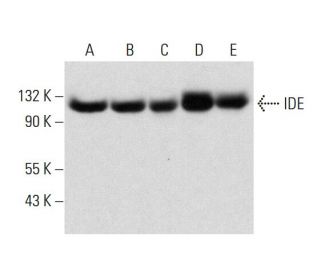
IDE Antibody (E-4): sc-514458
- IDE Antibody (E-4) is a mouse monoclonal IgG1 κ, cited in 4 publications, provided at 200 µg/ml
- raised against amino acids 720-1019 mapping at the C-terminus of IDE of human origin
- recommended for detection of IDE of mouse, rat and human origin by WB, IP, IF and ELISA
- m-IgG Fc BP-HRP and m-IgG1 BP-HRP are the preferred secondary detection reagents for IDE Antibody (E-4) for WB applications. These reagents are now offered in bundles with IDE Antibody (E-4) (see ordering information below).

QUICK LINKS
SEE ALSO...
IDE Antibody (E-4) is a mouse monoclonal IgG1 antibody that detects insulin degrading enzyme (IDE) in mouse, rat, and human samples through applications such as western blotting (WB), immunoprecipitation (IP), immunofluorescence (IF), and enzyme-linked immunosorbent assay (ELISA). IDE plays a crucial role in the regulation of insulin levels by initiating the cleavage of insulin, which is vital for maintaining glucose homeostasis. Beyond its primary function, IDE is also involved in the degradation of various bioactive peptides, including amyloid-β peptides, linking IDE to age-related changes associated with Alzheimer′s disease. Notably, alterations in IDE gene expression, located on chromosome 10q23.3, can lead to significant changes not only in glucose metabolism but also in the levels of brain amyloid-β peptides, specifically Abeta40 and Abeta42. The inhibition of IDE by compounds such as bacitracin has been shown to prevent the degradation of both insulin and amylin, suggesting a shared proteolytic pathway. Furthermore, the rate of proteolysis by IDE is influenced by conformational state, which opens avenues for potential therapeutic strategies targeting IDE in the treatment of diabetes, Alzheimer′s disease, and other conditions linked to the proteolysis of IDE substrates. Anti-IDE antibody (E-4) is an essential tool for researchers investigating these critical pathways and their implications in metabolic and neurodegenerative diseases.
Alexa Fluor® is a trademark of Molecular Probes Inc., OR., USA
LI-COR® and Odyssey® are registered trademarks of LI-COR Biosciences
IDE Antibody (E-4) References:
- Insulin degrading enzyme is up-regulated in pancreatic β cells by insulin treatment. | Fernández-Díaz, CM., et al. 2018. Histol Histopathol. 33: 1167-1180. PMID: 29726577
- Hepatic insulin-degrading enzyme regulates glucose and insulin homeostasis in diet-induced obese mice. | Merino, B., et al. 2020. Metabolism. 113: 154352. PMID: 32916153
- Insulin-degrading enzyme higher in subjects with metabolic syndrome. | Sofer, Y., et al. 2021. Endocrine. 71: 357-364. PMID: 33398768
- Identification of indole-based activators of insulin degrading enzyme. | Kraupner, N., et al. 2022. Eur J Med Chem. 228: 113982. PMID: 34815130
- Antibody-Mediated Inhibition of Insulin-Degrading Enzyme Improves Insulin Activity in a Diabetic Mouse Model. | Fursht, O., et al. 2022. Front Immunol. 13: 835774. PMID: 35350789
- Inhibition of Insulin Degrading Enzyme to Control Diabetes Mellitus and its Applications on some Other Chronic Disease: a Critical Review. | Azam, MS., et al. 2022. Pharm Res. 39: 611-629. PMID: 35378698
- Possible Role of Insulin-Degrading Enzyme in the Physiopathology of Retinitis Pigmentosa. | Sánchez-Cruz, A., et al. 2022. Cells. 11: PMID: 35626658
- Insulin-Degrading Enzyme Interacts with Mitochondrial Ribosomes and Respiratory Chain Proteins. | Yilmaz, A., et al. 2023. Biomolecules. 13: PMID: 37371470
- Insulin-degrading enzyme inhibition increases the unfolded protein response and favours lipid accumulation in the liver. | Andres, M., et al. 2024. Br J Pharmacol. 181: 3610-3626. PMID: 38812293
- Insulin-degrading enzyme regulates insulin-directed cellular autoimmunity in murine type 1 diabetes. | Bessard, MA., et al. 2024. Front Immunol. 15: 1474453. PMID: 39600694
Ordering Information
| Product Name | Catalog # | UNIT | Price | Qty | FAVORITES | |
IDE Antibody (E-4) | sc-514458 | 200 µg/ml | $322.00 | |||
IDE Antibody (E-4): m-IgG Fc BP-HRP Bundle | sc-540975 | 200 µg Ab; 10 µg BP | $361.00 | |||
IDE Antibody (E-4): m-IgG1 BP-HRP Bundle | sc-542503 | 200 µg Ab; 20 µg BP | $361.00 |