
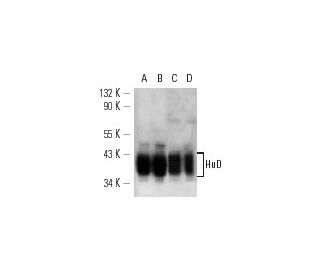
HuD Antibody (H-9): sc-48421
- HuD Antibody (H-9) is a mouse monoclonal IgG2a κ HuD antibody, cited in 21 publications, provided at 200 µg/ml
- raised against amino acids 1-300 of HuD of human origin
- HuD Antibody (H-9) is recommended for detection of HuD of mouse, rat and human origin by WB, IP, IF, IHC(P) and ELISA
- Anti-HuD Antibody (H-9) is available conjugated to agarose for IP; HRP for WB, IHC(P) and ELISA; and to either phycoerythrin or FITC for IF, IHC(P) and FCM
- also available conjugated to Alexa Fluor® 488, Alexa Fluor® 546, Alexa Fluor® 594 or Alexa Fluor® 647 for WB (RGB), IF, IHC(P) and FCM, and for use with RGB fluorescent imaging systems, such as iBright™ FL1000, FluorChem™, Typhoon, Azure and other comparable systems
- also available conjugated to Alexa Fluor® 680 or Alexa Fluor® 790 for WB (NIR), IF and FCM; for use with Near-Infrared (NIR) detection systems, such as LI-COR®Odyssey®, iBright™ FL1000, FluorChem™, Typhoon, Azure and other comparable systems
- m-IgG Fc BP-HRP, m-IgG2a BP-HRP and m-IgGκ BP-HRP are the preferred secondary detection reagents for HuD Antibody (H-9) for WB and IHC(P) applications. These reagents are now offered in bundles with HuD Antibody (H-9) (see ordering information below).

QUICK LINKS
HuD Antibody (H-9) is a mouse monoclonal IgG2a kappa light chain antibody that detects HuD protein of mouse, rat, and human origin by western blotting (WB), immunoprecipitation (IP), immunofluorescence (IF), immunohistochemistry with paraffin-embedded sections (IHCP), and enzyme-linked immunosorbent assay (ELISA). anti-HuD antibody (H-9) is available in both non-conjugated and various conjugated forms, including agarose, horseradish peroxidase (HRP), phycoerythrin (PE), fluorescein isothiocyanate (FITC), and multiple Alexa Fluor® conjugates. HuD protein, a member of the Elav-like family of RNA-binding proteins, plays a crucial role in neuronal differentiation and maintenance, being expressed in postmitotic neurons. HuD contains three RNA recognition motifs (RRM) that specifically bind to AU-rich elements (ARE) in the 3′-untranslated region of mRNA transcripts. This interaction regulates the stability and degradation of mRNAs, thereby influencing gene expression levels associated with cell growth and differentiation. By binding to ARE sites, HuD inhibits rapid degradation of target mRNAs, leading to increased transcript stability, which is essential for proper neuronal function and development. Dynamic regulation of HuD, including shuttling between nucleus and cytoplasm, ensures accessibility to mRNA targets, making HuD monoclonal antibody (H-9) an invaluable tool for studying molecular mechanisms underlying neuronal biology and related disorders.
Alexa Fluor® is a trademark of Molecular Probes Inc., OR., USA
LI-COR® and Odyssey® are registered trademarks of LI-COR Biosciences
HuD Antibody (H-9) References:
- Role of HuD and other RNA-binding proteins in neural development and plasticity. | Perrone-Bizzozero, N. and Bolognani, F. 2002. J Neurosci Res. 68: 121-6. PMID: 11948657
- The RNA-binding protein HuD: a regulator of neuronal differentiation, maintenance and plasticity. | Deschênes-Furry, J., et al. 2006. Bioessays. 28: 822-33. PMID: 16927307
- Alternative role of HuD splicing variants in neuronal differentiation. | Hayashi, S., et al. 2015. J Neurosci Res. 93: 399-409. PMID: 25332105
- HuD Binds to and Regulates Circular RNAs Derived From Neuronal Development- and Synaptic Plasticity-Associated Genes. | Dell'Orco, M., et al. 2020. Front Genet. 11: 790. PMID: 32849796
- HuD regulates SOD1 expression during oxidative stress in differentiated neuroblastoma cells and sporadic ALS motor cortex. | Dell'Orco, M., et al. 2021. Neurobiol Dis. 148: 105211. PMID: 33271327
- RNA-Binding Protein HuD Controls Insulin Translation. | Lee, EK., et al. 2020. Mol Cell. 80: 1135. PMID: 33338402
- ALS-related FUS mutations alter axon growth in motoneurons and affect HuD/ELAVL4 and FMRP activity. | Garone, MG., et al. 2021. Commun Biol. 4: 1025. PMID: 34471224
- RNA binding protein HuD promotes autophagy and tumor stress survival by suppressing mTORC1 activity and augmenting ARL6IP1 levels. | Bishayee, K., et al. 2022. J Exp Clin Cancer Res. 41: 18. PMID: 35012594
- Deciphering the Akt1-HuD interaction in HuD-mediated neuronal differentiation. | Nishisaka, H., et al. 2024. Biochimie. 221: 20-26. PMID: 38244852
- HuD (ELAVL4) gain-of-function impairs neuromuscular junctions and induces apoptosis in in vitro and in vivo models of amyotrophic lateral sclerosis. | Silvestri, B., et al. 2024. bioRxiv.. PMID: 38464028
Ordering Information
| Product Name | Catalog # | UNIT | Price | Qty | FAVORITES | |
HuD Antibody (H-9) | sc-48421 | 200 µg/ml | $322.00 | |||
HuD Antibody (H-9): m-IgG Fc BP-HRP Bundle | sc-528541 | 200 µg Ab; 10 µg BP | $361.00 | |||
HuD Antibody (H-9): m-IgGκ BP-HRP Bundle | sc-520939 | 200 µg Ab, 40 µg BP | $361.00 | |||
HuD Antibody (H-9): m-IgG2a BP-HRP Bundle | sc-547121 | 200 µg Ab; 10 µg BP | $361.00 | |||
HuD Antibody (H-9) AC | sc-48421 AC | 500 µg/ml, 25% agarose | $424.00 | |||
HuD Antibody (H-9) HRP | sc-48421 HRP | 200 µg/ml | $322.00 | |||
HuD Antibody (H-9) FITC | sc-48421 FITC | 200 µg/ml | $336.00 | |||
HuD Antibody (H-9) PE | sc-48421 PE | 200 µg/ml | $349.00 | |||
HuD Antibody (H-9) Alexa Fluor® 488 | sc-48421 AF488 | 200 µg/ml | $364.00 | |||
HuD Antibody (H-9) Alexa Fluor® 546 | sc-48421 AF546 | 200 µg/ml | $364.00 | |||
HuD Antibody (H-9) Alexa Fluor® 594 | sc-48421 AF594 | 200 µg/ml | $364.00 | |||
HuD Antibody (H-9) Alexa Fluor® 647 | sc-48421 AF647 | 200 µg/ml | $364.00 | |||
HuD Antibody (H-9) Alexa Fluor® 680 | sc-48421 AF680 | 200 µg/ml | $364.00 | |||
HuD Antibody (H-9) Alexa Fluor® 790 | sc-48421 AF790 | 200 µg/ml | $364.00 |