

GST Antikörper (1E5): sc-53909
- GST Antikörper 1E5 ist ein monoklonales IgG2b aus der Maus, verwendet in 33 wissenschaftlichen Veröffentlichungen, in einer Menge von 50 µg/500 µl
- gegen rekombinante Glutathion-S-Transferase
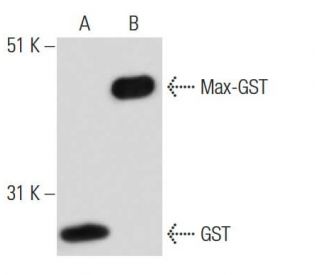
- Empfohlen für die Detektion von GST per WB und IP
- Als Direktkonjugat zur Detektion von GST wird GST (B-14): sc-138 angeboten; Primärantikörper konjugiert mit AC, HRP, FITC, PE, Alexa Fluor® 488, 594, 647, 680 und 790.
- m-IgG Fc BP-HRP und 2b BP-HRP">m-IgG2b BP-HRP sind die bevorzugten sekundären Nachweisreagenzien für GST Antikörper (1E5) für WB-Anwendungen. Diese Reagenzien werden jetzt in Bündeln mit GST Antikörper (1E5) angeboten(siehe Bestellinformationen unten).

Direktverknüpfungen
Siehe auch...
Der GST-Antikörper (1E5) ist ein monoklonaler Maus Ig2bGST-Antikörper, der GST durch WB und IP nachweist. Der GST-Antikörper (1E5) ist als nicht konjugierte Form des Anti-GST-Antikörpers erhältlich. Plasmidvektoren zur Expression codierender Regionen eukaryotischer Gene in E. coli sind weit verbreitet; solche Expressionvektoren codieren oft Hybrid-Fusionsproteine, die teilweise prokaryotische und teilweise eukaryotische spezifische Proteine enthalten. Zum Beispiel ermöglicht der von Smith und Johnson entwickelte pGEX.3X-Expressionvektor die Synthese von Fusionsproteinen zwischen Glutathion-S-Transferase (GST) und Proteinen, die durch eingefügte cDNA-Sequenzen kodiert werden. Antikörper, die aus diesen GST-Fusionsproteinen abgeleitet werden, sind nützlich zur Überprüfung der Proteinexpression sowohl in Plaques als auch auf Western Blots sowie zur immunaffinen Purifizierung von in E. coli exprimierten Proteinen.
Alexa Fluor® ist ein Markenzeichen von Molecular Probes Inc., OR., USA
LI-COR® und Odyssey® sind Markenzeichen von LI-COR Biosciences
GST Antikörper (1E5) Literaturhinweise:
- Glutathion-S-Transferase (GST)-M1- und GST-T1-Genotypen und hämatopoetische Auswirkungen der Benzolexposition. | Hsieh, LL., et al. 1999. Arch Toxicol. 73: 80-2. PMID: 10350187
- Verlust des Glutathion-S-Transferase (GST)-mu-Phänotyps in kolorektalen Adenokarzinomen von Patienten mit einem GSTM1-positiven Genotyp. | Barker, HJ., et al. 2002. Cancer Lett. 177: 65-74. PMID: 11809532
- Glutathion-S-Transferase (GST)-M1-, -T1- und -N-Acetyltransferase-2 (NAT2)-Polymorphismen und das Risiko für Urothelkarzinome bei Tabakkonsum. | Tsukino, H., et al. 2004. Eur J Cancer Prev. 13: 509-14. PMID: 15548945
- Glutathion-S-Transferase (GST) M1-Null-Genotyp und kombinierte GSTM1- und GSTT1-Null-Genotypen sind Risikofaktoren für erhöhte Serum-Gamma-Glutamyltransferase bei mit Valproinsäure behandelten Patienten. | Fukushima, Y., et al. 2008. Clin Chim Acta. 389: 98-102. PMID: 18155166
- Glutathion-S-Transferase (GST)-Genvarianten und Risiko einer gutartigen Prostatahyperplasie: ein Bericht über eine nordindische Bevölkerung. | Konwar, R., et al. 2010. Asian Pac J Cancer Prev. 11: 1067-72. PMID: 21133626
- Die Glutathion-S-Transferase-PI (GST-PI)-mRNA-Expression und DNA-Methylierung ist an der Pathogenese und Prognose von nicht-kleinzelligem Lungenkrebs beteiligt. | Grimminger, PP., et al. 2012. Lung Cancer. 78: 87-91. PMID: 22884253
- Polymorphismus des Glutathion-S-Transferase-P1-Gens (GST-pi) bei Brustkrebs. | Khabaz, MN. 2014. Pol J Pathol. 65: 141-6. PMID: 25119175
- Das diagnostische Potenzial von Glutathion-S-Transferase (GST)-Polymorphismen bei Patienten mit kolorektalem Karzinom. | Waś, J., et al. 2018. Adv Clin Exp Med. 27: 1561-1566. PMID: 30106268
- Ein Glutathion-S-Transferase (GST)-Isozym aus Brokkoli mit signifikanter Sequenzhomologie zur Theta-Klasse der GSTs bei Säugetieren. | Lopez, MF., et al. 1994. Biochim Biophys Acta. 1205: 29-38. PMID: 8142481
- Glutathion-S-Transferase Klasse Kappa: Charakterisierung durch Klonierung der mitochondrialen GST der Ratte und Identifizierung eines menschlichen Homologs. | Pemble, SE., et al. 1996. Biochem J. 319 (Pt 3): 749-54. PMID: 8920976
Bestellinformation
| Produkt | Katalog # | EINHEIT | Preis | ANZAHL | Favoriten | |
GST Antikörper (1E5) | sc-53909 | 50 µg/500 µl | $322.00 | |||
GST (1E5): m-IgG Fc BP-HRP Bundle | sc-539012 | 50 µg Ab; 10 µg BP | $361.00 | |||
GST (1E5): m-IgG2b BP-HRP Bundle | sc-549725 | 50 µg Ab; 10 µg BP | $361.00 |