
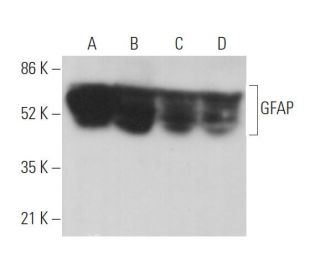
GFAP Antibody (2E1): sc-33673
- GFAP Antibody (2E1) is a mouse monoclonal IgG2b κ GFAP antibody, cited in 358 publications, provided at 200 µg/ml
- raised against spinal chord homogenate of bovine origin
- GFAP Antibody (2E1) is recommended for detection of GFAP of mouse, rat and human origin by WB, IP, IF and IHC(P); also reactive with additional species, including bovine
- Anti-GFAP Antibody (2E1) is available conjugated to agarose for IP; HRP for WB, IHC(P) and ELISA; and to either phycoerythrin or FITC for IF, IHC(P) and FCM
- also available conjugated to Alexa Fluor® 488, Alexa Fluor® 546, Alexa Fluor® 594 or Alexa Fluor® 647 for WB (RGB), IF, IHC(P) and FCM, and for use with RGB fluorescent imaging systems, such as iBright™ FL1000, FluorChem™, Typhoon, Azure and other comparable systems
- also available conjugated to Alexa Fluor® 680 or Alexa Fluor® 790 for WB (NIR), IF and FCM; for use with Near-Infrared (NIR) detection systems, such as LI-COR®Odyssey®, iBright™ FL1000, FluorChem™, Typhoon, Azure and other comparable systems
- m-IgG Fc BP-HRP, m-IgG2b BP-HRP and m-IgGκ BP-HRP are the preferred secondary detection reagents for GFAP Antibody (2E1) for WB and IHC(P) applications. These reagents are now offered in bundles with GFAP Antibody (2E1) (see ordering information below).

QUICK LINKS
SEE ALSO...
GFAP Antibody (2E1) is a mouse monoclonal IgG2b kappa light chain antibody engineered to detect Glial Fibrillary Acidic Protein (GFAP), an essential intermediate filament protein predominantly expressed in astroglial cells within the central nervous system. Raised against bovine spinal cord homogenate, anti-GFAP antibody (2E1) exhibits strong reactivity across multiple species, including mouse, rat, human, and bovine, making it a versatile tool for applications such as western blotting (WB), immunoprecipitation (IP), immunofluorescence (IF), and immunohistochemistry with paraffin-embedded sections (IHCP). GFAP, also known as ALXDRD, plays a crucial role in maintaining the structural integrity and function of astrocytes, which are vital for supporting neuronal networks, regulating the blood-brain barrier, and facilitating synaptic transmission. Additionally, GFAP is integral to the process of astrogliosis, where astrocytes respond to neurological injuries and diseases by increasing GFAP expression, thereby aiding in tissue repair and scar formation. This makes GFAP an important biomarker for studying a variety of neurological conditions, including mechanical trauma, AIDS-related dementia, prion infections, and inflammatory demyelinating diseases. By targeting GFAP, GFAP (2E1) monoclonal antibody enables researchers to investigate astrocyte biology, monitor glial responses in disease models, and identify both benign and neoplastic glial cells in the central nervous system. Available in both non-conjugated and multiple conjugated forms, including horseradish peroxidase (HRP), phycoerythrin (PE), fluorescein isothiocyanate (FITC), and various Alexa Fluor® conjugates, GFAP (2E1) antibody provides flexibility and reliability to meet diverse experimental needs, facilitating advancements in neuroscience research and the understanding of glial cell functions and pathologies.
Alexa Fluor® is a trademark of Molecular Probes Inc., OR., USA
LI-COR® and Odyssey® are registered trademarks of LI-COR Biosciences
GFAP Antibody (2E1) References:
- Analysis of glial acidic fibrillary protein in the human entorhinal cortex during aging and in Alzheimer's disease. | Porchet, R., et al. 2003. Proteomics. 3: 1476-85. PMID: 12923773
- Co-expression of glial fibrillary acidic protein- and vimentin-type intermediate filaments in human astrocytomas. | Herpers, MJ., et al. 1986. Acta Neuropathol. 70: 333-9. PMID: 3020864
- Coexpression of intermediate filament polypeptides in human fetal and adult tissues. | Van Muijen, GN., et al. 1987. Lab Invest. 57: 359-69. PMID: 3669613
- Immunohistochemistry of the glial fibrillary acidic protein: basic and applied considerations. | McLendon, RE. and Bigner, DD. 1994. Brain Pathol. 4: 221-8. PMID: 7952263
- GFAP and astrogliosis. | Eng, LF. and Ghirnikar, RS. 1994. Brain Pathol. 4: 229-37. PMID: 7952264
- Glial fibrillary acidic protein: dynamic property and regulation by phosphorylation. | Inagaki, M., et al. 1994. Brain Pathol. 4: 239-43. PMID: 7952265
- Structure and transcriptional regulation of the GFAP gene. | Brenner, M. 1994. Brain Pathol. 4: 245-57. PMID: 7952266
- Glial fibrillary acidic protein: regulation by hormones, cytokines, and growth factors. | Laping, NJ., et al. 1994. Brain Pathol. 4: 259-75. PMID: 7952267
- Glial fibrillary acidic protein (GFAP) immunohistochemistry in human cortex: a quantitative study using different antisera. | Halliday, GM., et al. 1996. Neurosci Lett. 209: 29-32. PMID: 8734902
Ordering Information
| Product Name | Catalog # | UNIT | Price | Qty | FAVORITES | |
GFAP Antibody (2E1) | sc-33673 | 200 µg/ml | $322.00 | |||
GFAP Antibody (2E1): m-IgG Fc BP-HRP Bundle | sc-528485 | 200 µg Ab; 10 µg BP | $361.00 | |||
GFAP Antibody (2E1): m-IgGκ BP-HRP Bundle | sc-520876 | 200 µg Ab, 40 µg BP | $361.00 | |||
GFAP Antibody (2E1): m-IgG2b BP-HRP Bundle | sc-550042 | 200 µg Ab; 10 µg BP | $361.00 | |||
GFAP Antibody (2E1) AC | sc-33673 AC | 500 µg/ml, 25% agarose | $424.00 | |||
GFAP Antibody (2E1) HRP | sc-33673 HRP | 200 µg/ml | $322.00 | |||
GFAP Antibody (2E1) FITC | sc-33673 FITC | 200 µg/ml | $336.00 | |||
GFAP Antibody (2E1) PE | sc-33673 PE | 200 µg/ml | $349.00 | |||
GFAP Antibody (2E1) Alexa Fluor® 488 | sc-33673 AF488 | 200 µg/ml | $364.00 | |||
GFAP Antibody (2E1) Alexa Fluor® 546 | sc-33673 AF546 | 200 µg/ml | $364.00 | |||
GFAP Antibody (2E1) Alexa Fluor® 594 | sc-33673 AF594 | 200 µg/ml | $364.00 | |||
GFAP Antibody (2E1) Alexa Fluor® 647 | sc-33673 AF647 | 200 µg/ml | $364.00 | |||
GFAP Antibody (2E1) Alexa Fluor® 680 | sc-33673 AF680 | 200 µg/ml | $364.00 | |||
GFAP Antibody (2E1) Alexa Fluor® 790 | sc-33673 AF790 | 200 µg/ml | $364.00 |