
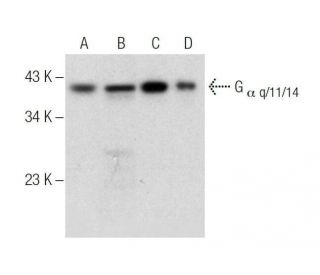
Gα q/11/14 Antibody (G-7): sc-365906
- Gα q/11/14 Antibody (G-7) is a mouse monoclonal IgG1 κ Gα q/11/14 antibody, cited in 24 publications, provided at 200 µg/ml
- raised against amino acids 60-359 mapping at the C-terminus of Gα 11 of mouse and human origin
- G alpha q/11/14 Antibody (G-7) is recommended for detection of Gα q, Gα 11 and Gα 14 of mouse, rat and human origin by WB, IP, IF, IHC(P) and ELISA
- Anti-G alpha q/11/14 Antibody (G-7) is available conjugated to agarose for IP; HRP for WB, IHC(P) and ELISA; and to either phycoerythrin or FITC for IF, IHC(P) and FCM
- also available conjugated to Alexa Fluor® 488, Alexa Fluor® 546, Alexa Fluor® 594 or Alexa Fluor® 647 for WB (RGB), IF, IHC(P) and FCM, and for use with RGB fluorescent imaging systems, such as iBright™ FL1000, FluorChem™, Typhoon, Azure and other comparable systems
- also available conjugated to Alexa Fluor® 680 or Alexa Fluor® 790 for WB (NIR), IF and FCM; for use with Near-Infrared (NIR) detection systems, such as LI-COR®Odyssey®, iBright™ FL1000, FluorChem™, Typhoon, Azure and other comparable systems
- m-IgG Fc BP-HRP, m-IgG1 BP-HRP and m-IgGκ BP-HRP are the preferred secondary detection reagents for Gα q/11/14 Antibody (G-7) for WB and IHC(P) applications. These reagents are now offered in bundles with Gα q/11/14 Antibody (G-7) (see ordering information below).

QUICK LINKS
Gα q/11/14 Antibody (G-7) is a mouse monoclonal IgG1 kappa light chain antibody that detects G alpha q/11/14 protein of mouse, rat, and human origin by western blotting (WB), immunoprecipitation (IP), immunofluorescence (IF), immunohistochemistry, and enzyme-linked immunosorbent assay (ELISA). Gα q/11/14 (G-7) antibody is available in both non-conjugated and various conjugated forms, including agarose, horseradish peroxidase (HRP), phycoerythrin (PE), fluorescein isothiocyanate (FITC), and multiple Alexa Fluor® conjugates. G alpha q/11/14 protein plays a crucial role in cellular signaling as a member of the heterotrimeric G protein family, which transmits signals from activated receptors on the cell surface to intracellular effectors. Specifically, G alpha q/11/14 proteins are involved in the activation of phospholipase C, leading to the production of inositol trisphosphate and diacylglycerol, which are vital for calcium signaling and various cellular responses. This signaling pathway is essential for numerous physiological processes, including muscle contraction, neurotransmitter release, and cell proliferation. G alpha q/11/14 proteins are particularly abundant in the brain and lungs, where these proteins mediate responses to a variety of extracellular signals, highlighting their importance in both central nervous system function and respiratory physiology.
Alexa Fluor® is a trademark of Molecular Probes Inc., OR., USA
LI-COR® and Odyssey® are registered trademarks of LI-COR Biosciences
Gα q/11/14 Antibody (G-7) References:
- Opioid receptor signalling mechanisms. | Connor, M. and Christie, MD. 1999. Clin Exp Pharmacol Physiol. 26: 493-9. PMID: 10405772
- Selective tissue distribution of G protein gamma subunits, including a new form of the gamma subunits identified by cDNA cloning. | Cali, JJ., et al. 1992. J Biol Chem. 267: 24023-7. PMID: 1385432
- Diversity among the beta subunits of heterotrimeric GTP-binding proteins: characterization of a novel beta-subunit cDNA. | von Weizsäcker, E., et al. 1992. Biochem Biophys Res Commun. 183: 350-6. PMID: 1543505
- Gustducin is a taste-cell-specific G protein closely related to the transducins. | McLaughlin, SK., et al. 1992. Nature. 357: 563-9. PMID: 1608467
- Diversity of G proteins in signal transduction. | Simon, MI., et al. 1991. Science. 252: 802-8. PMID: 1902986
- G protein diversity: a distinct class of alpha subunits is present in vertebrates and invertebrates. | Strathmann, M. and Simon, MI. 1990. Proc Natl Acad Sci U S A. 87: 9113-7. PMID: 2123549
- Unusual phototransduction via cross-motif signaling from Gq to adenylyl cyclase in intrinsically photosensitive retinalganglion cells. | Chen, L., et al. 2023. Proc Natl Acad Sci U S A. 120: e2216599120. PMID: 36584299
- The role of Gαq in regulating NLRP3 inflammasome activation. | Kong, R., et al. 2024. Inflamm Res. 73: 2249-2261. PMID: 39455437
- Characterization of Gq family G proteins GL1 alpha (G14 alpha), GL2 alpha (G11 alpha), and Gq alpha expressed in the baculovirus-insect cell system. | Nakamura, F., et al. 1995. J Biol Chem. 270: 6246-53. PMID: 7890762
- Structural elements of G alpha subunits that interact with G beta gamma, receptors, and effectors. | Conklin, BR. and Bourne, HR. 1993. Cell. 73: 631-41. PMID: 8388779
- Importance of N-terminal regions of G protein alpha subunits for the activation of phospholipase C in Xenopus oocytes. | Nakamura, K., et al. 1996. J Biochem. 120: 996-1001. PMID: 8982868
- Evidence that Gq family G proteins do not function in mouse egg activation at fertilization. | Williams, CJ., et al. 1998. Dev Biol. 198: 116-27. PMID: 9640335
Ordering Information
| Product Name | Catalog # | UNIT | Price | Qty | FAVORITES | |
Gα q/11/14 Antibody (G-7) | sc-365906 | 200 µg/ml | $322.00 | |||
Gα q/11/14 Antibody (G-7): m-IgG Fc BP-HRP Bundle | sc-529506 | 200 µg Ab; 10 µg BP | $361.00 | |||
Gα q/11/14 Antibody (G-7): m-IgGκ BP-HRP Bundle | sc-522416 | 200 µg Ab, 40 µg BP | $361.00 | |||
Gα q/11/14 Antibody (G-7): m-IgG1 BP-HRP Bundle | sc-543548 | 200 µg Ab; 20 µg BP | $361.00 | |||
Gα q/11/14 Antibody (G-7) AC | sc-365906 AC | 500 µg/ml, 25% agarose | $424.00 | |||
Gα q/11/14 Antibody (G-7) HRP | sc-365906 HRP | 200 µg/ml | $322.00 | |||
Gα q/11/14 Antibody (G-7) FITC | sc-365906 FITC | 200 µg/ml | $336.00 | |||
Gα q/11/14 Antibody (G-7) PE | sc-365906 PE | 200 µg/ml | $349.00 | |||
Gα q/11/14 Antibody (G-7) Alexa Fluor® 488 | sc-365906 AF488 | 200 µg/ml | $364.00 | |||
Gα q/11/14 Antibody (G-7) Alexa Fluor® 546 | sc-365906 AF546 | 200 µg/ml | $364.00 | |||
Gα q/11/14 Antibody (G-7) Alexa Fluor® 594 | sc-365906 AF594 | 200 µg/ml | $364.00 | |||
Gα q/11/14 Antibody (G-7) Alexa Fluor® 647 | sc-365906 AF647 | 200 µg/ml | $364.00 | |||
Gα q/11/14 Antibody (G-7) Alexa Fluor® 680 | sc-365906 AF680 | 200 µg/ml | $364.00 | |||
Gα q/11/14 Antibody (G-7) Alexa Fluor® 790 | sc-365906 AF790 | 200 µg/ml | $364.00 |