
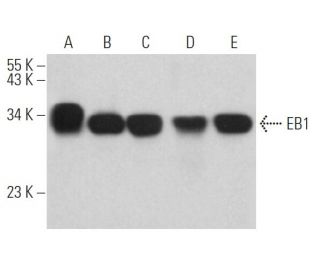
EB1 Antibody (B-7): sc-398900
- EB1 Antibody (B-7) is a mouse monoclonal IgG1 κ provided at 200 µg/ml
- raised against amino acids 133-202 mapping near the C-terminus of EB1 of human origin
- Anti-EB1 Antibody (B-7) is recommended for detection of EB1 of mouse, rat and human origin by WB, IP, IF and ELISA
- Anti-EB1 Antibody (B-7) is available conjugated to agarose for IP; HRP for WB, IHC(P) and ELISA; and to either phycoerythrin or FITC for IF, IHC(P) and FCM
- also available conjugated to Alexa Fluor® 488, Alexa Fluor® 546, Alexa Fluor® 594 or Alexa Fluor® 647 for WB (RGB), IF, IHC(P) and FCM, and for use with RGB fluorescent imaging systems, such as iBright™ FL1000, FluorChem™, Typhoon, Azure and other comparable systems
- also available conjugated to Alexa Fluor® 680 or Alexa Fluor® 790 for WB (NIR), IF and FCM; for use with Near-Infrared (NIR) detection systems, such as LI-COR®Odyssey®, iBright™ FL1000, FluorChem™, Typhoon, Azure and other comparable systems
- m-IgG Fc BP-HRP, m-IgG1 BP-HRP and m-IgGκ BP-HRP are the preferred secondary detection reagents for EB1 Antibody (B-7) for WB applications. These reagents are now offered in bundles with EB1 Antibody (B-7) (see ordering information below).

QUICK LINKS
SEE ALSO...
EB1 Antibody (B-7) is a mouse monoclonal IgG1 kappa light chain antibody that detects EB1 in mouse, rat, and human samples through applications such as western blotting (WB), immunoprecipitation (IP), immunofluorescence (IF), and enzyme-linked immunosorbent assay (ELISA). Anti-EB1 antibody (B-7) is available in both non-conjugated and various conjugated forms, including agarose, horseradish peroxidase (HRP), phycoerythrin (PE), fluorescein isothiocyanate (FITC), and multiple Alexa Fluor® conjugates. EB1, or end-binding protein 1, plays a crucial role in microtubule dynamics and is essential for regulating cell migration and division, making EB1 a significant factor in cancer biology. EB1 is primarily located at the plus ends of microtubules, where EB1 stabilizes microtubule growth and facilitates cellular component transport. This localization is vital for maintaining proper cellular architecture and function, as disruptions in microtubule dynamics can lead to aberrant cell division and contribute to tumorigenesis. EB1 has been implicated in colorectal cancer progression, where EB1 interacts with adenomatous polyposis coli (APC) tumor suppressor protein, influencing signaling pathways that govern cell proliferation and differentiation. EB1′s binding to APC′s carboxy terminal region highlights EB1′s role in modulating APC′s tumor-suppressive functions, linking EB1 to early events in colorectal carcinogenesis.
Alexa Fluor® is a trademark of Molecular Probes Inc., OR., USA
LI-COR® and Odyssey® are registered trademarks of LI-COR Biosciences
EB1 Antibody (B-7) References:
- EB1 accelerates two conformational transitions important for microtubule maturation and dynamics. | Maurer, SP., et al. 2014. Curr Biol. 24: 372-84. PMID: 24508171
- H2-EB1 Molecule Alleviates Allergic Rhinitis Symptoms of H2-Eb1 Knockout Mice. | Li, L., et al. 2015. Iran J Immunol. 12: 263-73. PMID: 26714418
- Interactions between the Microtubule Binding Protein EB1 and F-Actin. | Alberico, EO., et al. 2016. J Mol Biol. 428: 1304-1314. PMID: 26854759
- EB1 interacts with outwardly curved and straight regions of the microtubule lattice. | Guesdon, A., et al. 2016. Nat Cell Biol. 18: 1102-8. PMID: 27617931
- EB1 contributes to proper front-to-back polarity in neutrophil-like HL-60 cells. | Samereier, M., et al. 2017. Eur J Cell Biol. 96: 143-153. PMID: 28132723
- EB1 phosphorylation mediates the functions of ASK1 in pancreatic cancer development. | Gao, S., et al. 2017. Oncotarget. 8: 98233-98241. PMID: 29228685
- Local control of intracellular microtubule dynamics by EB1 photodissociation. | van Haren, J., et al. 2018. Nat Cell Biol. 20: 252-261. PMID: 29379139
- EB1 traps STIM1 and regulates local store-operated Ca2+ entry. | Wang, QC., et al. 2018. J Cell Biol. 217: 1899-1900. PMID: 29764906
- GTP-binding facilitates EB1 recruitment onto microtubules by relieving its auto-inhibition. | Gireesh, KK., et al. 2018. Sci Rep. 8: 9792. PMID: 29955158
- The microtubule end-binding affinity of EB1 is enhanced by a dimeric organization that is susceptible to phosphorylation. | Song, Y., et al. 2020. J Cell Sci. 133: PMID: 32152183
Ordering Information
| Product Name | Catalog # | UNIT | Price | Qty | FAVORITES | |
EB1 Antibody (B-7) | sc-398900 | 200 µg/ml | $322.00 | |||
EB1 Antibody (B-7): m-IgG Fc BP-HRP Bundle | sc-530959 | 200 µg Ab; 10 µg BP | $361.00 | |||
EB1 Antibody (B-7): m-IgGκ BP-HRP Bundle | sc-524526 | 200 µg Ab, 40 µg BP | $361.00 | |||
EB1 Antibody (B-7): m-IgG1 BP-HRP Bundle | sc-544337 | 200 µg Ab; 20 µg BP | $361.00 | |||
EB1 Antibody (B-7) AC | sc-398900 AC | 500 µg/ml, 25% agarose | $424.00 | |||
EB1 Antibody (B-7) HRP | sc-398900 HRP | 200 µg/ml | $322.00 | |||
EB1 Antibody (B-7) FITC | sc-398900 FITC | 200 µg/ml | $336.00 | |||
EB1 Antibody (B-7) PE | sc-398900 PE | 200 µg/ml | $349.00 | |||
EB1 Antibody (B-7) Alexa Fluor® 488 | sc-398900 AF488 | 200 µg/ml | $364.00 | |||
EB1 Antibody (B-7) Alexa Fluor® 546 | sc-398900 AF546 | 200 µg/ml | $364.00 | |||
EB1 Antibody (B-7) Alexa Fluor® 594 | sc-398900 AF594 | 200 µg/ml | $364.00 | |||
EB1 Antibody (B-7) Alexa Fluor® 647 | sc-398900 AF647 | 200 µg/ml | $364.00 | |||
EB1 Antibody (B-7) Alexa Fluor® 680 | sc-398900 AF680 | 200 µg/ml | $364.00 | |||
EB1 Antibody (B-7) Alexa Fluor® 790 | sc-398900 AF790 | 200 µg/ml | $364.00 |