
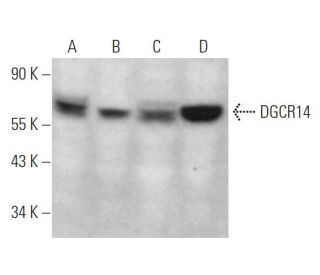


Anticorps DGCR14 (C-9): sc-398472
- L'anticorps DGCR14 C-9 est un monoclonal IgG2a (chaîne légère kappa) L'Anticorps DGCR14 fourni en 200 µg/ml
- dirigé contre les acides aminés 177-476 situés au niveau C-terminus de DGCR14 d'origine human
- L'Anticorps DGCR14 (C-9) est recommandé pour la détection de DGCR14 d'origine mouse, rat et human par WB, IP, IF et ELISA
- Anti-L'Anticorps DGCR14 (C-9) est disponible conjugué à l'agarose pour IP; à l'HRP pour WB, IHC(P) et ELISA; et soit à la phycoerythrin ou FITC pour IF, IHC(P) et FCM
- aussi disponible conjugué à l'Alexa Fluor® 488, Alexa Fluor® 546, Alexa Fluor® 594 ou Alexa Fluor® 647 pour WB (RGB), IF, IHC(P) et FCM
- aussi disponible conjugué à l'Alexa Fluor® 680 ou Alexa Fluor® 790 pour WB (NIR), IF et FCM
- m-IgG Fc BP-HRP, 2a BP-HRP">m-IgG2a BP-HRP et m-IgGκ BP-HRP sont les réactifs de détection secondaire préférés pour l'anticorps DGCR14 (C-9) pour les applications WB. Ces réactifs sont désormais proposés en lots avec l'anticorps DGCR14 (C-9)(voir les informations de commande ci-dessous).

ACCÈS RAPIDE AUX LIENS
L'anticorps DGCR14 (C-9) est un anticorps monoclonal IgG2a κ de souris DGCR14 (également désigné comme anticorps DGCR14) qui détecte la protéine DGCR14 de souris, de rat et d'origine humaine par WB, IP, IF et ELISA. L'anticorps DGCR14 (C-9) est disponible sous forme d'anticorps anti-DGCR14 non conjugué, ainsi que sous plusieurs formes conjuguées d'anticorps anti-DGCR14, y compris agarose, HRP, PE, FITC et plusieurs conjugués Alexa Fluor®. DGCR14 (DiGeorge syndrome critical region 14, ES2 protein) est une protéine nucléaire de 476 acides aminés qui appartient à la famille DGCR14. On pense que DGCR14 joue un rôle dans l'étiologie du syndrome velocardiofacial/DiGeorge (VCFS/DGS), un trouble du développement caractérisé par des anomalies structurelles et fonctionnelles du palais, des malformations cardiaques conotronculaires, une immunodéficience, une hypocalcémie et des anomalies faciales typiques. La plupart des cas résultent d'une délétion du chromosome 22q11.2 (région chromosomique du syndrome de DiGeorge ou DGCR). Cette protéine se localise dans le noyau et est copurifiée avec les spliceosomes du complexe C.
Alexa Fluor® est une marque déposée de Molecular Probes Inc., OR., USA
LI-COR® et Odyssey® sont marques déposées de LI-COR Biosciences
Anticorps DGCR14 (C-9) Références:
- Analyse fonctionnelle des polymorphismes dans les régions promotrices des gènes sur 22q11. | Hoogendoorn, B., et al. 2004. Hum Mutat. 24: 35-42. PMID: 15221787
- Le test de déséquilibre de transmission fournit des preuves de l'association entre les polymorphismes du promoteur du gène 22q11 DGCR14 et la schizophrénie. | Wang, H., et al. 2006. J Neural Transm (Vienna). 113: 1551-61. PMID: 16432632
- Clonage et cartographie comparative d'un gène de la région communément supprimée des syndromes de DiGeorge et de Velocardiofacial conservés chez C. elegans. | Rizzu, P., et al. 1996. Mamm Genome. 7: 639-43. PMID: 8703114
- Analyse structurale et mutationnelle d'un gène conservé (DGSI) de la région critique minimale du syndrome de DiGeorge. | Gong, W., et al. 1997. Hum Mol Genet. 6: 267-76. PMID: 9063747
- Isolement et caractérisation d'un gène de la région chromosomique de DiGeorge homologue au gène Tbx1 de la souris. | Chieffo, C., et al. 1997. Genomics. 43: 267-77. PMID: 9268629
- ES2, un gène supprimé dans le syndrome de DiGeorge, code pour une protéine nucléaire et est exprimé au cours du développement précoce de la souris, où il partage un domaine d'expression avec un gène de type Goosecoid. | Lindsay, EA., et al. 1998. Hum Mol Genet. 7: 629-35. PMID: 9499415
- Analyse fonctionnelle de Gscl dans la pathogenèse des syndromes de DiGeorge et de vélocardiofacial. | Wakamiya, M., et al. 1998. Hum Mol Genet. 7: 1835-40. PMID: 9811926
Informations pour la commande
| Nom du produit | Ref. Catalogue | COND. | Prix HT | QTÉ | Favoris | |
Anticorps DGCR14 (C-9) | sc-398472 | 200 µg/ml | $322.00 | |||
DGCR14 (C-9): m-IgG Fc BP-HRP Kit | sc-530813 | 200 µg Ab; 10 µg BP | $361.00 | |||
DGCR14 (C-9): m-IgGκ BP-HRP Kit | sc-524358 | 200 µg Ab, 40 µg BP | $361.00 | |||
DGCR14 (C-9): m-IgG2a BP-HRP Kit | sc-547596 | 200 µg Ab; 10 µg BP | $361.00 | |||
Anticorps DGCR14 (C-9) AC | sc-398472 AC | 500 µg/ml, 25% agarose | $424.00 | |||
Anticorps DGCR14 (C-9) HRP | sc-398472 HRP | 200 µg/ml | $322.00 | |||
Anticorps DGCR14 (C-9) FITC | sc-398472 FITC | 200 µg/ml | $336.00 | |||
Anticorps DGCR14 (C-9) PE | sc-398472 PE | 200 µg/ml | $349.00 | |||
Anticorps DGCR14 (C-9) Alexa Fluor® 488 | sc-398472 AF488 | 200 µg/ml | $364.00 | |||
Anticorps DGCR14 (C-9) Alexa Fluor® 546 | sc-398472 AF546 | 200 µg/ml | $364.00 | |||
Anticorps DGCR14 (C-9) Alexa Fluor® 594 | sc-398472 AF594 | 200 µg/ml | $364.00 | |||
Anticorps DGCR14 (C-9) Alexa Fluor® 647 | sc-398472 AF647 | 200 µg/ml | $364.00 | |||
Anticorps DGCR14 (C-9) Alexa Fluor® 680 | sc-398472 AF680 | 200 µg/ml | $364.00 | |||
Anticorps DGCR14 (C-9) Alexa Fluor® 790 | sc-398472 AF790 | 200 µg/ml | $364.00 |