
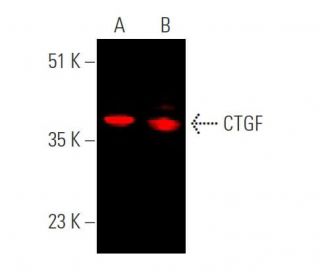
CTGF Antibody (E-5): sc-365970
- CTGF Antibody (E-5) is a mouse monoclonal IgG2a κ CTGF antibody, cited in 82 publications, provided at 200 µg/ml
- specific for an epitope mapping between amino acids 170-207 within an internal region of CTGF of human origin
- CTGF Antibody (E-5) is recommended for detection of CTGF of mouse, rat and human origin by WB, IP, IF and ELISA; also reactive with additional species, including and equine, canine and bovine
- Anti-CTGF Antibody (E-5) is available conjugated to agarose for IP; HRP for WB, IHC(P) and ELISA; and to either phycoerythrin or FITC for IF, IHC(P) and FCM
- also available conjugated to Alexa Fluor® 488, Alexa Fluor® 546, Alexa Fluor® 594 or Alexa Fluor® 647 for WB (RGB), IF, IHC(P) and FCM, and for use with RGB fluorescent imaging systems, such as iBright™ FL1000, FluorChem™, Typhoon, Azure and other comparable systems
- also available conjugated to Alexa Fluor® 680 or Alexa Fluor® 790 for WB (NIR), IF and FCM; for use with Near-Infrared (NIR) detection systems, such as LI-COR®Odyssey®, iBright™ FL1000, FluorChem™, Typhoon, Azure and other comparable systems
- m-IgG Fc BP-HRP and m-IgGκ BP-HRP are the preferred secondary detection reagents for CTGF Antibody (E-5) for WB applications. These reagents are now offered in bundles with CTGF Antibody (E-5) (see ordering information below).

QUICK LINKS
SEE ALSO...
CTGF Antibody (E-5) is a mouse monoclonal IgG2a kappa light chain antibody engineered to detect Connective Tissue Growth Factor (CTGF), also known as CCN2. Anti-CTGF antibody (E-5) recognizes an epitope mapped to amino acids 170-207 within an internal region of human CTGF and is effective in identifying CTGF from mouse, rat, human, equine, canine, and bovine species through western blotting (WB), immunoprecipitation (IP), immunofluorescence (IF), and enzyme-linked immunosorbent assay (ELISA). CTGF is a vital member of the CCN family of immediate early proteins, involved in regulating cell proliferation, migration, and extracellular matrix production, which are critical processes for tissue development, repair, and fibrosis. Located primarily in the extracellular matrix, CTGF facilitates essential cell-matrix interactions and signaling pathways that maintain tissue homeostasis and drive fibrotic responses in various diseases. CTGF is secreted by endothelial cells, fibroblasts, smooth muscle cells, and myofibroblasts, highlighting its significant role in vascular biology and the progression of fibrotic conditions. Elevated CTGF levels are closely associated with numerous fibrotic diseases, including those affecting the kidneys, liver, and lungs, making CTGF a key target for both research and therapeutic strategies aimed at mitigating fibrosis. The extracellular localization of CTGF allows interaction with multiple receptors and growth factors, thereby influencing cellular behavior and tissue remodeling. Available in both non-conjugated and various conjugated forms such as agarose, horseradish peroxidase (HRP), phycoerythrin (PE), fluorescein isothiocyanate (FITC), and multiple Alexa Fluor® derivatives, CTGF (E-5) antibody offers versatile applications for diverse experimental needs. CTGF monoclonal antibody (E-5) is an essential tool for researchers exploring molecular mechanisms of CTGF in fibrosis, angiogenesis, and tissue repair, providing reliable detection and analysis of this critical growth factor in multiple biological contexts.
Alexa Fluor® is a trademark of Molecular Probes Inc., OR., USA
LI-COR® and Odyssey® are registered trademarks of LI-COR Biosciences
CTGF Antibody (E-5) References:
- Connective tissue growth factor (CTGF) stimulates vascular smooth muscle cell growth and migration in vitro. | Fan, WH., et al. 2000. Eur J Cell Biol. 79: 915-23. PMID: 11152282
- Kinetics of connective tissue growth factor expression during experimental proliferative glomerulonephritis. | Ito, Y., et al. 2001. J Am Soc Nephrol. 12: 472-484. PMID: 11181795
- Connective tissue growth factor expression in pediatric myofibroblastic tumors. | Kasaragod, AB., et al. 2001. Pediatr Dev Pathol. 4: 37-45. PMID: 11200489
- Overexpression of connective tissue growth factor/hypertrophic chondrocyte-specific gene product 24 decreases bone density in adult mice and induces dwarfism. | Nakanishi, T., et al. 2001. Biochem Biophys Res Commun. 281: 678-81. PMID: 11237711
- Expression and regulation of osteopontin and connective tissue growth factor transcripts in rat anterior pituitary. | Ehrchen, J., et al. 2001. J Endocrinol. 169: 87-96. PMID: 11250650
- Expression of Nov, CYR61 and CTGF genes in human hepatocellular carcinoma. | Hirasaki, S., et al. 2001. Hepatol Res. 19: 294-305. PMID: 11251312
Ordering Information
| Product Name | Catalog # | UNIT | Price | Qty | FAVORITES | |
CTGF Antibody (E-5) | sc-365970 | 200 µg/ml | $322.00 | |||
CTGF Antibody (E-5): m-IgG Fc BP-HRP Bundle | sc-529530 | 200 µg Ab; 10 µg BP | $361.00 | |||
CTGF Antibody (E-5): m-IgGκ BP-HRP Bundle | sc-522447 | 200 µg Ab, 40 µg BP | $361.00 | |||
CTGF Antibody (E-5) AC | sc-365970 AC | 500 µg/ml, 25% agarose | $424.00 | |||
CTGF Antibody (E-5) HRP | sc-365970 HRP | 200 µg/ml | $322.00 | |||
CTGF Antibody (E-5) FITC | sc-365970 FITC | 200 µg/ml | $336.00 | |||
CTGF Antibody (E-5) PE | sc-365970 PE | 200 µg/ml | $349.00 | |||
CTGF Antibody (E-5) Alexa Fluor® 488 | sc-365970 AF488 | 200 µg/ml | $364.00 | |||
CTGF Antibody (E-5) Alexa Fluor® 546 | sc-365970 AF546 | 200 µg/ml | $364.00 | |||
CTGF Antibody (E-5) Alexa Fluor® 594 | sc-365970 AF594 | 200 µg/ml | $364.00 | |||
CTGF Antibody (E-5) Alexa Fluor® 647 | sc-365970 AF647 | 200 µg/ml | $364.00 | |||
CTGF Antibody (E-5) Alexa Fluor® 680 | sc-365970 AF680 | 200 µg/ml | $364.00 | |||
CTGF Antibody (E-5) Alexa Fluor® 790 | sc-365970 AF790 | 200 µg/ml | $364.00 | |||
CTGF (E-5) Neutralizing Peptide | sc-365970 P | 100 µg/0.5 ml | $69.00 |