
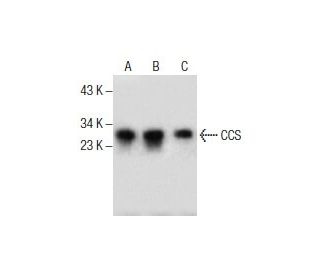


CCS Antibody (E-5): sc-365820
- CCS Antibody (E-5) is a mouse monoclonal IgG1 κ provided at 200 µg/ml
- specific for an epitope mapping between amino acids 257-274 at the C-terminus of CCS of human origin
- recommended for detection of CCS of mouse, rat and human origin by WB, IP, IF and ELISA
- m-IgG Fc BP-HRP, m-IgG1 BP-HRP and m-IgGκ BP-HRP are the preferred secondary detection reagents for CCS Antibody (E-5) for WB applications. These reagents are now offered in bundles with CCS Antibody (E-5) (see ordering information below).

QUICK LINKS
SEE ALSO...
CCS Antibody (E-5) is a mouse monoclonal IgG1 antibody that detects Copper Chaperone for SOD-1 (CCS) in mouse, rat, and human samples through applications such as western blotting (WB), immunoprecipitation (IP), immunofluorescence (IF), and enzyme-linked immunosorbent assay (ELISA). Anti-CCS antibody (E-5) plays a crucial role in studying cellular defense against oxidative stress by facilitating the proper incorporation of copper into Cu-Zn superoxide dismutase-1 (SOD-1), an essential enzyme that protects cells from damage caused by reactive oxygen species. CCS monoclonal antibody (E-5) enables research into CCS′s function as a chaperone and specific interaction with SOD-1, as CCS ensures copper ions are delivered exclusively to this enzyme, thereby enhancing activity while preventing copper misallocation to other cellular proteins. This selective delivery is vital because improper copper handling can lead to cellular dysfunction and contribute to neurodegenerative diseases. CCS (E-5) antibody helps researchers study CCS expression in the kidney, liver, and Purkinje cells of the central nervous system, highlighting significance in tissues particularly vulnerable to oxidative damage. Anti-CCS antibody (E-5) enables insights into copper metabolism and oxidative stress response mechanisms, furthering understanding of various pathological conditions.
Alexa Fluor® is a trademark of Molecular Probes Inc., OR., USA
LI-COR® and Odyssey® are registered trademarks of LI-COR Biosciences
CCS Antibody (E-5) References:
- A gain of superoxide dismutase (SOD) activity obtained with CCS, the copper metallochaperone for SOD1. | Schmidt, PJ., et al. 1999. J Biol Chem. 274: 36952-6. PMID: 10601249
- Human CCS gene: genomic organization and exclusion as a candidate for amyotrophic lateral sclerosis (ALS). | Silahtaroglu, AN., et al. 2002. BMC Genet. 3: 5. PMID: 11991808
- Mechanisms for activating Cu- and Zn-containing superoxide dismutase in the absence of the CCS Cu chaperone. | Carroll, MC., et al. 2004. Proc Natl Acad Sci U S A. 101: 5964-9. PMID: 15069187
- Oxygen-induced maturation of SOD1: a key role for disulfide formation by the copper chaperone CCS. | Furukawa, Y., et al. 2004. EMBO J. 23: 2872-81. PMID: 15215895
- Overexpression of CCS in G93A-SOD1 mice leads to accelerated neurological deficits with severe mitochondrial pathology. | Son, M., et al. 2007. Proc Natl Acad Sci U S A. 104: 6072-7. PMID: 17389365
- Biological effects of CCS in the absence of SOD1 enzyme activation: implications for disease in a mouse model for ALS. | Proescher, JB., et al. 2008. Hum Mol Genet. 17: 1728-37. PMID: 18337307
- Import, maturation, and function of SOD1 and its copper chaperone CCS in the mitochondrial intermembrane space. | Kawamata, H. and Manfredi, G. 2010. Antioxid Redox Signal. 13: 1375-84. PMID: 20367259
- Effect of CCS on the accumulation of FALS SOD1 mutant-containing aggregates and on mitochondrial translocation of SOD1 mutants: implication of a free radical hypothesis. | Kim, HK., et al. 2011. Arch Biochem Biophys. 509: 177-85. PMID: 21354101
- S-acylation of SOD1, CCS, and a stable SOD1-CCS heterodimer in human spinal cords from ALS and non-ALS subjects. | Antinone, SE., et al. 2017. Sci Rep. 7: 41141. PMID: 28120938
- CRISPR/Cas9 screens unravel miR-3689a-3p regulating sorafenib resistance in hepatocellular carcinoma via suppressing CCS/SOD1-dependent mitochondrial oxidative stress. | Lu, Y., et al. 2023. Drug Resist Updat. 71: 101015. PMID: 37924725
Ordering Information
| Product Name | Catalog # | UNIT | Price | Qty | FAVORITES | |
CCS Antibody (E-5) | sc-365820 | 200 µg/ml | $322.00 | |||
CCS Antibody (E-5): m-IgG Fc BP-HRP Bundle | sc-537843 | 200 µg Ab; 10 µg BP | $361.00 | |||
CCS Antibody (E-5): m-IgGκ BP-HRP Bundle | sc-535265 | 200 µg Ab; 40 µg BP | $361.00 | |||
CCS Antibody (E-5): m-IgG1 BP-HRP Bundle | sc-545396 | 200 µg Ab; 20 µg BP | $361.00 | |||
CCS (E-5) Neutralizing Peptide | sc-365820 P | 100 µg/0.5 ml | $69.00 |