
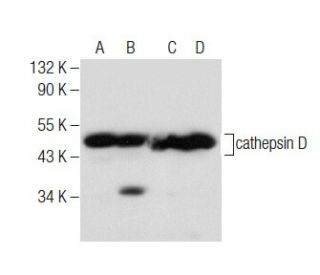
cathepsin D Anticuerpo (D-7): sc-377299
- cathepsin D Anticuerpo D-7 es un monoclonal de ratón IgM κ cathepsin D Anticuerpo, ver las 49 publicaciones, proporcionado como 200 µg/ml
- específico para un epítopo localizado entre los amino ácidos 383-411 en el C-terminus de cathepsin D de origen human
- recomendado para detectarcathepsin D de mouse, rat y human origen, mediante WB, IP, IF, IHC(P) y ELISA
- disponible conjugado a agarosa para IP; HRP para WB, IHC(P) y ELISA; ficoeritrina, fluoresceina, Alexa Fluor® 488 ó Alexa Fluor® 647 para IF, IHC(P) y FCM
- m-IgGκ BP-HRP es el reactivo de detección secundario preferido para cathepsin D Anticuerpo (D-7) para aplicaciones WB e IHC(P). Este reactivo se ofrece ahora en un paquete con cathepsin D Anticuerpo (D-7)(ver información de pedido más abajo). Para otros conjugados m-IgGκ BP, consulte nuestra lista completa de proteínas de unión a IgG de ratón.

ENLACES RÁPIDOS
VER TAMBIÉN ....
El anticuerpo de la cathepsin D (D-7) es un anticuerpo monoclonal de ratón IgM κ que detecta la proteína de la cathepsin D de origen humano, de ratón y de rata mediante técnicas como WB, IP, IF, IHC(P) y ELISA. Este anticuerpo está disponible en forma no conjugada, así como en varias formas conjugadas, incluyendo agarosa, HRP, PE, FITC y múltiples conjugados de Alexa Fluor®. La familia de enzimas proteolíticas de la cathepsin contiene varias clases diversas de proteasas. La clase de proteasa de cisteína comprende las cathepsins B, L, H, K, S y O. La clase de proteasa de aspartilo está compuesta por las cathepsins D y E. La cathepsin G pertenece a la clase de proteasa de serina. La mayoría de las cathepsins son lisosomales y cada una está involucrada en el metabolismo celular, participando en varios eventos como la biosíntesis de péptidos y la degradación de proteínas. Las cathepsins también pueden dividir algunos precursores de proteínas, liberando así péptidos reguladores. La región promotora del gen de la cathepsin D contiene cinco sitios de unión de Sp1 y cuatro sitios de unión de AP-2.
Alexa Fluor® es una marca registrada de Molecular Probes Inc., OR., USA
Información sobre pedidos
| Nombre del producto | Número de catálogo | UNIDAD | Precio | CANTIDAD | Favoritos | |
cathepsin D Anticuerpo (D-7) | sc-377299 | 200 µg/ml | $322.00 | |||
Paquete de cathepsin D (D-7): m-IgGκ BP-HRP | sc-550757 | 200 µg Ab; 40 µg BP | $361.00 | |||
cathepsin D Anticuerpo (D-7) AC | sc-377299 AC | 500 µg/ml, 25% agarose | $424.00 | |||
cathepsin D Anticuerpo (D-7) Alexa Fluor® 488 | sc-377299 AF488 | 200 µg/ml | $364.00 | |||
cathepsin D Anticuerpo (D-7) Alexa Fluor® 647 | sc-377299 AF647 | 200 µg/ml | $364.00 | |||
cathepsin D Anticuerpo (D-7) FITC | sc-377299 FITC | 200 µg/ml | $336.00 | |||
cathepsin D Anticuerpo (D-7) HRP | sc-377299 HRP | 200 µg/ml | $322.00 | |||
cathepsin D (D-7) péptido neutralizante | sc-377299 P | 100 µg/0.5 ml | $69.00 | |||
cathepsin D Anticuerpo (D-7) PE | sc-377299 PE | 200 µg/ml | $349.00 |