
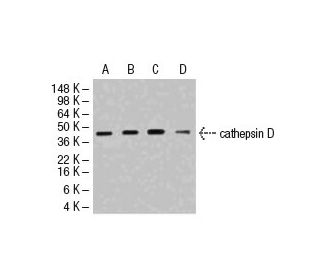

cathepsin D Antibody (4G2): sc-53927
- cathepsin D Antibody (4G2) is a mouse monoclonal IgG2b, cited in 2 publications, provided at 100 µg/ml
- raised against amino acids 21-412 of cathepsin D of human origin
- recommended for detection of cathepsin D of human origin by WB and IP
- See cathepsin D (D-7): sc-377299 for cathepsin D antibody conjugates, including AC, HRP, FITC, PE, Alexa Fluor® 488, 594, 647, 680 and 790.
- At present, we have not yet completed the identification of the preferred secondary detection reagent(s) for cathepsin D Antibody (4G2). This work is in progress.

QUICK LINKS
SEE ALSO...
Cathepsin D Antibody (4G2) is a mouse monoclonal IgG2b antibody raised against amino acids 21-412 of human cathepsin D, with validated applications in western blotting (WB) and immunoprecipitation (IP). Cathepsin D, also known as CTSD, is an aspartyl protease predominantly localized in the lysosomes, where CTSD functions in the degradation of proteins and peptides within the acidic lysosomal environment. This localization is critical for maintaining cellular homeostasis, as cathepsin D participates in autophagy, apoptosis, and the turnover of intracellular proteins. Synthesized as an inactive precursor, cathepsin D undergoes proteolytic cleavage to produce active forms that mediate enzymatic activity. Beyond degradative roles, cathepsin D processes protein precursors to release bioactive peptides that regulate various physiological processes. Dysregulation of cathepsin D has been implicated in diseases such as cancer, where cathepsin D can influence tumor growth, invasion, and metastasis. The gene encoding cathepsin D is regulated by transcription factors such as Sp1 and AP-2, which govern expression in response to cellular needs. Anti-cathepsin D antibody (4G2) is a powerful tool for studying cathepsin D′s role in lysosomal function, cellular metabolism, and pathological conditions.
Alexa Fluor® is a trademark of Molecular Probes Inc., OR., USA
LI-COR® and Odyssey® are registered trademarks of LI-COR Biosciences
cathepsin D Antibody (4G2) References:
- Quantitative determination and localization of cathepsin D and its inhibitors. | Minarowska, A., et al. 2009. Folia Histochem Cytobiol. 47: 153-77. PMID: 19995700
- Cathepsin D as a potential prognostic marker for lung adenocarcinoma. | Mimae, T., et al. 2012. Pathol Res Pract. 208: 534-40. PMID: 22824147
- Cathepsin D in Podocytes Is Important in the Pathogenesis of Proteinuria and CKD. | Yamamoto-Nonaka, K., et al. 2016. J Am Soc Nephrol. 27: 2685-700. PMID: 26823550
- Cathepsin D regulates lipid metabolism in murine steatohepatitis. | Houben, T., et al. 2017. Sci Rep. 7: 3494. PMID: 28615690
- Cathepsin D immobilized capillary reactors for on-flow screening assays. | Cornelio, VE., et al. 2018. J Pharm Biomed Anal. 151: 252-259. PMID: 29367161
- Cathepsin D Expression and Gemcitabine Resistance in Pancreatic Cancer. | Mahajan, UM., et al. 2020. JNCI Cancer Spectr. 4: pkz060. PMID: 32296755
- Lysosomal ATP Transporter SLC17A9 Controls Cell Viability via Regulating Cathepsin D. | Huang, P., et al. 2022. Cells. 11: PMID: 35269509
- Role of cathepsin D induced by Porphyromonas gingivalis lipopolysaccharide in periodontitis. | Jeong, HW., et al. 2023. Eur J Oral Sci. 131: e12923. PMID: 36788303
- A novel function by cathepsin D in degradation of nucleic acids. | Zhang, Y., et al. 2023. Biochem Biophys Res Commun. 682: 250-258. PMID: 37826948
- Proteolysis of IGFBPs by cathepsin D in vitro and in cathepsin D-deficient mice. | Braulke, T., et al. 1995. Prog Growth Factor Res. 6: 265-71. PMID: 8817669
Ordering Information
| Product Name | Catalog # | UNIT | Price | Qty | FAVORITES | |
cathepsin D Antibody (4G2) | sc-53927 | 100 µg/ml | $322.00 |