
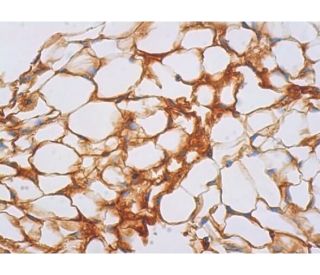
UCP1 Antibody (A-6): sc-518024
- UCP1 Antibody (A-6) is a mouse monoclonal IgG2a κ, cited in 7 publications, provided at 200 µg/ml
- specific for an epitope mapping between amino acids 284-307 at the C-terminus of UCP1 of mouse origin
- Anti-UCP1 Antibody (A-6) is recommended for detection of UCP1 of mouse and rat origin by WB, IP, IF, IHC(P) and ELISA
- Anti-UCP1 Antibody (A-6) is available conjugated to agarose for IP; HRP for WB, IHC(P) and ELISA; and to either phycoerythrin or FITC for IF, IHC(P) and FCM
- also available conjugated to Alexa Fluor® 488, Alexa Fluor® 546, Alexa Fluor® 594 or Alexa Fluor® 647 for WB (RGB), IF, IHC(P) and FCM, and for use with RGB fluorescent imaging systems, such as iBright™ FL1000, FluorChem™, Typhoon, Azure and other comparable systems
- also available conjugated to Alexa Fluor® 680 or Alexa Fluor® 790 for WB (NIR), IF and FCM; for use with Near-Infrared (NIR) detection systems, such as LI-COR®Odyssey®, iBright™ FL1000, FluorChem™, Typhoon, Azure and other comparable systems
- m-IgG2a BP-HRP and m-IgGκ BP-HRP are the preferred secondary detection reagents for UCP1 Antibody (A-6) for WB and IHC(P) applications. These reagents are now offered in bundles with UCP1 Antibody (A-6) (see ordering information below).

QUICK LINKS
UCP1 Antibody (A-6) is a mouse monoclonal IgG2a kappa light chain antibody that detects UCP1 of mouse and rat origin by western blotting (WB), immunoprecipitation (IP), immunofluorescence (IF), immunohistochemistry with paraffin-embedded sections (IHCP), and enzyme-linked immunosorbent assay (ELISA). UCP1 (A-6) antibody is available in both non-conjugated and various conjugated forms, including agarose, horseradish peroxidase (HRP), phycoerythrin (PE), fluorescein isothiocyanate (FITC), and multiple Alexa Fluor® conjugates. UCP1 is an integral membrane protein predominantly found in the mitochondria of brown adipose tissue, where UCP1 plays a crucial role in thermogenesis. UCP1 functions by forming a dimer that acts as a proton channel, allowing protons to re-enter the mitochondrial matrix without generating ATP, thereby dissipating the electrochemical gradient and producing heat instead. This process is vital for maintaining body temperature in cold environments and is also implicated in the regulation of glucose metabolism, making UCP1 a key player in energy expenditure and metabolic health. Additionally, UCP1 is structurally related to UCP2, which is expressed in a wider range of tissues, including white adipose tissue and muscle, and is thought to contribute to body weight regulation.
Alexa Fluor® is a trademark of Molecular Probes Inc., OR., USA
LI-COR® and Odyssey® are registered trademarks of LI-COR Biosciences
UCP1 Antibody (A-6) References:
- Mitochondrial ROS regulate thermogenic energy expenditure and sulfenylation of UCP1. | Chouchani, ET., et al. 2016. Nature. 532: 112-6. PMID: 27027295
- UCP1-independent signaling involving SERCA2b-mediated calcium cycling regulates beige fat thermogenesis and systemic glucose homeostasis. | Ikeda, K., et al. 2017. Nat Med. 23: 1454-1465. PMID: 29131158
- Regulation of UCP1 and Mitochondrial Metabolism in Brown Adipose Tissue by Reversible Succinylation. | Wang, G., et al. 2019. Mol Cell. 74: 844-857.e7. PMID: 31000437
- UCP1-dependent and UCP1-independent metabolic changes induced by acute cold exposure in brown adipose tissue of mice. | Okamatsu-Ogura, Y., et al. 2020. Metabolism. 113: 154396. PMID: 33065161
- Cysteine 253 of UCP1 regulates energy expenditure and sex-dependent adipose tissue inflammation. | Mills, EL., et al. 2022. Cell Metab. 34: 140-157.e8. PMID: 34861155
- Mitochondrial Protein UCP1 Inhibits the Malignant Behaviors of Triple-negative Breast Cancer through Activation of Mitophagy and Pyroptosis. | Xia, J., et al. 2022. Int J Biol Sci. 18: 2949-2961. PMID: 35541900
- Mitochondrial uncouplers induce proton leak by activating AAC and UCP1. | Bertholet, AM., et al. 2022. Nature. 606: 180-187. PMID: 35614225
- The mitochondrial calcium uniporter engages UCP1 to form a thermoporter that promotes thermogenesis. | Xue, K., et al. 2022. Cell Metab. 34: 1325-1341.e6. PMID: 35977541
- Mitochondrial phosphatidylethanolamine modulates UCP1 to promote brown adipose thermogenesis. | Johnson, JM., et al. 2023. Sci Adv. 9: eade7864. PMID: 36827367
- Single-nucleus transcriptomics identifies separate classes of UCP1 and futile cycle adipocytes. | Wang, T., et al. 2024. Cell Metab. 36: 2130-2145.e7. PMID: 39084216
Ordering Information
| Product Name | Catalog # | UNIT | Price | Qty | FAVORITES | |
UCP1 Antibody (A-6) | sc-518024 | 200 µg/ml | $322.00 | |||
UCP1 Antibody (A-6): m-IgGκ BP-HRP Bundle | sc-525330 | 200 µg Ab, 40 µg BP | $361.00 | |||
UCP1 Antibody (A-6): m-IgG2a BP-HRP Bundle | sc-546182 | 200 µg Ab; 10 µg BP | $361.00 | |||
UCP1 Antibody (A-6) AC | sc-518024 AC | 500 µg/ml, 25% agarose | $424.00 | |||
UCP1 Antibody (A-6) HRP | sc-518024 HRP | 200 µg/ml | $322.00 | |||
UCP1 Antibody (A-6) FITC | sc-518024 FITC | 200 µg/ml | $336.00 | |||
UCP1 Antibody (A-6) PE | sc-518024 PE | 200 µg/ml | $349.00 | |||
UCP1 Antibody (A-6) Alexa Fluor® 488 | sc-518024 AF488 | 200 µg/ml | $364.00 | |||
UCP1 Antibody (A-6) Alexa Fluor® 546 | sc-518024 AF546 | 200 µg/ml | $364.00 | |||
UCP1 Antibody (A-6) Alexa Fluor® 594 | sc-518024 AF594 | 200 µg/ml | $364.00 | |||
UCP1 Antibody (A-6) Alexa Fluor® 647 | sc-518024 AF647 | 200 µg/ml | $364.00 | |||
UCP1 Antibody (A-6) Alexa Fluor® 680 | sc-518024 AF680 | 200 µg/ml | $364.00 | |||
UCP1 Antibody (A-6) Alexa Fluor® 790 | sc-518024 AF790 | 200 µg/ml | $364.00 |