
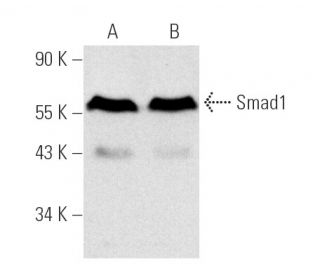
Smad1 Antibody (A-4): sc-7965
- Smad1 Antibody (A-4) is a mouse monoclonal IgG1 κ Smad1 antibody, cited in 112 publications, provided at 200 µg/ml
- raised against amino acids 1-465 representing full length Smad1 of human origin
- Smad1 Antibody (A-4) is recommended for detection of Smad1 of mouse, rat, human and mink origin by WB, IP, IF, IHC(P) and ELISA
- Anti-Smad1 Antibody (A-4) is available conjugated to agarose for IP; and to either phycoerythrin or FITC for IF, IHC(P) and FCM
- also available conjugated to Alexa Fluor® 488, Alexa Fluor® 546, Alexa Fluor® 594 or Alexa Fluor® 647 for WB (RGB), IF, IHC(P) and FCM, and for use with RGB fluorescent imaging systems, such as iBright™ FL1000, FluorChem™, Typhoon, Azure and other comparable systems
- also available conjugated to Alexa Fluor® 680 or Alexa Fluor® 790 for WB (NIR), IF and FCM; for use with Near-Infrared (NIR) detection systems, such as LI-COR®Odyssey®, iBright™ FL1000, FluorChem™, Typhoon, Azure and other comparable systems
- TransCruz reagent for Gel Supershift and ChIP applications (sc-7965 X, 200 µg/0.1 ml)
- m-IgG Fc BP-HRP is the preferred secondary detection reagent for Smad1 Antibody (A-4) for WB and IHC(P) applications. This reagent is now offered in a bundle with Smad1 Antibody (A-4) (see ordering information below).

Smad1 Antibody (A-4) is a mouse monoclonal IgG1 kappa light chain antibody raised against the full-length Smad1 protein of human origin, reactive with mouse, rat, mink, and human species. Smad1, also known as Mothers against decapentaplegic homolog 1 (MADH1), MADR1, or JV4-1, is a critical intracellular signal transducer in the Bone Morphogenetic Protein (BMP) signaling pathway, which is part of the Transforming Growth Factor-beta (TGF-β) superfamily. Upon phosphorylation by BMP type I receptors, Smad1 forms a complex with Smad4 and translocates to the nucleus to regulate the transcription of genes involved in cell proliferation, differentiation, and apoptosis. This function is essential for processes such as bone formation, neuronal development, and embryogenesis. Smad1 contains two conserved domains, MH1 and MH2, which are important for DNA binding and protein interactions, respectively; these structural features are crucial for its role in transcriptional regulation. Dysregulation of Smad1 signaling can lead to developmental abnormalities and has been implicated in various diseases, including cancer and fibrosis. Smad1 monoclonal antibody (A-4) is suitable for applications like western blotting (WB), immunoprecipitation (IP), immunofluorescence (IF), immunohistochemistry (IHC) on paraffin-embedded sections, and enzyme-linked immunosorbent assay (ELISA), making Smad1 monoclonal antibody (A-4) a valuable tool for studying Smad1′s role in cellular signaling pathways. By targeting Smad1, researchers can investigate the molecular mechanisms of BMP signaling and its impact on development and disease.
Alexa Fluor® is a trademark of Molecular Probes Inc., OR., USA
LI-COR® and Odyssey® are registered trademarks of LI-COR Biosciences
Smad1 Antibody (A-4) References:
- Global analysis of Smad2/3-dependent TGF-beta signaling in living mice reveals prominent tissue-specific responses to injury. | Lin, AH., et al. 2005. J Immunol. 175: 547-54. PMID: 15972691
- Smads and chromatin modulation. | van Grunsven, LA., et al. 2005. Cytokine Growth Factor Rev. 16: 495-512. PMID: 15979924
- TGF-beta signalling through the Smad pathway. | Massaous, J. and Hata, A. 1997. Trends Cell Biol. 7: 187-92. PMID: 17708943
- A human Mad protein acting as a BMP-regulated transcriptional activator. | Liu, F., et al. 1996. Nature. 381: 620-3. PMID: 8637600
- MADR2 maps to 18q21 and encodes a TGFbeta-regulated MAD-related protein that is functionally mutated in colorectal carcinoma. | Eppert, K., et al. 1996. Cell. 86: 543-52. PMID: 8752209
- Receptor-associated Mad homologues synergize as effectors of the TGF-beta response. | Zhang, Y., et al. 1996. Nature. 383: 168-72. PMID: 8774881
- Partnership between DPC4 and SMAD proteins in TGF-beta signalling pathways. | Lagna, G., et al. 1996. Nature. 383: 832-6. PMID: 8893010
- Smad6 inhibits signalling by the TGF-beta superfamily. | Imamura, T., et al. 1997. Nature. 389: 622-6. PMID: 9335505
- Smad8 mediates the signaling of the ALK-2 [corrected] receptor serine kinase. | Chen, Y., et al. 1997. Proc Natl Acad Sci U S A. 94: 12938-43. PMID: 9371779
- TGF-beta signalling from cell membrane to nucleus through SMAD proteins. | Heldin, CH., et al. 1997. Nature. 390: 465-71. PMID: 9393997
Ordering Information
| Product Name | Catalog # | UNIT | Price | Qty | FAVORITES | |
Smad1 Antibody (A-4) | sc-7965 | 200 µg/ml | $322.00 | |||
Smad1 Antibody (A-4): m-IgG Fc BP-HRP Bundle | sc-525444 | 200 µg Ab; 10 µg BP | $361.00 | |||
Smad1 Antibody (A-4) X | sc-7965 X | 200 µg/0.1 ml | $322.00 | |||
Smad1 Antibody (A-4) AC | sc-7965 AC | 500 µg/ml, 25% agarose | $424.00 | |||
Smad1 Antibody (A-4) FITC | sc-7965 FITC | 200 µg/ml | $336.00 | |||
Smad1 Antibody (A-4) PE | sc-7965 PE | 200 µg/ml | $349.00 | |||
Smad1 Antibody (A-4) Alexa Fluor® 488 | sc-7965 AF488 | 200 µg/ml | $364.00 | |||
Smad1 Antibody (A-4) Alexa Fluor® 546 | sc-7965 AF546 | 200 µg/ml | $364.00 | |||
Smad1 Antibody (A-4) Alexa Fluor® 594 | sc-7965 AF594 | 200 µg/ml | $364.00 | |||
Smad1 Antibody (A-4) Alexa Fluor® 647 | sc-7965 AF647 | 200 µg/ml | $364.00 | |||
Smad1 Antibody (A-4) Alexa Fluor® 680 | sc-7965 AF680 | 200 µg/ml | $364.00 | |||
Smad1 Antibody (A-4) Alexa Fluor® 790 | sc-7965 AF790 | 200 µg/ml | $364.00 |