
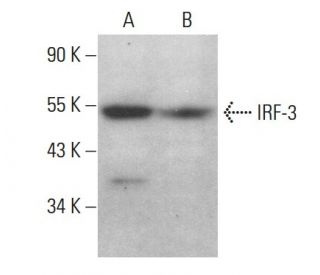
IRF3 Antibody (SL-14): sc-33642
- IRF3 Antibody (SL-14) is a mouse monoclonal IgG1 κ, cited in 3 publications, provided at 200 µg/ml
- raised against recombinant IRF-3 fusion protein corresponding to human IRF-3
- recommended for detection of IRF-3 of human origin by WB, IP, IF and IHC(P)
- TransCruz reagent for Gel Supershift and ChIP applications (sc-33642 X, 200 µg/0.1 ml)
- See IRF3 (SL-12): sc-33641 for IRF3 antibody conjugates, including AC, HRP, FITC, PE, Alexa Fluor® 488, 594, 647, 680 and 790.
- m-IgG Fc BP-HRP, m-IgG1 BP-HRP and m-IgGκ BP-HRP are the preferred secondary detection reagents for IRF3 Antibody (SL-14) for WB and IHC(P) applications. These reagents are now offered in bundles with IRF3 Antibody (SL-14) (see ordering information below).

IRF-3 Antibody (SL-14) is a mouse monoclonal IgG1 kappa light chain antibody engineered to target the Interferon Regulatory Factor 3 (IRF-3) protein with exceptional precision. Anti-IRF-3 antibody (SL-14) is raised against a recombinant IRF-3 fusion protein corresponding to the human IRF-3 sequence, ensuring robust detection of IRF-3 in human samples through western blotting (WB), immunoprecipitation (IP), immunofluorescence (IF), and immunohistochemistry with paraffin-embedded sections (IHCP). IRF-3, also called IIAE7, is a pivotal transcription factor primarily located in the cytoplasm of cells under basal conditions, where IRF-3 remains inactive. Upon detection of viral infections or other pathogenic stimuli, IRF-3 undergoes phosphorylation, which triggers dimerization and translocation into the nucleus. Once in the nucleus, IRF-3 binds to specific DNA elements to activate the transcription of type I interferons, such as IFN-β, and other antiviral genes, orchestrating a critical innate immune response. The precise localization and activation of IRF-3 are essential for initiating effective antiviral defenses and regulating immune signaling pathways. IRF-3 monoclonal antibody (SL-14) enables researchers to accurately monitor the spatial and temporal dynamics of IRF-3 within cells, facilitating a deeper understanding of IRF-3′s role in immune regulation, pathogen response, and the molecular mechanisms underlying various diseases. Anti-IRF-3 antibody (SL-14) is an invaluable tool for studies aiming to elucidate the complex interactions and functions of IRF-3 in maintaining cellular homeostasis and combating infections.
Alexa Fluor® is a trademark of Molecular Probes Inc., OR., USA
LI-COR® and Odyssey® are registered trademarks of LI-COR Biosciences
IRF3 Antibody (SL-14) References:
- IRF-3, IRF-5, and IRF-7 coordinately regulate the type I IFN response in myeloid dendritic cells downstream of MAVS signaling. | Lazear, HM., et al. 2013. PLoS Pathog. 9: e1003118. PMID: 23300459
- IRF-3, IRF-7, and IPS-1 promote host defense against acute human metapneumovirus infection in neonatal mice. | Spann, KM., et al. 2014. Am J Pathol. 184: 1795-806. PMID: 24726644
- Cloning and characterizing of the murine IRF-3 gene promoter region. | Xu, HG., et al. 2016. Immunol Res. 64: 969-77. PMID: 26740329
- IRF-3 gene polymorphisms are associated with the susceptibility to and the survival in chronic lymphocytic leukemia and could also serve as an auxiliary index. | Zhang, ZX., et al. 2017. Leuk Lymphoma. 58: 646-654. PMID: 27348780
- Up-regulation of IRF-3 expression through GATA-1 acetylation by histone deacetylase inhibitor in lung adenocarcinoma A549 cells. | Wang, LL., et al. 2017. Oncotarget. 8: 75943-75951. PMID: 29100282
- An IRF-3-, IRF-5-, and IRF-7-Independent Pathway of Dengue Viral Resistance Utilizes IRF-1 to Stimulate Type I and II Interferon Responses. | Carlin, AF., et al. 2017. Cell Rep. 21: 1600-1612. PMID: 29117564
- The RNA helicase DDX3 promotes IFNB transcription via enhancing IRF-3/p300 holocomplex binding to the IFNB promoter. | Saikruang, W., et al. 2022. Sci Rep. 12: 3967. PMID: 35273248
- Melatonin decreases IRF-3 protein expression in the gastrocnemius muscle, reduces IL-1β and LPS plasma concentrations, and improves the lipid profile in rats with apical periodontitis fed on a high-fat diet. | Dos Santos, RM., et al. 2023. Odontology. 111: 687-696. PMID: 36567367
- Requirement of scavenger receptors for activation of the IRF-3/IFN-β/STAT-1 pathway in TLR4-mediated production of NO by LPS-activated macrophages. | de Queiroz, NMGP., et al. 2023. Nitric Oxide. 134-135: 61-71. PMID: 37059259
- FHL2 Inhibits SARS-CoV-2 Replication by Enhancing IFN-β Expression through Regulating IRF-3. | Xu, Z., et al. 2023. Int J Mol Sci. 25: PMID: 38203523
Ordering Information
| Product Name | Catalog # | UNIT | Price | Qty | FAVORITES | |
IRF3 Antibody (SL-14) | sc-33642 | 200 µg/ml | $322.00 | |||
IRF3 Antibody (SL-14): m-IgG Fc BP-HRP Bundle | sc-536765 | 200 µg Ab; 10 µg BP | $361.00 | |||
IRF3 Antibody (SL-14): m-IgGκ BP-HRP Bundle | sc-533929 | 200 µg Ab; 40 µg BP | $361.00 | |||
IRF3 Antibody (SL-14): m-IgG1 BP-HRP Bundle | sc-544808 | 200 µg Ab; 20 µg BP | $361.00 | |||
IRF3 Antibody (SL-14) X | sc-33642 X | 200 µg/0.1 ml | $322.00 |