
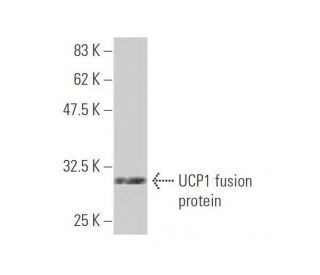


UCP1 Antibody (4E5): sc-293418
- UCP1 Antibody (4E5) is a mouse monoclonal IgG2a κ UCP1 antibody, cited in 26 publications, provided at 100 µg/ml
- raised against amino acids 232-267 representing partial length UCP1 of human origin
- recommended for detection of UCP1 of mouse, rat and human origin by WB, IP and ELISA
- m-IgG Fc BP-HRP is the preferred secondary detection reagent for UCP1 Antibody (4E5) for WB applications. This reagent is now offered in a bundle with UCP1 Antibody (4E5) (see ordering information below).

QUICK LINKS
UCP1 Antibody (4E5) is a mouse monoclonal IgG2a kappa light chain antibody that detects UCP1 protein of mouse, rat, and human origin by western blotting (WB), immunoprecipitation (IP), and enzyme-linked immunosorbent assay (ELISA). Anti-UCP1 antibody (4E5) is available as a non-conjugated format. UCP1, also known as SLC25A7, is an integral membrane protein predominantly found in brown adipose tissue mitochondria, where UCP1 plays a crucial role in thermogenesis. UCP1 functions by forming a dimer that acts as a proton channel, allowing protons to re-enter the mitochondrial matrix without generating ATP, thereby dissipating the electrochemical gradient and producing heat instead. This process maintains body temperature in cold environments and links intricately to energy expenditure and glucose metabolism. UCP1 activity regulation is essential for metabolic health, as UCP1 influences the balance between energy storage and expenditure, making UCP1 a significant target for research into obesity and metabolic disorders. UCP2, a related protein, shares structural similarities with UCP1 and expresses in a broader range of tissues, including white adipose tissue and muscle, suggesting a complex interplay between these proteins in energy regulation and body weight management.
Alexa Fluor® is a trademark of Molecular Probes Inc., OR., USA
LI-COR® and Odyssey® are registered trademarks of LI-COR Biosciences
UCP1 Antibody (4E5) References:
- Hydroperoxy fatty acid cycling mediated by mitochondrial uncoupling protein UCP2. | Jaburek, M., et al. 2004. J Biol Chem. 279: 53097-102. PMID: 15475368
- Heterogeneous nuclear ribonucleoprotein K enhances insulin-induced expression of mitochondrial UCP2 protein. | Ostrowski, J., et al. 2004. J Biol Chem. 279: 54599-609. PMID: 15485813
- Overexpression of short heterodimer partner recovers impaired glucose-stimulated insulin secretion of pancreatic beta-cells overexpressing UCP2. | Suh, YH., et al. 2004. J Endocrinol. 183: 133-44. PMID: 15525581
- Brown adipose tissue thermogenesis: interdisciplinary studies. | Himms-Hagen, J. 1990. FASEB J. 4: 2890-8. PMID: 2199286
- Human uncoupling protein gene: structure, comparison with rat gene, and assignment to the long arm of chromosome 4. | Cassard, AM., et al. 1990. J Cell Biochem. 43: 255-64. PMID: 2380264
- Mitochondrial uncoupling protein from mouse brown fat. Molecular cloning, genetic mapping, and mRNA expression. | Jacobsson, A., et al. 1985. J Biol Chem. 260: 16250-4. PMID: 2999153
- UCP1 Dependent and Independent Thermogenesis in Brown and Beige Adipocytes. | Ikeda, K. and Yamada, T. 2020. Front Endocrinol (Lausanne). 11: 498. PMID: 32849287
- AIDA directly connects sympathetic innervation to adaptive thermogenesis by UCP1. | Shi, M., et al. 2021. Nat Cell Biol. 23: 268-277. PMID: 33664495
- UCP1 governs liver extracellular succinate and inflammatory pathogenesis. | Mills, EL., et al. 2021. Nat Metab. 3: 604-617. PMID: 34002097
- Parallel control of cold-triggered adipocyte thermogenesis by UCP1 and CKB. | Rahbani, JF., et al. 2024. Cell Metab. 36: 526-540.e7. PMID: 38272036
- Thermogenic mechanisms in brown fat. | Nicholls, DG. and Locke, RM. 1984. Physiol Rev. 64: 1-64. PMID: 6320232
- Uncoupling protein-2: a novel gene linked to obesity and hyperinsulinemia. | Fleury, C., et al. 1997. Nat Genet. 15: 269-72. PMID: 9054939
Ordering Information
| Product Name | Catalog # | UNIT | Price | Qty | FAVORITES | |
UCP1 Antibody (4E5) | sc-293418 | 100 µg/ml | $322.00 | |||
UCP1 Antibody (4E5): m-IgG Fc BP-HRP Bundle | sc-540289 | 100 µg Ab; 10 µg BP | $361.00 |